
Pros
- Clear budget tiers from under $100 to flagship stacks
- Honest pairing advice for IEMs vs planars vs high-Ω dynamics
- Explains when you do not need a separate amp
- Links desktop DAC/amp combos vs pure amplifiers
Cons
- Prices and stock shift quickly — verify current street price
- Sound impressions are system-dependent
- Does not replace a full single-product deep dive for every SKU
Looking for amp reviews that cut through chipset marketing and tell you what to buy for your headphones? This 2026 guide covers the best headphone amplifiers and DAC/amp combos — from compact USB desktop units to discrete stacks — with pairing notes, power reality checks, and clear “buy / skip” calls. Whether you run sensitive IEMs, hungry planars, or high-impedance dynamics, these amp reviews are written to prevent wasteful upgrades.
If you already own Sony WH-1000XM5 or Bose QuietComfort Ultra, you may not need a desktop amp at all — Bluetooth ANC headphones are designed for phones. This article is for wired headphones, IEMs, and anyone feeding a DAC into a proper amp stage.
Desktop listening setup — Wikimedia Commons
Amp Reviews Quick Picks (2026)
| Use case | Pick | Why it wins |
|---|---|---|
| Best starter DAC/amp | FiiO K7-class / similar ~$150–200 integrated | Enough power, clean noise floor, simple USB |
| Best under $100 dongle/desktop | Apple USB-C dongle or entry Topping/SMSL | Honest value; don’t overspend early |
| Best balanced mid-tier | Topping DX5 Lite / iFi ZEN DAC 3 class | 4.4mm options, better drive for planars |
| Best “stack” transparency | Separate DAC + amp (e.g. SMSL/Topping mid stacks) | Upgrade path and cleaner role separation |
| Best travel hybrid | Chord Mojo 2 / iFi Gryphon class | Battery + desktop manners |
| Skip if… | You only use Bluetooth ANC headphones | Built-in amps already match the drivers |
NexReview editorial score for this guide: 9.0/10 as a decision framework — not a single product score.
What “Amp Reviews” Should Actually Cover
People search amp reviews for different products: guitar amps, car audio amps, home AV receivers, and headphone amps. On NexReview we focus on headphone amplifiers and DAC/amp combos, because they match our tech audience upgrading from phone/laptop jacks and pair naturally with headphone reviews already on the site.
A useful amp review answers five questions:
- How much clean power does it deliver into 32Ω and 300Ω?
- How high is the noise floor with sensitive IEMs?
- Which inputs/outputs matter (USB, coax/optical, RCA, XLR, 6.35mm, 4.4mm, XLR4)?
- Does the tuning stay neutral or add warmth/bass shelves?
- Is the price justified versus a cheaper unit that already drives your headphones well?
If a review only quotes chip names (ESS, AKM, THX AAA) without pairing context, ignore it.
Do You Even Need a Headphone Amp?
Before any shopping from these amp reviews, run this filter:
You probably do not need one if…
- You primarily use wireless ANC headphones
- Your wired headphones already get loud and clean from a phone/laptop
- You are unhappy with tonality more than volume (EQ or different headphones may help more)
You likely do benefit if…
- High-impedance dynamics (e.g. 250–600Ω) sound thin or quiet from a dongle
- Planar magnetics lack slam and headroom from USB power alone
- You hear hiss with IEMs from a noisy motherboard jack
- You want desktop volume control, gain switches, and stable impedance
An amp cannot invent detail that is not in the recording or the headphone. It removes bottlenecks — current, voltage, noise, and sometimes output impedance mismatches.
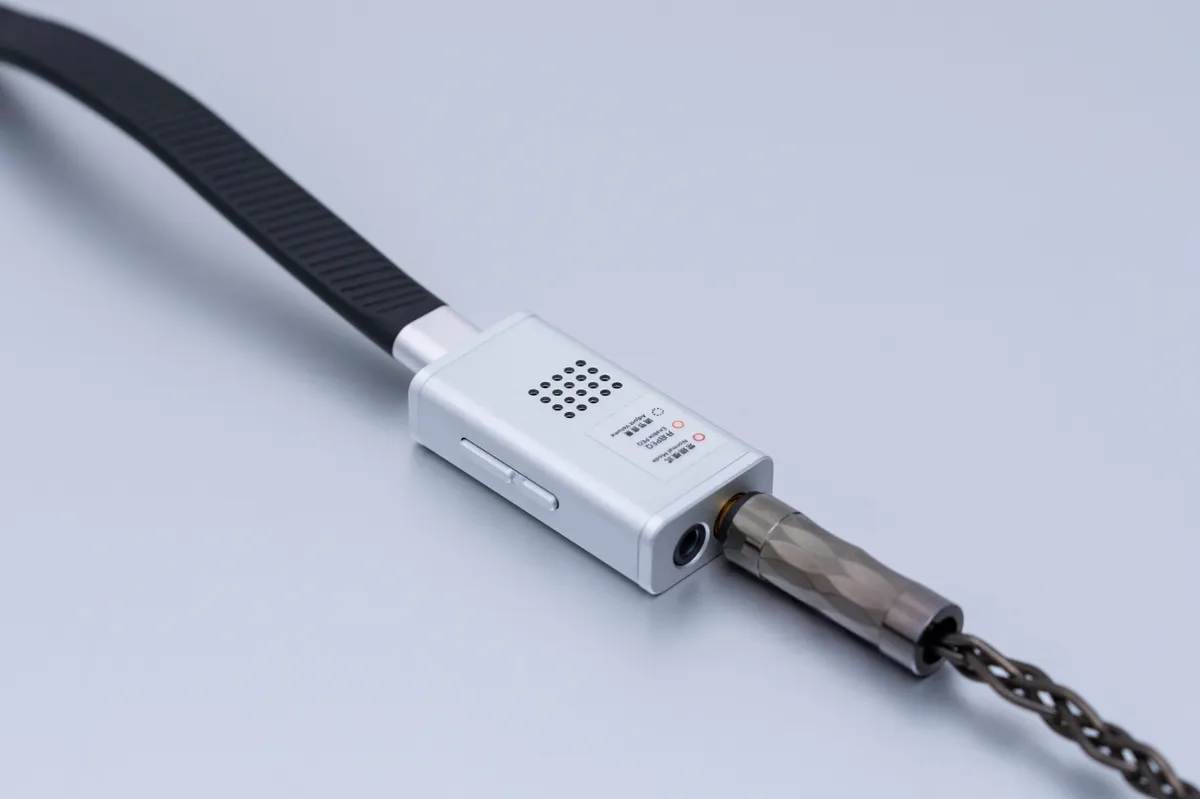
DAC/amp desktop gear context — Wikimedia Commons
Key Specs Explained (Without the Brochure Nonsense)
Output Power (mW into Ω)
Manufacturers advertise peak milliwatts into 32Ω. That number is useful for planars and low-impedance dynamics, but high-Ω headphones need voltage, not just current. Look for power figures at 300Ω too. A unit that is “strong” at 32Ω can still feel soft on 600Ω cans.
Output Impedance
Rule of thumb: keep amp output impedance low relative to headphone impedance (often cited as ≤1/8th). High output impedance can change frequency response on some multi-driver IEMs.
Gain Stages
Low gain for IEMs; high gain for hard-to-drive over-ears. A good amp makes low gain silent and high gain controlled — not a volume lottery.
DAC vs Amp vs Combo
- DAC converts digital to analog
- Amp drives headphones
- DAC/amp combo does both in one chassis
Most beginners should start with a reputable combo. Stacks make sense after you know you want to upgrade one half independently.
Balanced vs Single-Ended
Balanced (4.4mm / XLR) can offer more power and better channel separation on some designs — but only if your cable and headphone support it. Balanced is not automatic “better sound.”
Amp Reviews by Budget Tier (2026)
Tier 1 — Under $100: Stop the Bleeding
Goal: Cleaner than a motherboard jack; enough loudness for easy headphones.
What to look for
- USB bus power with stable volume curve
- Low hiss on IEMs
- Basic 3.5mm out (6.35mm via adapter is fine)
Who it is for
Students, office desks, first upgrade from a cracked phone dongle.
Who should skip
Owners of demanding planars expecting concert-level slam — save for Tier 2.
Editorial take: This tier wins on convenience. Do not chase exotic filters here. Buy something returnable, listen for one week, then decide if you still need more power.
Tier 2 — $100–$250: The Sweet Spot for Most People
This is where modern amp reviews get interesting. Chinese desktop brands compressed performance that used to cost $500+ into attainable boxes.
Typical winners in this band (category examples)
- Integrated DAC/amps with solid AKM/ESS implementations
- 2000mW-class balanced outputs on mid units
- Metal chassis, real volume knobs, RCA pre-outs for powered speakers
Buy this tier if you own mid-fi headphones (HD 600-class dynamics, entry planars, popular hybrids) and want a “set and forget” desktop chain.
Watch-outs
- Feature bloat (RGB, dozens of filters) rarely equals better headphones
- Bluetooth on a desktop amp is optional, not a reason to pay double
- Check firmware update history — abandoned apps are a red flag
Tier 3 — $250–$500: Balanced Power and Flexibility
Here you pay for:
- Stronger balanced amplification
- Better PSU design / lower noise
- More inputs (USB + optical/coax)
- Gain staging that flatters both IEMs and full-size cans
Category examples discussed widely in 2026 amp reviews include Topping DX5-class combos, iFi ZEN stacks, and similar mid-tier all-in-ones. The right pick depends on whether you prioritize measurements-first neutrality or feature DSP (XBass-style bass shelves, iEMatch, etc.).
Pairing tip: If your headphones are already bright, a razor-neutral amp can feel clinical. If your headphones are dark, a warmer amp may double-dip bass. Match chain to transducer.
Tier 4 — $500–$1,000+: Diminishing Returns (But Real for Flagships)
Above ~$500, improvements become subtler for average headphones and more obvious for revealing flagships (HD 800S-class, higher-end planars, hard-to-drive dynamics).
You are paying for:
- Discrete amp topologies
- Better power supplies / external PSU options
- Network streaming / PEQ in some flagship DAC/amps
- Build, support, and long-term keepability
Examples frequently covered in enthusiast amp reviews include higher FiiO K-series units, Chord portable/desktop hybrids, and separate reference stacks (transparent amp + transparent DAC).
Brutal honesty: If your room is noisy and you mostly stream compressed playlists on mid headphones, Tier 2 already won. Flagship amps reward quiet rooms, high-res libraries, and headphones that scale.

Critical listening context — Wikimedia Commons
Mini Amp Reviews: Categories That Matter
1) Compact USB DAC/Amp (Desktop Dongle Grown Up)
Strengths: Tiny footprint, USB plug-and-play, great for laptops.
Weaknesses: Limited power vs full desktop PSUs; fewer analog inputs.
Best for: Work-from-home and portable desktop hybrids.
Skip if: You need XLR studio monitoring or multi-source switching.
2) Full-Size Integrated DAC/Amp
Strengths: One box, volume knob, enough power for most collections.
Weaknesses: When the DAC or amp section ages, you replace both.
Best for: 80% of enthusiasts reading amp reviews.
Skip if: You already own a great DAC and only need amplification.
3) Pure Headphone Amplifier (RCA/XLR In)
Strengths: Upgrade path; choose your DAC flavor separately.
Weaknesses: More cables, more space, more decisions.
Best for: Hobbyists iterating a stack.
Skip if: You want simplicity over tweaking.
4) Portable / Transportable Amp-DAC
Strengths: Battery listening, travel, desk + bag dual use.
Weaknesses: Battery aging; sometimes compromised desktop I/O.
Best for: Commuters with wired IEMs/over-ears.
Skip if: The unit never leaves a desk — buy a wall-powered desktop instead.
5) “Tube Flavor” and Hybrid Amps
Strengths: Subjective warmth, harmonics some listeners love.
Weaknesses: Maintenance, heat, inconsistency; not ideal as a first amp.
Best for: Experienced listeners chasing a specific vibe.
Skip if: You want ruler-flat accuracy for mixing or competitive FPS footsteps.
Pairing Guide: Match Amp to Headphones
| Headphone type | Amp priority | Notes |
|---|---|---|
| Sensitive IEMs | Ultra-low noise, low gain | Power is easy; hiss is the enemy |
| 32–80Ω dynamics | Moderate power, good volume taper | Most Tier 2 combos suffice |
| 250–600Ω dynamics | Voltage headroom | Check 300Ω power specs |
| Planar magnetics | Current + clean headroom | Balanced outs often help |
| Bluetooth ANC | Usually none | Use the headphone’s built-in amp |
Practical Pairing Examples (Illustrative)
- Sennheiser HD 600 / 6XX class: A competent Tier 2 combo transforms them versus a weak laptop jack.
- Entry HiFiMAN/Audeze planars: Prioritize current and stable power; audition for bass control.
- Campfire/Thieaudio-style IEMs: Prioritize black backgrounds; avoid noisy high-gain modes.
- Gaming headsets with USB sound cards: An external amp may do little if the headset is USB-only digital.
How We Evaluate Amp Reviews on NexReview
Our editorial checklist for future single-product amp reviews:
- Setup notes — source chain, cables, gain, filters
- Volume matching when comparing units
- IEM hiss test at usable listening levels
- Hard-to-drive test — can it cleanly peak without strain?
- Feature reliability — app, PEQ, Bluetooth if present
- Value — what cheaper unit already solves 90%?
We also consider ecosystem fit: if you live on PlayStation or Switch, optical/USB quirks matter. If you are a creator on MacBook, class-compliant USB behavior matters more than Android app EQ.
Common Mistakes We See in Amp Shopping
- Buying flagship power for easy IEMs — money wasted; risk of hiss.
- Chasing SINAD charts only — measurements matter, but pairing and features decide daily joy.
- Ignoring output impedance with multi-BA IEMs.
- Skipping returns — always buy from retailers with a listening window.
- Upgrading amp before headphones — transducers usually bottleneck first.
- Assuming balanced = mandatory — only if your headphones/cable benefit.
Desktop Gaming & Creator Notes
Gamers often ask whether a headphone amp improves footsteps in competitive titles. A clean amp + decent headset can improve clarity versus a noisy PC front panel, but it will not replace good positional audio software or a well-tuned headset. If you already love a wireless gaming headset, stay there.
Creators monitoring mixes should prefer neutral amps with known behavior and avoid heavy DSP bass boosts while mixing. Use amp EQ for pleasure listening, not for mastering decisions.
For subscription and PC tool context while you work, NexReview also covers NexPass and NexCheck — different problems, same “buy once with confidence” philosophy.
Amp Reviews: Comparison Snapshot
| Category | Noise focus | Power focus | Complexity | Best first buy? |
|---|---|---|---|---|
| USB dongle | Medium | Low–Med | Low | Yes for IEMs |
| Desktop combo | High | Med–High | Low | Yes for most |
| Separate stack | High | High | High | After you outgrow a combo |
| Portable DAC/amp | High | Med | Med | If you commute wired |
| Tube/hybrid | Variable | Variable | Med–High | No (advanced) |
Pros and Cons of Investing in a Headphone Amp
| Pros | Cons |
|---|---|
| Cleaner drive for demanding headphones | Easy to overspend relative to gains |
| Lower noise than many PC jacks | Extra cables and desk clutter |
| Better volume control and gain options | Diminishing returns above mid-tier |
| Future-proofs a growing headphone collection | Does nothing for Bluetooth-only setups |
FAQ — Amp Reviews
What does amp reviews mean on this page?
A practical buying guide and category reviews of headphone amplifiers and DAC/amp combos for 2026 — not car audio or guitar amps.
Do I need an amp for Sony WH-1000XM5 or Bose QC Ultra?
Usually no. Those wireless ANC headphones are designed around their internal amps and DSP.
DAC/amp combo or separate stack?
Start with a combo. Split later if you want to upgrade DAC or amp independently.
Is balanced better?
Sometimes more power and channel separation — not automatic sonic superiority. Your headphones must support balanced cabling.
Will an amp make low-bitrate Spotify sound high-res?
No. It can improve drive and noise, not invent missing data.
How much should I spend?
Often 1/3 to equal the headphone price is a sane band — but stop when your headphones are already clean and loud.
Can an amp damage headphones?
Abuse can. Use low gain first, raise volume gradually, and avoid slamming max gain into sensitive IEMs.
What specs matter most?
Power into your headphone’s impedance, noise floor, output impedance, and usable features — not marketing chip names alone.
Are Chinese desktop brands reliable in 2026?
Many are excellent value; buy from vendors with warranty/returns and check recent firmware support.
Amp reviews vs receiver AV amps?
Different products. Home theater receivers drive speakers; this guide is about headphones.
How to Choose in 15 Minutes
- List your headphones (impedance, planar vs dynamic, IEM vs over-ear).
- Decide desktop-only vs portable.
- Pick a budget tier from this guide.
- Shortlist two units with return policies.
- Test for hiss, headroom, and tonality with your music for a week.
- Keep the one that disappears in the music; return the one you “notice” for the wrong reasons.
Final Verdict
The best amp reviews do not crown a universal champion — they match power, noise performance, and features to real headphones and real desks. In 2026, the market is friendly to buyers: Tier 2 desktop DAC/amps deliver most of the audible upgrade for reasonable money, while flagship stacks exist for enthusiasts with revealing gear and quiet rooms.
If you take one lesson from this guide: upgrade the bottleneck you can hear. For many listeners that is still the headphones themselves. For owners of demanding wired cans stuck on a weak jack, a well-chosen amp is one of the highest-satisfaction desktop upgrades you can make.
Guide score: 9.0/10 — Essential Amp Buying Guide for Headphone Upgrades