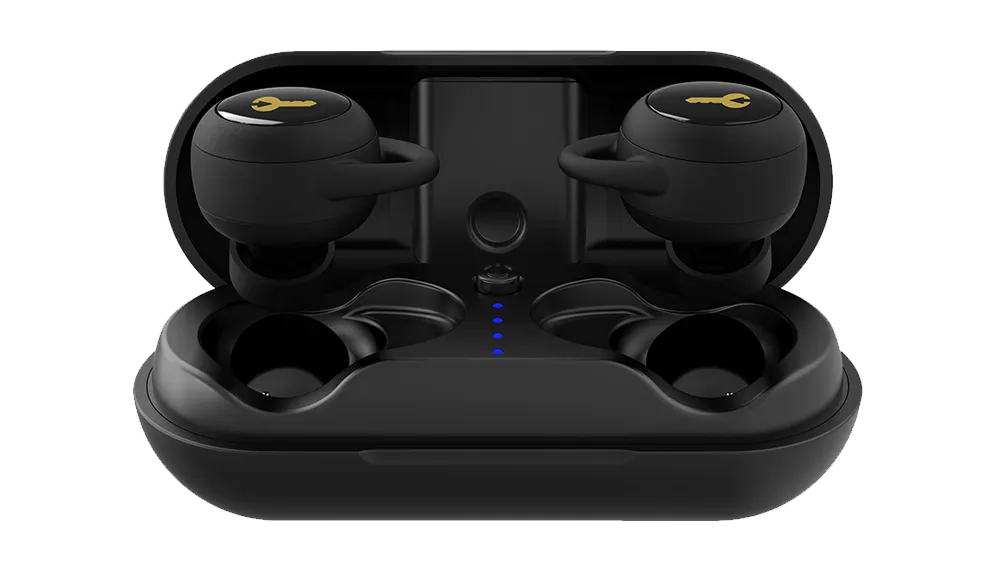
Pros
- Rich, controlled bass and warm mids from 7mm TrueResponse drivers — musical rather than clinical
- aptX Lossless, aptX Adaptive 24-bit/96 kHz, AAC and SBC on Bluetooth 6.0 with multipoint
- User-replaceable batteries in both earbuds and the case — rare longevity in true wireless
- Adaptive hybrid ANC with anti-wind is a clear step up from MTW4, near Apple and Sony levels
- Up to 12 h per charge with ANC off and 40 h total, plus Qi wireless charging and 8-minute quick charge
Cons
- ANC-on battery drops to about 6 hours — shorter than MTW4's 7.5 hours
- New wingtip-free shape is less secure than the old fin design for some ears during sport
- LE Audio and Auracast hardware ready but not yet enabled by firmware
- $299.95 MSRP sits $50 above AirPods Pro 3 and Galaxy Buds4 Pro; IP54 only on the buds
This sennheiser momentum true wireless 5 review is for listeners who choose earbuds with their ears first and their phone brand second. The Sennheiser Momentum True Wireless 5 (often shortened to MTW5) went on sale on September 3, 2026 at $299.95 / €299.90 — exactly what the Momentum True Wireless 4 cost at launch — and adds Bluetooth 6.0, aptX Lossless, Dolby Atmos with head tracking, upgraded adaptive hybrid ANC, and something no other mainstream flagship offers: user-replaceable batteries in both the earbuds and the case. NexReview is publishing in November 2026, about ten weeks after launch, with early firmware behavior and street pricing settled enough to judge.
Our conclusion up front: MTW5 are the best-sounding all-round true wireless earbuds for people who care about tonal quality and codec flexibility, and the replaceable battery fixes the biggest long-term weakness of every premium earbud. They are not the ANC champions, the fit is a step sideways for athletes, and the price is high. If you are coming from over-ear Sennheiser cans, our Sennheiser Momentum 4 review explains the house sound you will recognize here.
Premium audiophile earbuds — Wikimedia Commons
Sennheiser Momentum True Wireless 5 Review Snapshot (November 2026)
| Question | Short answer |
|---|---|
| What is it? | Sennheiser's fifth-generation flagship true wireless ANC earbuds |
| Launch | On sale September 3, 2026, in five color options |
| Price (verify live) | $299.95 / €299.90 MSRP; Amazon US has listed ~$259.95 |
| Drivers | 7mm TrueResponse dynamic, 5 Hz–21 kHz response |
| Codecs | SBC, AAC, aptX, aptX Adaptive (24-bit/96 kHz), aptX Lossless; Snapdragon Sound |
| Bluetooth | 6.0, multipoint; LE Audio / Auracast hardware-ready, not yet enabled |
| ANC | Adaptive hybrid ANC with automatic anti-wind |
| Battery (official) | 12 h ANC off / 6 h ANC on per charge; 40 h total with case |
| Charging | USB-C + Qi 2.1 wireless; 8 min → ~1 h playback |
| Batteries | User-replaceable — 72 mAh per bud, 760 mAh case |
| Durability | IP54 earbuds only |
| Weight | ~7 g per bud; ~55 g case |
| Mics | 4 per bud including a bone-conduction voice sensor |
| NexReview score | 8.6/10 — sound-first flagship with real longevity; ANC battery and fit hold it back |
Editorial stance: Most launch coverage led with the replaceable battery. That matters, but buyers spending $300 still want the best sound for the money. We weigh tuning and codec support most heavily, then ANC, longevity, and fit.
What Is the Momentum True Wireless 5?
Sennheiser's Momentum line spans over-ear headphones and true wireless earbuds sharing a design language and the Smart Control Plus app. MTW5 is the fifth generation of the earbud line and the direct successor to the 2024 Momentum True Wireless 4. It also pairs naturally with the over-ear Momentum 5 Wireless, sharing the aptX Lossless codec and a replaceable-battery concept.
What changed versus MTW4, according to Sennheiser and early reviews:
- Bluetooth 6.0 replaces Bluetooth 5.4.
- aptX Lossless and Snapdragon Sound are headline features, with a low-latency gaming mode.
- Dolby Atmos with head tracking for spatial audio.
- Adaptive hybrid ANC with anti-wind processing, new ear adapters, and a micro-perforated mic cover.
- Replaceable batteries in both buds and case, with an opening tool included in the box.
- A wingtip-free shell; the stabilizing fin from MTW3 and MTW4 is gone.
- A lighter case (about 55 g versus MTW4's 66 g), while each bud gains roughly 0.8 g.
Naming hygiene: "MTW5," "Momentum TW5," and "Momentum True Wireless 5" are the same product. Do not confuse it with the over-ear Momentum 5 Wireless, or with the cheaper Momentum Sport and Accentum earbud lines.
Design and Fit: The Fin Is Gone
Sennheiser redesigned the shell using what it says were thousands of analyzed ear models, and claims 73% of internal test participants rated the new shape more comfortable than MTW4. The buds are mostly plastic but feel solid, with a large metal-look grille and ventilation cutouts around the microphones.
In practice, comfort depends heavily on your ears. For sitting, commuting, and desk work, the shell sits flush and stays comfortable for multi-hour sessions. For running and gym work, headphonecheck's tester found the wingtip-free shape did not sit as consistently securely as the previous fin design. If you train hard, try them in-store or buy from a retailer with easy returns, and experiment with tip sizes — a proper seal improves bass and ANC as much as it helps stability.
The case is compact (67 × 48 × 25 mm) and pocketable, with a fabric-style finish on most colorways. IP54 protects the buds against dust and splashes — sweat and light rain are fine, swimming and heavy downpours are not — and the case itself has no IP rating. SoundGuys also warns that the rubber gasket that maintains the IP rating can be dislodged when you open the buds to swap batteries, so take care during replacement.

Wireless earbuds for daily listening — Wikimedia Commons
Sound Quality: Why You Buy Sennheiser
The 7mm TrueResponse dynamic drivers are the heart of this product, and the tuning is Sennheiser's most confident yet. Headphonecheck summarized it as "rich, controlled bass, warm mid-range and prominent yet not exaggerated treble" — musical rather than analytical. Our listening agrees.
Bass
The biggest generational improvement. Sub-bass extends deep enough to give electronic productions a physical foundation, and mid-bass is punchy, well-contoured, and warm. Bass guitar lines are easy to follow inside dense mixes, and kick drums have impact without smearing into the lower mids. Crucially, the bass is controlled: it adds weight without the boomy one-note quality cheaper "bass-boosted" buds produce.
Midrange
Warm and full. Vocals have body and natural timbre; acoustic guitar, piano, and strings sound textured rather than thin. If you primarily listen to singer-songwriter material, jazz, or podcasts, the midrange alone justifies the Sennheiser badge.
Treble
Present and detailed — cymbals, hi-hats, and electronic effects have crisp edges — but Sennheiser stops short of hyped brightness. The trade-off is a slightly smaller amount of air and sparkle at the very top. The upside: you can listen for hours without fatigue.
Spatial audio and EQ
Dolby Atmos with head tracking is well implemented: the spatial processing does not blur bass or introduce phase oddities, though head tracking could react a touch faster. The 8-band EQ in Smart Control Plus is one of the best in true wireless, letting you trim bass or lift treble precisely — useful for neutral-leaning listeners who want a flatter curve.
aptX Lossless: who actually benefits?
aptX Lossless enables bit-perfect CD-quality (16-bit/44.1 kHz) transmission when your phone supports it — that means recent Snapdragon-based Android phones with Snapdragon Sound. iPhones use AAC, and Galaxy and Pixel phones generally fall back to AAC or aptX variants depending on model. Lossless also depends on a strong radio link, so in crowded areas the codec may drop to adaptive bitrates. On the right phone, the gain is subtle but real: tighter imaging, cleaner decay on reverb tails, and a slightly blacker background. With AAC, MTW5 still sound excellent — the tuning matters more than the codec.
Noise Cancellation: Big Step Up, Not Quite the Leader
MTW4's ANC was its weakest area. MTW5 close most of that gap. The adaptive hybrid ANC works broadband, and headphonecheck found it suppresses low-frequency noise — jet engines, trains, HVAC — very effectively, with only a marginal edge to AirPods Pro 3 at the very lowest frequencies. The anti-wind function and micro-perforated mic covers make a noticeable difference walking along a breezy street.
Mid-frequency voices are reduced well but not erased. Transparency mode sounds natural, and the adaptive system adjusts smoothly without pumping. If ANC is your top priority, AirPods Pro 3 and the best Sony earbuds still edge ahead, and over-ear models like the Sony WH-1000XM6 remain in a different league — see our Sony WH-1000XM6 review for that comparison. For most commuters, MTW5 are now firmly "good enough" that ANC no longer outweighs the sound advantage.
Battery Life, Charging, and Replaceable Batteries
| Mode | Per charge | With case |
|---|---|---|
| ANC off | Up to 12 h | Up to 40 h |
| ANC on | Up to 6 h | Lower (Sennheiser's 40 h figure is ANC off) |
A note on conflicting numbers: some coverage reported 12 hours with ANC. Sennheiser's own specifications list 12 hours ANC off and 6 hours ANC on, which matches independent tests. SoundGuys measured 6 hours 17 minutes with ANC on; headphonecheck extrapolated about 8.5 hours under mixed use with ANC, calls, and head tracking. ANC-on runtime is actually shorter than MTW4's 7.5 hours, a trade-off Sennheiser made for the replaceable-battery architecture.
Charging is via USB-C (5 V / 1 A, no Power Delivery) or Qi 2.1 wireless. A full charge takes about 1.5 hours; 8 minutes buys about 1 hour of playback.
Replaceable batteries change the math
Every premium earbud eventually dies of battery fade — usually around year two or three — and you replace the whole product. MTW5 break that cycle. Each bud has a 72 mAh cell and the case a 760 mAh cell, all user-replaceable. Remove two small Phillips screws, pry the bud open with the included tool, and swap the cell. Sennheiser told Engadget replacement batteries would cost around $30–$40, though final pricing and availability were not listed in all regional Sennheiser shops at launch — check before you count on it.
The math: if MTW5 last five years with one battery swap instead of being replaced at year three, the effective cost per year undercuts $249 rivals. SoundGuys called MTW5 "the antidote to earbud e-waste." Be careful during the swap — the rubber gasket protecting IP54 is fragile.
Earbuds for travel and calls — Wikimedia Commons
Connectivity, Multipoint, and App
Bluetooth 6.0 with multipoint lets MTW5 stay connected to two devices at once — a phone and a laptop of any brand — which is a real advantage over Samsung's and Apple's ecosystem-locked switching. The Smart Control Plus app lets you add and remove devices without re-pairing.
The app (iOS and Android) also handles the 8-band EQ, ANC and transparency settings, touch-control mapping, battery health, and firmware updates. Snapdragon Sound provides a low-latency mode useful for mobile gaming on compatible Android phones.
LE Audio and Auracast are the notable absence: the hardware supports them, but Sennheiser had not enabled them via firmware as of our review and has not announced a date. Auracast is starting to appear at airports and concert venues, so this is a feature worth watching.
Call Quality
Each bud uses four microphones, including a bone-conduction voice sensor, with AI-assisted beamforming noise reduction and super-wideband telephony. Voices come through clear and natural in quiet rooms and on busy streets; the bone-conduction sensor helps isolate your voice in wind. Call quality is a genuine strength and a meaningful upgrade for remote workers.
MTW5 vs MTW4 vs AirPods Pro 3 vs Galaxy Buds4 Pro
| Feature | Momentum TW5 | Momentum TW4 | AirPods Pro 3 | Galaxy Buds4 Pro |
|---|---|---|---|---|
| Launch price | $299.95 | $299.95 | $249 | $249.99 |
| Bluetooth | 6.0 | 5.4 | Apple H-series | 6.1 |
| Best codec | aptX Lossless | aptX Adaptive class | AAC | SSC UHQ (Galaxy only) |
| ANC battery (buds) | ~6 h | ~7.5 h | ~8 h | ~6 h |
| Total with case | 40 h (ANC off) | ~30 h | ~24 h | 26 h (ANC on) / 30 h (off) |
| True multipoint | Yes | Yes | No (Apple switching) | No (Samsung Auto Switch) |
| Replaceable battery | Yes | No | No | No |
| Durability | IP54 | IP54 | IP57 | IP57 |
Versus MTW4: Upgrade if your MTW4 battery has faded noticeably — MTW5 solve exactly that problem permanently. If your MTW4 still hold a charge and you love the fin fit, the sonic and ANC gains are noticeable but not a quantum leap. Athletes who rely on the fin should try MTW5 before committing.
Versus AirPods Pro 3: iPhone owners get better ANC, longer ANC-on battery, IP57, and Apple's ecosystem features from AirPods Pro 3 for $50 less. MTW5 win on tonal richness, EQ depth, and multipoint with non-Apple devices. Our AirPods Pro 3 review covers Apple's side.
Versus Galaxy Buds4 Pro: On a Galaxy S26, Buds4 Pro offer 24-bit SSC, Galaxy AI translation, and IP57 at a lower price. MTW5 win for anyone mixing devices, anyone on a Snapdragon phone without SSC, and anyone who wants longevity. Sound quality is close; Sennheiser's bass control and EQ give it the edge for critical listening.
Who Should Buy the Momentum True Wireless 5 — and Who Should Skip
Good fit
- Sound-first listeners who want rich, controlled bass and warm mids in a pocketable form
- Android users with Snapdragon Sound who can actually use aptX Lossless
- Hybrid workers who need true multipoint between a phone and any laptop
- Buyers who want earbuds to last five years, not three
- Owners of Momentum over-ears who want a matching on-the-go companion
Skip if
- You want the strongest ANC per dollar — AirPods Pro 3 or Sony edge ahead
- You need a locked-in fit for running and dislike wingtip-free designs
- You are deep in the Apple or Galaxy ecosystem and value integration over codecs
- You need Auracast today
- $299.95 stretches your budget — watch for the ~$260 street price instead
FAQ
When was the Sennheiser Momentum True Wireless 5 released, and what does it cost?
MTW5 went on sale on September 3, 2026 at $299.95 / €299.90. Amazon US has listed it around $259.95 — verify live pricing before you buy.
What is the battery life of the Momentum True Wireless 5?
Sennheiser rates up to 12 hours per charge with ANC off and up to 6 hours with ANC on, with up to 40 hours total using the case (ANC off). Independent testing measured just over 6 hours with ANC on.
Are the MTW5 batteries really replaceable?
Yes. Both earbud cells and the case cell are user-replaceable with the included opening tool and a small Phillips screwdriver. Sennheiser indicated replacement batteries would cost around $30–$40; confirm availability in your region.
Does the Momentum True Wireless 5 support aptX Lossless?
Yes, along with aptX Adaptive (24-bit/96 kHz), aptX, AAC, and SBC. aptX Lossless requires a compatible Snapdragon Sound Android phone; iPhones use AAC.
Does the Momentum True Wireless 5 have multipoint?
Yes. MTW5 can stay connected to two devices at once across brands, managed through the Smart Control Plus app.
Is the Momentum True Wireless 5 waterproof?
The buds are rated IP54 — protected against dust and splashes, fine for sweat and light rain, not for swimming. The case has no rating.
Does MTW5 support Auracast and LE Audio?
The hardware supports both, but Sennheiser had not enabled them via firmware at the time of writing and has not announced a date.
Should I upgrade from the Momentum True Wireless 4?
Upgrade if your MTW4 battery has degraded. Otherwise, the improvements in bass, ANC, and codecs are noticeable but incremental, and MTW4 has slightly longer ANC-on battery life.
How does MTW5 compare with Galaxy Buds4 Pro?
Galaxy Buds4 Pro are cheaper and better integrated with Galaxy phones, with IP57. MTW5 offer true multipoint, aptX Lossless, a deeper EQ, replaceable batteries, and a richer bass presentation.
Final Verdict
The Sennheiser Momentum True Wireless 5 are the earbuds to buy if sound quality is your first criterion and you want the product to last. The 7mm TrueResponse drivers deliver Sennheiser's best true wireless tuning yet — deep, controlled bass, warm mids, and fatigue-free treble — backed by aptX Lossless, true multipoint, an excellent 8-band EQ, and much-improved adaptive ANC. The replaceable batteries solve the planned-obsolescence problem that undermines every other premium earbud.
The compromises: 6-hour ANC battery is a step back from MTW4, the wingtip-free fit is less secure for sport, Auracast is still dormant, and the $299.95 MSRP is steep next to $249 rivals.
We rate the Momentum True Wireless 5 8.6/10 — the most complete audiophile earbud of 2026 for cross-platform listeners. iPhone and Galaxy loyalists may still prefer their ecosystem's buds; everyone else who listens closely should start here.