Pros
- Crossroads cards create unforgettable table stories
- Secret objectives keep every session suspenseful
- Strong zombie-winter theme with premium components
- Excellent at 3–5 players for drama and debate
- Expansions and scenarios extend lifespan for years
Cons
- Rules overhead and setup time can intimidate new groups
- Player elimination / exile moments feel harsh
- Two-player is weaker than the sweet spot
- Analysis paralysis can stretch longer scenarios
Dead of Winter is Plaid Hat Games’ landmark “meta-cooperative” zombie survival board game — a colony clinging to life through frostbite, crises, and distrust. This Dead of Winter game review (updated August 2026) covers how Crossroads cards work, why secret objectives matter more than the zombie standees, who should buy the base box versus The Long Night, and whether the classic still belongs on a modern hobby shelf next to newer narrative co-ops.
If you searched for a dead of winter game review because a friend mentioned betrayal at the table, you are in the right place. This is not a video-game FPS with the same name — it is Dead of Winter: A Crossroads Game (2014), the tabletop experience that made moral dilemmas and maybe-traitors mainstream for board-game nights.
Winter atmosphere for Dead of Winter — photo via Wikimedia Commons
Quick Verdict (For Skimmers)
| Field | Detail |
|---|---|
| Publisher | Plaid Hat Games (designers Jonathan Gilmour & Isaac Vega) |
| Players | 2–5 (best at 3–5; peak drama at 4) |
| Play time | ~60–120+ minutes depending on scenario |
| Age | 13+ / 14+ recommended |
| Type | Semi-cooperative / meta-cooperative survival |
| Standout feature | Crossroads narrative cards + secret personal objectives |
| NexReview score | 8.7/10 |
Buy it if you want story-driven co-op with paranoia, hard choices, and table talk that continues after the box closes. Skip it if your group hates hidden agendas, long setups, or “gotcha” moments when someone fails a secret goal after the colony “wins.”
What Is Dead of Winter?
Dead of Winter puts two to five players in charge of survivor factions inside a shared colony after the zombie apocalypse. Every session opens with a main objective — the public colony goal that must be completed before morale collapses or time runs out. At the same time, every player draws a secret objective. Some secrets align with helping the colony. Others demand selfish stockpiles, risky behavior, or outright betrayal.
That dual-layer design is why reviewers still call it a meta-cooperative game: you look cooperative, you often are cooperative, but nobody can fully trust the table. The zombies are a timer and a thematic threat. The real engine is social tension.
Components lean premium for a mid-2010s hobby release: colony board, location sheets (police station, grocery, school, hospital, library, gas station), dozens of survivor and zombie standees, action dice, a nasty exposure die, and a thick stack of cards covering items, crises, and the famous Crossroads deck. Fernanda Suarez’s art sells the bleak winter mood without turning the box into a gore festival — important if you host mixed groups.

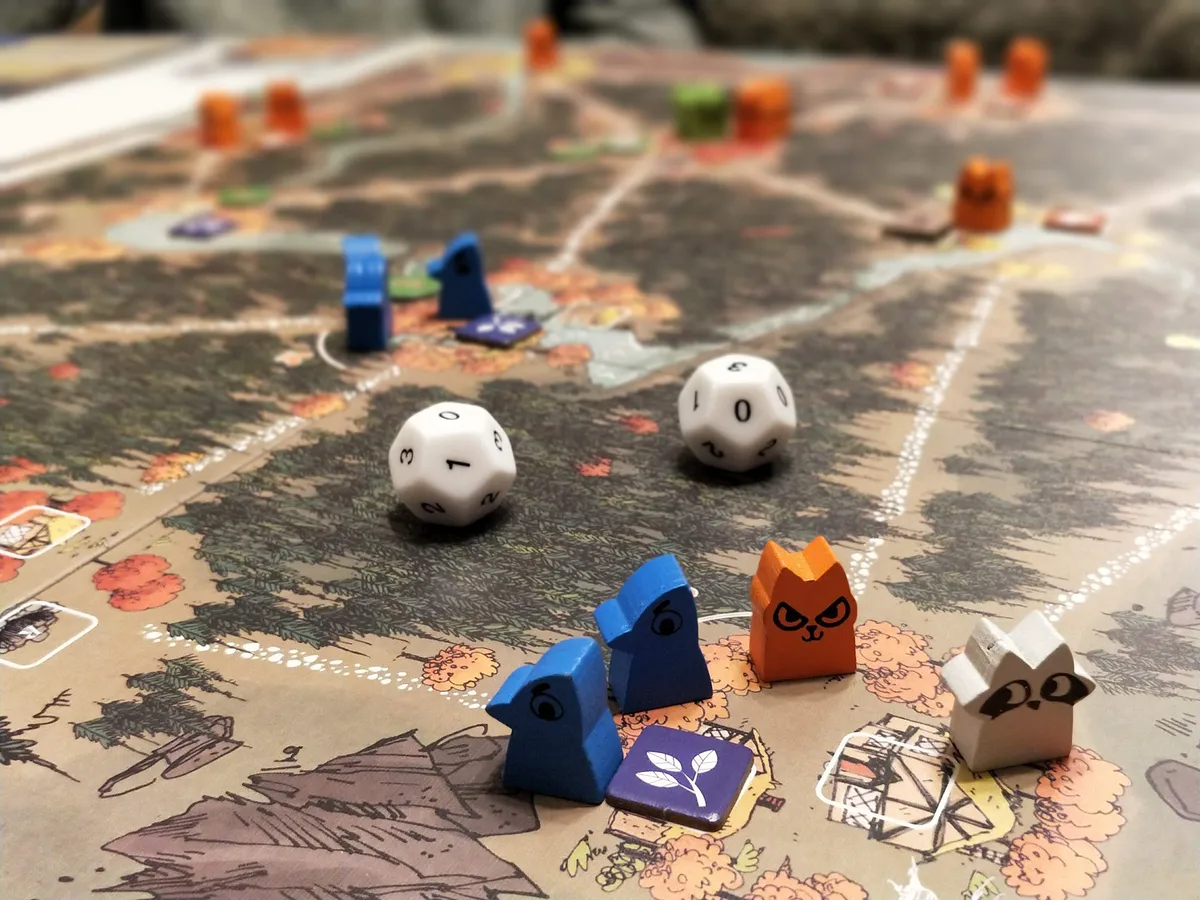
Tabletop session atmosphere — Wikimedia Commons
How a Round Feels (Core Loop)
Understanding the loop helps more than memorizing edge-case rules. A typical round cycles through:
- Player turns — spend action dice to move survivors, search locations, attack zombies, barricade, clean waste, or contribute to the colony.
- Exposure risk — leaving the colony or fighting the dead can trigger the exposure die: nothing, a wound, a bite (contagion panic), or frostbite that snowballs.
- Crisis resolution — the colony must contribute matching resources or suffer morale hits and other punishments.
- Colony phase — zombies surge, noise attracts danger, food gets eaten, helpless survivors demand care, and morale ticks toward disaster if you mismanage the settlement.
The mechanical skeleton resembles other worker-placement survival games. What elevates Dead of Winter is timing: Crossroads cards interrupt the plan with human drama exactly when someone is about to do something thematic — visit the school, search the hospital, exile a survivor, or leave a friend behind.
Action Dice and Opportunity Cost
Each of your survivors contributes dice based on their influence. High rolls unlock stronger actions; low rolls force improvisation. You will constantly choose between:
- Searching for medicine before a crisis kills morale
- Clearing zombies so a location does not overflow
- Hoarding a key item for your secret objective
- Helping a teammate who might be a betrayer
That opportunity cost is the heart of this Dead of Winter game review. The zombies create urgency; the secrets create suspicion; the dice create unfairness that feels like winter itself.
Crossroads Cards: The Signature Hook
If Dead of Winter had shipped without Crossroads, it would be a solid but forgettable zombie co-op. Crossroads are the reason people still recommend it in 2026.
A Crossroads card is a short narrative vignette tied to a trigger (a location, an action, or a situation). When the trigger happens, another player reads the card aloud. Suddenly the table faces a dilemma: save a child and risk infection, steal medicine and tank morale, or abandon a search to rescue a stranger. Outcomes branch. Survivors can die. Morale can spike or crater. The story becomes your group’s story, not a scripted campaign book.
Why Crossroads Still Work
Modern narrative games often use app companions or huge legacy stickers. Dead of Winter keeps drama analog and portable:
- No phone required at the table
- Replayable because the deck is large and situational
- Mature-content callouts let you prune cards for family-friendlier nights
- Moments create quotable disasters (“Remember when we burned the library for heat?”)
For SEO readers comparing “story board games,” Crossroads sit between pure co-op campaigns and social deduction. You are not solving a mystery module; you are surviving a season of bad options.
Secret Objectives and Betrayal
Every honest dead of winter game review must explain the win condition carefully: completing the main objective is necessary but not sufficient. Only players who also complete their secret objective win. If the colony succeeds and your secret fails, you lose while others celebrate. That stings — and it is intentional.
Non-Betrayal Secrets
Many secrets ask you to collect sets, keep certain survivors alive, or hold specific item types. These create quiet selfishness: you contribute just enough to keep morale alive while steering searches toward your private needs. Friends notice odd moves. Debates start.
Betrayal Secrets
A minority of secrets are true betrayal goals. A betrayer wants the colony to fail in a particular way, or needs chaos that looks like incompetence until it is too late. Because betrayal is not guaranteed every game, paranoia exists even in “clean” sessions. That ambiguity is brilliant design.
Exile and Social Blow-Ups
Groups can vote to exile a suspected traitor. Exile is dramatic and sometimes correct — and sometimes a tragic misread that dooms the colony. Teach new players that accusation without evidence can be as deadly as zombies. Table culture matters as much as rules mastery.
Scenarios, Difficulty, and Playtime
The base game includes multiple dual-sided main objectives with short, medium, and long estimates. Short scenarios fit a weeknight if your group already knows the rules. Medium and long scenarios are weekend fare, especially with four or five players who love debating Crossroads.
Hard variants tighten resource pressure. We recommend:
- First game: short objective, remove a few mature Crossroads if needed, openly remind everyone that secrets exist
- Second game: medium objective, full secret tension
- Veterans: hard variants, add The Long Night modules later
Setup is not trivial. Sort item decks by location, place standees, deal objectives, and explain exposure. Budget 15–20 minutes for a new table. After two plays, setup shrinks and the drama expands.
Player Count Guide
| Players | Experience |
|---|---|
| 2 | Playable teaching mode, but secrets feel thinner and Crossroads hit less often |
| 3 | Strong — enough suspicion without chaos overload |
| 4 | Best overall balance of debate, betrayal odds, and pacing |
| 5 | Maximum soap opera; watch the clock on long objectives |
If your regular night is two people, consider other co-ops first or accept that Dead of Winter shines as a “bring friends” box. At four players it becomes the table’s villain and hero.
Components, Production, and Table Presence
Standees look great in a swarm — early games feel sparse until the “add zombies” phase carpets a location and you understand why the count seemed excessive in the insert. Cards are readable; icon language takes one session to internalize. The exposure die is pure thematic cruelty.
Table footprint is medium-large. You need space for the colony board, six locations, player areas, and card discard piles. Apartment tables work; coffee tables struggle. Organization bags or a foam-core upgrade help if you play monthly.
Compared with newer Kickstarter monsters overflowing with miniatures, Dead of Winter still looks intentional rather than bloated. It is a design-first production, not a shelf trophy that plays worse than it photographs.

Harsh winter pressure — Wikimedia Commons
Teaching the Game Without Killing the Mood
Rules complexity is the most common complaint in any Dead of Winter game review, so teach in layers:
- Goal structure (colony objective + secret objective)
- What you can do on a turn (move, search, attack, barricade, clean, contribute)
- Exposure die outcomes in one sentence
- Crisis contribution before the first colony phase
- Crossroads: “When this triggers, someone reads; we choose; consequences stick”
Do not explain every edge-case token on turn zero. Learn by surviving. Keep the rulebook nearby for bites, frostbite stacking, and exile timing. After one full game, most groups internalize 90% of the procedures.
Avoiding Analysis Paralysis
Appoint a gentle timekeeper. Limit Crossroads debates to two minutes unless the table is having fun. Remind players that imperfect heroic failures make better stories than perfect spreadsheets. Dead of Winter rewards narrative courage more than optimal math — though math still matters when morale is at one.
Expansions and the Broader Line
Dead of Winter: The Long Night
The Long Night (2016) can stand alone or combine with the base game. It adds bandits, Raxxon experiments, improvement modules, and fresh objectives. If your group already loves the base box, Long Night is the highest-value next purchase. If you are brand new, start with the original Crossroads game so you learn the core tension before modular complexity.
Colonies of Winter and Other Follow-Ups
The line expanded with promotional survivors, additional Crossroads packs, and related titles in the same universe. Collectors can go deep; casual owners can stay with one well-loved box for years. For most readers of this review, base game first remains the correct advice in 2026.
Dead of Winter vs Similar Games
| Game | Vibe | Choose it instead when… |
|---|---|---|
| Dead of Winter | Semi-co-op zombie winter + Crossroads | You want secrets, stories, and maybe-traitors |
| Betrayal at House on the Hill | Haunt phase flips one player | You prefer haunted-house campaigns over colony management |
| Battlestar Galactica | Heavy traitor + politics | Your group wants longer, denser deduction |
| Pandemic | Pure co-op, no secrets | You want teamwork without paranoia |
| Nemesis | Semi-co-op miniatures horror | You prefer miniature spectacle and objective private goals in space |
Dead of Winter sits in a sweet middle: heavier than family co-ops, lighter than all-evening traitor epics, and more narratively punchy than efficiency engines.
Who Should Buy It in 2026?
Perfect For
- Groups that love talking in character or telling “remember when” stories
- Fans of The Walking Dead-style colony politics (without needing the license)
- Players who enjoy social deduction but still want a board state to manage
- Hobby shelves that need a dramatic centerpiece for 3–5 friends
Not Ideal For
- Purely competitive eurogamers who dislike hidden scoring feel-bads
- Parents seeking a light 30-minute kids’ game (age rating is there for a reason)
- Two-player couples looking for a weekly short co-op (try something tighter first)
- Anyone allergic to player conflict inside “cooperative” boxes
Pros and Cons
| Pros | Cons |
|---|---|
| Unforgettable Crossroads stories | Setup and rules tax new groups |
| Secret objectives create lasting tension | Exile / loss conditions can feel brutal |
| Theme and art still hold up | 2-player is a compromise |
| High replay via scenarios + deck | Long scenarios invite analysis paralysis |
| Strong expansion path | Component organization needed |
Strategy Tips (Without Spoiling Secrets)
- Treat morale like hit points for the whole table. Food shortages and failed crises kill colonies faster than a single zombie swarm.
- Noise is a debt instrument. Searching loudly pays now and collects later when zombies pour in.
- Barricades and cleaning are underrated. Survival is logistics, not just hero kills.
- Watch contribution patterns. Players who never help crises but always search one location are either optimizing a secret — or betraying.
- Do not over-accuse early. False exile can collapse morale and trust permanently.
- Plan Crossroads risk. If a location is “hot” for narrative triggers, decide as a group whether the reward is worth the story bomb.
Mobile-Friendly Buying & Play Notes
Reading this dead of winter game review on a phone? Here is the condensed shopping checklist:
- Confirm player count matches your real group (3–5)
- Budget 90 minutes minimum for game one
- Buy the base Crossroads box before The Long Night
- Sleeve cards if you play weekly; the Crossroads deck sees heavy handling
- Use a turn-order reminder app or phone timer only if your table stalls — keep phones face-down during Crossroads readings for immersion
FAQ — Dead of Winter Game Review
Is Dead of Winter a board game or a video game?
This review covers the Plaid Hat board game Dead of Winter: A Crossroads Game. Search results for “dead of winter game review” almost always mean this tabletop title.
Is Dead of Winter worth it in 2026?
Yes — if your group enjoys narrative co-op with distrust. It remains one of the best theme-first hobby games of the 2010s and still hits hard today.
How long does Dead of Winter take?
Most groups finish in 60–120 minutes once rules are known. First plays and long objectives can run longer.
Does every game have a traitor?
No. Betrayal secrets exist in the deck, but many games have no true betrayer. The possibility alone creates tension.
Can you play Dead of Winter with two players?
Yes, but it is the weakest count. Prefer three to five for the full Crossroads and suspicion experience.
Is Dead of Winter too hard for beginners?
Rules are medium-heavy. A patient teacher and a short scenario make the first game accessible. Jumping into a hard long objective with five new players is a bad idea.
Dead of Winter vs The Long Night — which to buy first?
Buy the original Crossroads game first. Add The Long Night when you want more modules and variety.
Is it scary?
It is tense and bleak more than jump-scare horror. Crossroads can include mature themes; filter cards if needed.
What age is Dead of Winter for?
Publisher guidance is roughly 13+/14+. Reading level and moral dilemmas matter more than zombie art.
Can it be played purely cooperatively?
You can house-rule open objectives, but you will remove the game’s identity. Better to pick Pandemic-style co-ops if you want zero hidden agendas.
Final Verdict
Dead of Winter endures because it understands that zombie fiction is really about people. The standees and frostbite matter, but the lasting memory is the Crossroads choice that split your friend group for ten minutes — and the quiet realization that someone at the table needed the colony to fail.
In 2026 the hobby is crowded with legacy campaigns, app-driven narratives, and miniature spectacles. Dead of Winter still earns a shelf slot by staying analog, replayable, and emotionally sharp. Teach it carefully, play it at three to five players, and let the secrets breathe. Do that, and this Dead of Winter game review ends the same way most good sessions do: with a story you will retell long after the zombies are back in the box.
Score: 8.7/10 — Best Narrative Co-op With Betrayal Tension
Related on NexReview
Looking for more game coverage after this board-game deep dive? Explore our Game Reviews hub, co-op chaos in Lethal Company, and tense squad play in Helldivers 2. For PC performance tools when you switch back to digital titles, open NexCheck and NexPass.