
Indiana Jones and the Great Circle is the adventure blockbuster that fans waited decades to play in modern form. MachineGames, the studio behind the Wolfenstein revival, partnered with Lucasfilm Games to deliver a first-person globe-trotting adventure starring archaeology's most famous professor — complete with Nazi conspiracies, whip combat, ancient puzzles, and set pieces that feel ripped from a lost Spielberg screenplay. If you want a thorough Indiana Jones and the Great Circle review covering gameplay systems, story ambition, stealth design, performance on PC and Xbox, and whether it truly rivals Uncharted in 2025, this guide delivers an honest verdict before you buy.
The game launched in December 2024 on PC and Xbox Series X|S as a Bethesda release and day-one Xbox Game Pass title, positioning itself as a premium single-player experience in a market hungry for cinematic adventures without live-service strings attached. MachineGames chose first-person perspective deliberately — not to mimic a shooter, but to put you inside Indy's hat and satchel as you decipher inscriptions, disarm traps, and improvise escapes when diplomacy fails. The result is one of the year's most confident licensed games: reverent without being museum-piece stiff, action-packed without forgetting that Indy wins as often with wit as with fists.
What Is Indiana Jones and the Great Circle?
Indiana Jones and the Great Circle is a first-person action-adventure set in 1937, between the events of Raiders of the Lost Ark and The Last Crusade. You play as Dr. Henry "Indiana" Jones Jr., voiced by Troy Baker, as he investigates a mysterious global conspiracy tied to concentric ancient circles appearing at sacred sites from Rome to Sukhothai.
Official screenshot — MachineGames (Steam)
The story begins at the Vatican and spirals across Egypt, the Himalayas, and other locales rendered with period detail — fascist agents, colonial tensions, and academic rivalries woven into a pulp narrative about an artifact network predating recorded history. MachineGames structures the campaign as a blend of hub exploration, linear set-piece missions, and optional dig sites rewarding curiosity with journal notes, relics, and skill book fragments.
Unlike open-world sandboxes that scatter icons across continents, The Great Circle favors authored adventure zones with multiple infiltration routes, environmental storytelling, and puzzle rooms that respect the fantasy of being an archaeologist rather than a loot vacuum. Combat exists — fists, improvised weapons, firearms, and the iconic whip — but stealth, disguise, and social navigation are equally viable tools.
For search queries like "Indiana Jones game review 2025" or "is Indiana Jones Great Circle worth it," the short answer: yes for adventure fans, especially Game Pass subscribers, with minor caveats around stealth AI and pacing in optional content.
Gameplay and Mechanics
The Great Circle's gameplay loop alternates between exploration, investigation, stealth infiltration, and hand-to-hand combat — a rhythm familiar to immersive sim fans and classic adventure devotees, updated with modern production values.
Exploration and Fieldwork
Each major location behaves like a dense diorama. Indy carries a journal that automatically sketches clues, maps symbols, and tracks narrative threads. Photography mechanics let you document discoveries; matching angles to reference photos unlocks hidden compartments and shortcut paths. Field notes accumulate into a readable chronicle that makes optional exploration feel like scholarship, not checklist padding.
Traversal mixes climbing, ledge grabs, rope hooks, and contextual jumps. First-person perspective heightens vertigo on catwalks and cliffside monasteries. Indy is athletic but not superhuman — falls hurt, stamina matters during chases, and misjudging a gap sends you tumbling into enemy patrol routes.
Puzzles and Archaeology
Puzzles range from environmental logic — aligning mirrors, rerouting water, weight plates — to cipher decryption using Indy's linguistic expertise. Difficulty skews accessible: hints appear through journal marginalia if you linger, but purists can disable assistance for a classic adventure challenge.
Trap disarmament sequences reward observation. Pressure plates, rolling boulders, and spike corridors reference franchise set pieces without lazy repetition. Optional dig sites hide relic collections and skill books that upgrade combat and utility abilities, encouraging thorough site surveys without mandating 100% completion for story progress.
Combat, Whip, and Improvisation
When stealth fails, Indy fights dirty. Melee combat uses a directional system — blocks, counters, grabs, and environmental finishers. Indy's fists are credible; he is a brawler, not a martial arts master. Improvised weapons — wrenches, bottles, shovels — break on use, pushing improvisation mid-fight.
The whip functions as utility and combat tool: disarming guns, swinging across gaps, triggering distant levers, and finishing staggered enemies. Firearms appear but ammo is scarce; the game discourages run-and-gun fantasy. Indy's revolver handles threats at range, yet loud gunfire alerts patrols — reinforcing stealth-first design even during combat spikes.
Stealth and Disguises
Stealth systems emphasize disguises, line-of-sight, and social blending. Stealing officer uniforms opens restricted corridors; maintaining cover requires acting natural — walking confidently, not sprinting through mess halls. Distraction tools include thrown objects and environmental noise sources.
Detection AI is functional but not revolutionary. Guards investigate disturbances logically yet occasionally rubber-band to scripted alert states during complex infiltrations. Patient players can ghost most scenarios; aggressive players can muscle through with higher difficulty friction. The game respects player agency without achieving immersive-sim perfection.
Progression and Skills
Skill books discovered in the field upgrade categories like Survival, Combat, and Utility. Perks unlock whip techniques, expanded inventory capacity, quieter takedowns, and enhanced journal deduction. Progression is modest — Indy remains human throughout — but upgrades noticeably improve quality of life for completionists returning to earlier zones.

World and exploration — MachineGames (Steam)
Story World and Characters
The Great Circle succeeds because it understands Indiana Jones is not a power fantasy avatar — he is a flawed academic stumbling into history's violent margins.
Main Narrative and Conspiracy
The central mystery revolves around the Great Circle, a geometric pattern linking sacred sites and implying a prehistorical unified cosmology. Fascist agents, led by formidable officers with personal stakes, race Indy to weaponize or suppress the discovery. The plot echoes real 1930s anxieties: authoritarian archaeology, stolen heritage, and the ethics of excavation under occupation.
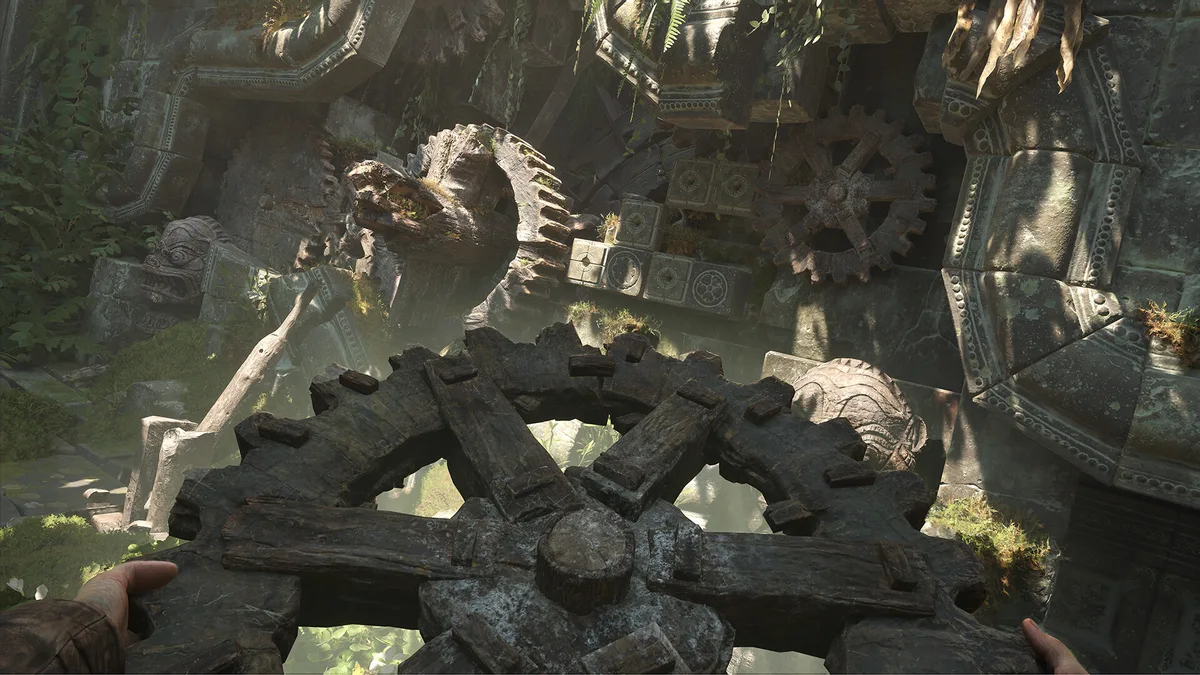
Systems and performance — MachineGames (Steam)
MachineGames paces revelations across roughly 15–20 hours of main story, with optional content pushing total playtime toward 25–30 hours. Set pieces include train-top chases, flooded tomb escapes, monastery sieges, and interrogation rooms where Indy's sarcasm is as dangerous as his right hook.
Characters and Performances
Troy Baker delivers a career-highlight performance, capturing Harrison Ford's gravelly warmth, impatience, and moral ambiguity without impressionist parody. Supporting cast members — allies, rival scholars, and civilians caught in crossfire — benefit from strong voice direction and facial animation during cutscenes.
Gina, a recurring ally, provides narrative counterweight and combat support without reducing Indy to passive escort duty. Antagonists receive motivations beyond mustache-twirling; one memorable villain ties personal loss to ideological fanaticism, grounding pulp in emotional stakes.
Tone and Franchise Fidelity
The writing balances humor, horror, and historical unease. Indy quips under pressure, but the game does not undercut Nazi menace. MachineGames references franchise iconography — fedora, bullwhip, fear of snakes — with restraint. Fan service exists in optional collectibles and journal callbacks, yet the original story stands alone for newcomers.
Lucasfilm oversight ensures visual and tonal consistency with the films. The 1937 setting avoids sequel contradictions while letting the art team recreate period wardrobes, vehicles, and propaganda aesthetics with obsessive detail.
Visuals and Audio
The Great Circle runs on id Tech technology refined across Wolfenstein and Doom projects, adapted here for global adventure rather than corridor carnage.
Art Direction and Environments
Locations burst with period authenticity: Vatican marble and candle smoke, Egyptian dig camps baking under harsh sun, Himalayan monasteries clinging to snow ridges. Lighting transitions sell time-of-day shifts; interiors use practical light sources — lanterns, torches, stained glass — that guide exploration naturally.
Character models and costumes render fabric wear, dust accumulation, and injury grime convincingly. Indy's satchel, notebook, and hands occupy foreground space constantly in first-person view, reinforcing tactile immersion. Destruction and environmental interaction are limited compared to pure shooters, but set-piece arenas deform appropriately during chases and collapses.
Animation and Cinematics
Cutscenes use in-engine rendering with cinematic camera work during key beats, returning seamlessly to first-person control afterward. Combat animations emphasize weight — Indy's punches look exhausting, whip cracks snap with audible tension. Stealth takedowns vary by angle and weapon, reducing repetition.
Audio Design and Music
Sound design prioritizes environmental authenticity: market chatter, prayer bells, train rattles, distant sirens. The whip's crack, revolver reports, and fist impacts carry satisfying punch without overpowering mix levels.
Gordy Haab's score channels John Williams' adventurous motifs without plagiarizing leitmotifs — brass swells during discoveries, tense strings during infiltrations, quieter woodwinds for journal deduction sequences. Optional commentary tracks and collectible audio logs expand lore for franchise enthusiasts.
Performance and Technical Quality
On Xbox Series X, The Great Circle offers performance and quality modes targeting smooth frame rates or enhanced fidelity. Series S scales resolution and effects predictably. PC players receive extensive graphics options, DLSS and FSR upscaling, and ray tracing toggles for reflections and global illumination on supported hardware.
Initial launch builds encountered sporadic stuttering during shader compilation and crowded hub scenes — common for id Tech titles. Post-launch patches through 2025 improved frame pacing and reduced hitching during camera-heavy traversal. By mid-2026, stability is substantially better, though ultra settings on mid-range GPUs still demand upscaling.
Load times are fast on SSD-equipped systems. Save systems checkpoint generously before major set pieces. Bugs reported at launch — animation pops, occasional objective marker confusion — have diminished though not vanished entirely. No microtransactions or live-service hooks appear; the product is a complete single-player campaign with optional replay incentives.
PC modding support remains limited compared to open-engine RPGs, consistent with Bethesda's recent single-player releases. Controller support on PC is excellent; mouse-and-keyboard suits shooting segments but controller rumble enhances whip feedback on consoles.
Pros and Cons
Pros
- Authentic Indiana Jones fantasy with reverent tone and strong Troy Baker performance
- First-person immersion makes exploration, journaling, and puzzle-solving tactile
- Varied globe-trotting locations with dense environmental storytelling
- Whip and melee combat feel distinctive without becoming a full shooter
- Stealth and disguise routes reward patience and multiple playstyles
- Excellent audio and cinematic score honoring franchise adventure spirit
- Day-one Game Pass availability offers tremendous value on Xbox and PC
- No microtransactions — complete narrative experience at launch
Cons
- Stealth AI and detection logic feel dated compared to immersive sim leaders
- First-person platforming may disorient players preferring third-person adventure
- Optional content pacing slows in middle chapters with backtracking
- PC performance demanded patches and tuning at launch on mid-tier hardware
- No PlayStation release at launch limits platform availability initially
- Combat depth satisfies adventure pacing but lacks long-term mastery hooks
- Photo and journal puzzles occasionally obscure objectives without hint systems
Who Should Buy Indiana Jones and the Great Circle?
Buy or play via Game Pass if you love cinematic adventure games, Uncharted-style set pieces, immersive exploration, and licensed experiences that respect source material. Fans of MachineGames' Wolfenstein storytelling, Tomb Raider reboot puzzles, and immersive sim infiltration will find overlapping pleasures here.
Buy at full price on PC if you prefer mouse precision for occasional shooting segments and want maximum visual settings on high-end hardware. Steam and Microsoft Store versions receive identical content support.
Wait or skip if you strongly dislike first-person perspective, expect open-world Ubisoft map density, or need cutting-edge stealth simulation on the level of Hitman or Dishonored. Players seeking endless endgame content after credits roll should look elsewhere — The Great Circle is a finite, story-forward campaign.
Consider platform carefully: Xbox Game Pass subscribers should treat this as a priority play. PlayStation-only households must wait for potential future ports or invest in PC/Xbox access for the current release window.
FAQ
How long is Indiana Jones and the Great Circle?
The main story takes approximately 15–20 hours. Completion with optional dig sites, relic collections, and skill book hunts reaches 25–30 hours.
Is Indiana Jones and the Great Circle on Game Pass?
Yes. It launched day one on Xbox Game Pass for console and PC in December 2024. Verify current subscription availability in your region before enrolling solely for this title.
Is Indiana Jones and the Great Circle first person only?
Yes. The entire campaign plays from first-person perspective. There is no third-person gameplay mode for exploration or combat.
Does Indiana Jones and the Great Circle have multiplayer?
No. It is strictly a single-player narrative adventure without co-op or competitive modes.
Is Indiana Jones and the Great Circle like Uncharted?
It shares DNA — cinematic set pieces, climbing, gunfights, witty protagonist — but emphasizes stealth, disguises, puzzles, and first-person immersion over third-person cover shooting. Think Uncharted meets immersive sim infiltration with archaeology journal mechanics.
Verdict
Indiana Jones and the Great Circle is the licensed adventure triumph fans deserved after years of false starts. MachineGames translates Wolfenstein's narrative confidence into a globe-spanning mystery that feels authentically Indy — curious, reckless, compassionate, and perpetually one step behind yet somehow ahead of fascism's worst ambitions. First-person perspective initially surprises, then justifies itself through journaling, photography, and claustrophobic tomb tension no third-person camera replicates as effectively.
It is not flawless. Stealth systems show genre-age seams, pacing wobbles when optional dig sites interrupt momentum, and combat will not replace dedicated action games as a mastery sandbox. Yet as a 2025 adventure blockbuster, The Great Circle delivers set pieces, performances, and historical pulp with rare confidence — a complete single-player journey worth your evenings.
NexReview Score: 8.5/10
Adventure fans should prioritize this immediately on Game Pass or purchase. For players comparing premium single-player experiences in 2025, pair this with our Black Myth Wukong review for mythological action spectacle and our Silent Hill 2 Remake review for narrative atmosphere at the opposite tonal extreme — both demonstrate how modern studios revive beloved IP without losing identity.
Score Breakdown
| Category | Score |
|---|---|
| Story and characters | 9/10 |
| Gameplay variety | 8.5/10 |
| Puzzle design | 8/10 |
| Combat and whip mechanics | 8/10 |
| Visual presentation | 9/10 |
| Audio and music | 9/10 |
| Stealth systems | 7/10 |
| Performance (2025–2026) | 8/10 |
| Overall | 8.5/10 |
System Requirements Overview
| Component | Minimum | Recommended |
|---|---|---|
| GPU | GTX 1070 / RX 6600 | RTX 2080 / RX 6800 XT |
| CPU | Intel i7-10700K / Ryzen 5 3600 | Intel i7-11700K / Ryzen 7 5800X |
| RAM | 16 GB | 32 GB |
| Storage | 120 GB SSD | 120 GB SSD |
SSD storage is strongly recommended due to id Tech asset streaming. Ray tracing and ultra textures demand high-end GPUs; upscaling via DLSS or FSR improves frame rates substantially on mid-range hardware.
Indiana Jones vs. Uncharted — Comparison
| Feature | Indiana Jones and the Great Circle | Uncharted series |
|---|---|---|
| Perspective | First person | Third person |
| Tone | 1930s pulp archaeology | Modern action cinema |
| Stealth emphasis | High — disguises and infiltration | Moderate — cover shooting focus |
| Puzzle depth | Journal, photography, ciphers | Environmental platforming |
| Combat style | Melee, whip, limited firearms | Cover shooter with set-piece tanks |
| Platform availability (launch) | PC, Xbox | PlayStation heritage |
The Great Circle competes with Uncharted on spectacle while carving identity through archaeology simulation and immersive sim routes. Players seeking third-person cover flow should temper expectations; players wanting to feel like Indy reading inscriptions by candlelight will find MachineGames' approach distinctive.
Platform Notes — PC, Xbox, and Game Pass
Xbox Series X delivers the most frictionless console experience with quick-resume support and performance mode stability above 60 FPS in many scenes. Series S remains playable at reduced fidelity — acceptable for narrative-focused players less sensitive to resolution scaling.
PC offers the highest ceiling with ultrawide support, uncapped frame rates on capable hardware, and granular graphics toggles. Launch stutter improved through patches; still budget time for settings optimization on mid-tier rigs.
Game Pass value is exceptional: The Great Circle is a flagship single-player title ideal for subscription sampling. Purchase separately if you collect Bethesda/Lucasfilm releases permanently or anticipate replay for optional collectibles.
PlayStation availability remained absent at launch, a strategic Microsoft exclusivity window typical of Bethesda's post-acquisition releases. PlayStation-only players should monitor official announcements rather than assuming timed exclusivity duration.
Final Recommendation
Indiana Jones and the Great Circle rewards curiosity, patience, and affection for adventure cinema. MachineGames did not reinvent the genre — they honored it, translating Harrison Ford's iconic hero into interactive form with first-person intimacy and global scope.
Start on normal difficulty, lean into journaling and photography mechanics, and resist rushing set pieces — the game breathes best when you treat dig sites as mysteries, not waypoint markers. Use stealth when uniforms are available; save whip combat for moments when Indy's temper earns narrative payoff.
Bottom line: The hat fits. The whip cracks true. For adventure fans in 2025, The Great Circle belongs alongside the finest licensed games ever made — not perfect, but unmistakably Indiana Jones, and that authenticity is worth the price of admission.