
Star Wars Outlaws is Ubisoft's answer to a question fans have asked for decades: what does a big-budget open-world Star Wars game feel like when you are not a Jedi? Developed by Ubisoft Massive — the studio behind The Division — and published in partnership with Lucasfilm Games, Outlaws puts you in the boots of Kay Vess, a scoundrel trying to escape her criminal past and pull the heist that changes her life. Released on August 30, 2024 for PC, PlayStation 5, and Xbox Series X|S, it targets the era between The Empire Strikes Back and Return of the Jedi, when the Rebellion is scattered and the underworld thrives in the Empire's shadow.
If you want a thorough Star Wars Outlaws review covering open-world design, stealth and combat systems, space dogfights, syndicate reputation mechanics, performance on modern hardware, and whether it is worth playing in 2025, this guide covers everything that matters before you spend your credits. Outlaws is not the Force-powered power fantasy of Jedi: Survivor — it is a thief's tale built on Ubisoft's open-world template, wrapped in some of the most convincing Star Wars atmosphere a AAA studio has produced.
The result is a game that often nails the vibe — cantina chatter, Imperial checkpoints, speeder chases across desert mesas — while struggling to escape the familiarity of formulaic map design and uneven mission pacing. Nearly two years after launch, with patches and a Gold Edition that bundles story DLC, Outlaws is easier to recommend at a discount or through subscription services than at full price on day one. It is good, sometimes great, but rarely essential.
What Is Star Wars Outlaws?
Star Wars Outlaws is an open-world action-adventure game set in the Original Trilogy timeline. You play as Kay Vess, a young thief who escapes an indentured life on the moon Toshara and teams up with Jaylen, a droidsmith with his own agenda, and Nix, a merqaat companion who assists in stealth, distraction, and traversal. The story follows Kay as she assembles a crew, navigates rival syndicates, and pursues a score big enough to buy freedom across the galaxy.
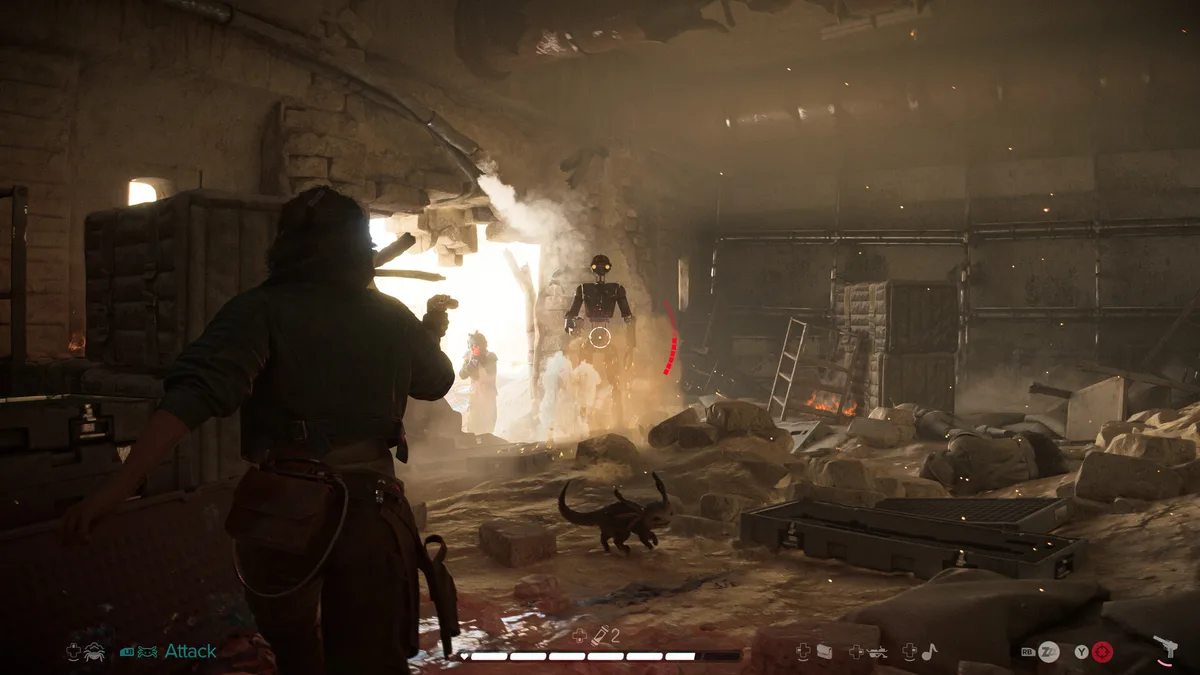
Official screenshot — Ubisoft (Steam)
The game spans multiple explorable locations:
- Toshara, a dusty frontier moon with mining towns and syndicate turf wars
- Tatooine, with Mos Eisley-adjacent cantina culture and Jawa territory
- Akiva, a jungle world caught between Imperial occupation and local resistance
- Kijimi, a frozen city-planet with underworld connections
- Mirogana and other hubs tied to the main narrative
- Space segments connecting systems via Kay's ship, the Trailblazer
Unlike linear action games in the franchise, Outlaws embraces Ubisoft open-world structure: discover regions, unlock fast travel, accept contracts from syndicates, upgrade gear, and infiltrate Imperial or criminal strongholds. Kay is not Force-sensitive. Her toolkit is blasters, stealth, gadgets, and social manipulation through a reputation system that tracks standing with factions like the Pyke Syndicate, Hutt Cartel, Crimson Dawn, and the Ashiga Clan.
For players searching "Star Wars open world game review" or "Kay Vess game worth it," the pitch is straightforward: live the scoundrel fantasy in a period-accurate galactic underworld, with production values that often surpass expectations even when the gameplay loop feels familiar.
Gameplay Overview and Core Loop
Outlaws follows a recognizable Ubisoft rhythm, executed with Star Wars dressing:
- Land on a planet or moon and explore districts, wilderness, and points of interest
- Accept main story missions and syndicate contracts from hubs and informants
- Infiltrate bases, vaults, and Imperial facilities using stealth, combat, or hybrid approaches
- Gather resources and credits for gear upgrades, ship improvements, and vendor purchases
- Manage syndicate reputation to unlock perks, discounts, and access to restricted areas
- Travel between systems for space encounters, smuggling runs, and story progression
What distinguishes Outlaws from generic Ubisoft fare is context. A stealth infiltration is not "clear the bandit camp" — it is slicing into an Imperial relay while patrols call out serial numbers over comms. A speeder chase across Toshara's canyons carries the same pulp energy as classic Expanded Universe smuggler tales. Massive invested heavily in world-building details: overheard conversations reference Rebellion setbacks, stormtroopers complain about posting assignments, and cantina bands play genre-appropriate arrangements.
Exploration rewards curiosity without demanding obsessive completion. Intel found in the world unlocks new contracts and shortcuts. Expert NPCs teach Kay abilities like improved hacking, better stealth takedowns, or enhanced ship maneuvers — a structure similar to Assassin's Creed's hidden skill sources. Side activities include gambling mini-games, racing, bounty hunting, and slice-based puzzles on security terminals.
The Trailblazer serves as your mobile base between planetary visits. Upgrade engines, shields, and weapons to survive space combat against pirates and Imperial patrols. Space is not a full simulation — think arcade dogfights with boost management and lock-on targeting — but it breaks up ground gameplay effectively and sells the fantasy of living between worlds.
Combat and Stealth Systems
Combat and stealth are the mechanical heart of any Star Wars Outlaws review, and Massive's approach favors accessibility over hardcore simulation.
Stealth and Infiltration
Kay's stealth toolkit includes cover-based movement, distraction commands for Nix, silent takedowns, and terminal hacking via Slicing. Detection states escalate from suspicious to alerted to combat, with guards investigating noises and reporting Kay's last known position. Nix can retrieve items from guarded areas, bite enemies to create openings, and scout ahead — making the merqaat more than cosmetic companion fluff.
Stealth feels functional rather than groundbreaking. Compared to immersive sim leaders or even Ubisoft's best work in Splinter Cell lineage, Outlaws' AI can be predictable: patrol routes loop obviously, and alarm resets sometimes feel generous. Still, ghosting an Imperial outpost and escaping on a speeder captures the scoundrel identity better than any firefight could. Higher difficulties tighten detection windows and increase enemy damage, rewarding patience without transforming the game into a tactical sim.
Environmental interactivity supports infiltration. Vents, ledges, and alternate entry points appear in mission-designated areas. Slicing puzzles — timing-based minigames on security terminals — gate access to vaults and restricted corridors. These puzzles are readable and quick, though they repeat across the campaign without much evolution.
Ground Combat and Blasters
When stealth fails, Kay fights with blasters, gadgets, and limited melee options. Cover shooting is standard third-person fare: pop from cover, land shots, manage a regenerating health bar, and use consumables when overwhelmed. Kay can carry multiple blaster configurations with different fire modes — burst, charged shots, spread patterns — swapped at workbenches.
Combat lacks the mechanical depth of dedicated shooters or action games like Uncharted. Recoil and weapon handling are simplified. Enemy variety includes stormtroopers, officers, pirates, and syndicate enforcers with modest behavioral differences. Elite enemies require flanking or gadget use. The system works for the fantasy — Kay is a survivor, not a supersoldier — but veterans may find firefights repetitive by the mid-game.
Gadgets add tactical options: EMP charges disable droids, smoke grenades break line of sight, and throwable distractions pull guards off patrol routes. Nix can fetch dropped items mid-combat on a cooldown timer. These tools prevent every encounter from devolving into pure shooting, but the game rarely forces creative gadget combinations outside optional challenges.
Space Combat
Space segments pit the Trailblazer against fighters, frigates, and environmental hazards. Combat uses lock-on targeting, boost dodges, and shield management. Missile salvos and turret fire create arcade spectacle without Star Wars: Squadrons depth. Ship upgrades — hull plating, engine speed, weapon output — matter more in later story missions and higher-difficulty encounters.
Space also hosts smuggling and contraband mechanics tied to syndicate contracts. Running cargo between systems with Imperial scans adds light tension, though the loop is simpler than dedicated space sims. For a ground-focused open world, the space layer is a welcome palate cleanser that reinforces Kay's identity as a ship-owning operator rather than a planet-bound thief.
Progression, Gear, and Reputation
Progression in Outlaws blends gear upgrades, ability unlocks, and faction standing — three pillars that shape how Kay interacts with the underworld.
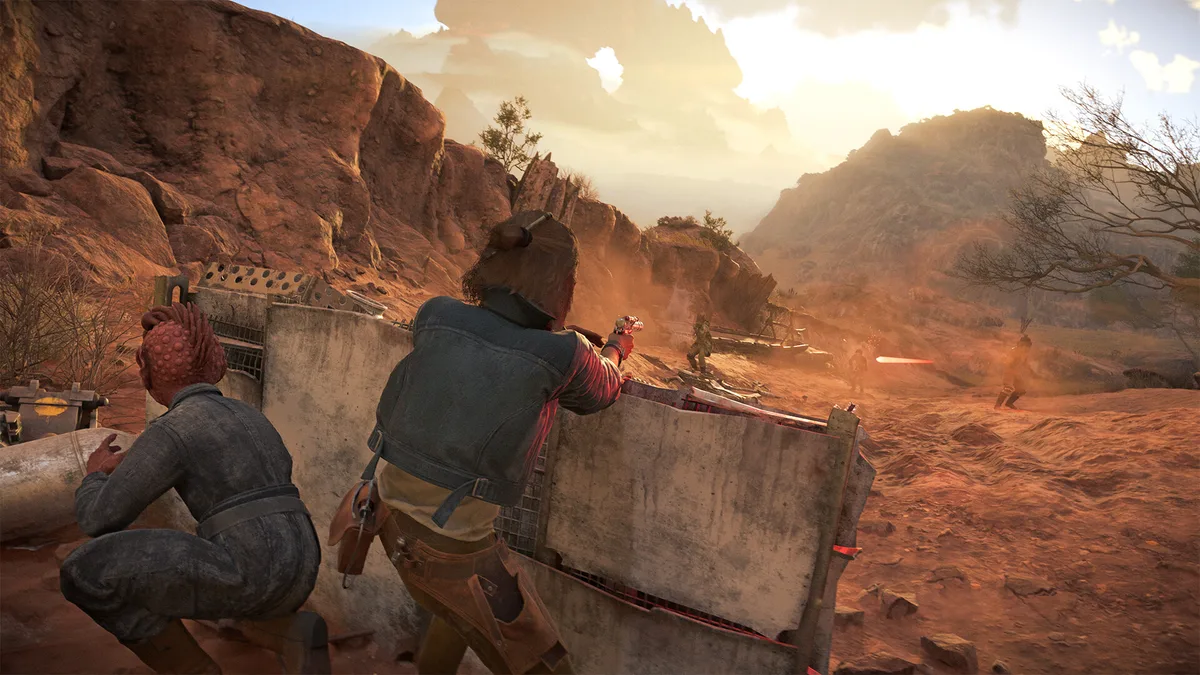
World and exploration — Ubisoft (Steam)
Gear and Crafting
Equipment includes blasters, outfits, and accessories with stat modifiers for stealth, combat, and slicing efficiency. Outfits affect social interactions in some hubs — wearing syndicate colors can ease access to restricted areas or trigger suspicion from rivals. Crafting uses materials gathered from exploration, dismantling junk, and mission rewards. Upgrades at workbenches improve weapon damage, stealth effectiveness, and health pools.
Loot rarity tiers follow Ubisoft RPG conventions. Unique quest rewards and expert-taught abilities provide meaningful spikes in capability. Transmog options let you customize Kay's appearance without sacrificing stats, a quality-of-life feature that matters when the best stealth outfit looks nothing like the best combat loadout aesthetically.
Expert Abilities and Skill Growth
Experts scattered across planets teach Kay new tricks: improved hacking speed, enhanced Nix commands, better speeder handling, or advanced combat maneuvers. Finding and completing expert questlines is one of Outlaws' strongest optional content hooks — these characters feel embedded in local culture rather than pasted onto the map as generic trainers.
Main story progression unlocks additional gadgets and ship modules. The skill growth curve is gentle; Kay never becomes overpowered, but late-game upgrades noticeably ease repetitive combat encounters.
Syndicate Reputation System
The reputation system is Outlaws' most distinctive mechanical layer. Actions during missions and contracts affect standing with criminal syndicates and Imperial forces. Helping the Pyke Syndicate might anger the Hutt Cartel; attacking Imperial assets improves underworld credibility while increasing patrol aggression in some regions.
High reputation unlocks vendor discounts, exclusive contracts, and safe passage through faction territory. Low reputation triggers ambushes and locked doors. The system creates meaningful trade-offs during multi-syndicate missions where Kay must choose which faction to favor. It is not as nuanced as KOTOR's alignment morality, but it adds texture to a genre that often treats factions as cosmetic quest givers.
Imperial reputation operates separately — too much heat and patrols become aggressive, mirroring the wanted-level tension of classic smuggler fiction without full GTA chaos.
Story, Characters, and Setting
Narrative quality determines whether Outlaws transcends its open-world scaffolding. Massive's writing is competent genre fare with occasional standout moments.
Main Narrative Arc
Kay's story begins with escape and revenge, then pivots into assembling a crew for an increasingly dangerous series of heists. Jaylen, her droidsmith ally, carries secrets that complicate trust. Nix provides emotional grounding through animation and ambient interactions rather than dialogue. Supporting characters — syndicate leaders, Imperial officers, fellow scoundrels — fill archetypal roles with varying depth.
The plot touches Rebellion-era politics without making Kay a secret hero. The Empire is an omnipresent threat; the Rebellion exists at the margins. This underworld focus is refreshing compared to Force-centric Star Wars games, though the main story occasionally forces set pieces that clash with Kay's "small-time thief" framing — she ends up involved in events larger than her initial scope suggests.
Pacing follows Ubisoft conventions: strong opening hours on Toshara, a sagging mid-game as planets unlock sequentially, and a concentrated final act with higher production set pieces. Heist missions — planning, infiltration, escape — are highlights. Fetch-heavy syndicate contracts between them are not.
Characters and Performances
Kay Vess is voiced with charisma and vulnerability, selling the transition from desperate survivor to confident operator. Nix communicates through chirps, gestures, and gameplay utility — a design choice that avoids companion dialogue bloat while building attachment. Jaylen and crew members serve functional narrative roles; few reach the memorability of BioWare companions or Obsidian's faction-heavy casts.
Systems and performance — Ubisoft (Steam)
Antagonists include syndicate rivals and Imperial officers with personal stakes. None redefine Star Wars villainy, but they provide adequate friction. The game shines more in ambient character work — bartenders, gamblers, miners, and patrol soldiers — than in main cast drama.
Star Wars Authenticity
Outlaws' greatest achievement is atmosphere. Lucasfilm collaboration shows in creature design, ship silhouettes, blaster sound effects, and architectural language. Toshara feels like a believable frontier moon. Tatooine callbacks land without excessive fan service. Kijimi's frozen underworld channels The Rise of Skywalker connections while standing on its own in the timeline.
The Original Trilogy setting avoids prequel-era political complexity and sequel-era divisiveness. Fans of Andor's grounded rebellion storytelling will appreciate the focus on ordinary people surviving under Imperial rule. Fans expecting lightsaber duels and Force powers will need to adjust expectations — this is a scoundrel game, full stop.
Performance, Visuals, and Technical State
Technical quality has been Outlaws' most debated topic since launch. By mid-2026, patches have improved stability substantially, but the game remains demanding and occasionally rough.
Graphics and Art Direction
On high-end hardware, Outlaws is visually impressive. Toshara's mesas and market districts showcase dense detail — dust particles, fabric physics on Kay's outfit, and lighting that sells harsh frontier sun. Kijimi's neon-under-ice aesthetic and Akiva's jungle ruins provide environmental variety that prevents planetary fatigue.
Character models and facial animation during cutscenes are solid, though not cutting-edge. Speeder traversal looks cinematic at speed. Imperial architecture, syndicate hideouts, and cantina interiors reference franchise design language without lazy asset reuse.
Ray tracing and DLSS/FSR upscaling are available on PC. Console versions offer performance and quality modes on PlayStation 5 and Xbox Series X.
PC and Console Performance
At launch in August 2024, Outlaws faced significant criticism:
- PC users reported stuttering, CPU bottlenecks, and inconsistent frame times even on high-end GPUs
- PlayStation 5 and Xbox Series X offered 30 FPS quality modes and 60 FPS performance modes with visual compromises
- Loading and streaming hitches appeared during fast speeder travel and hub transitions
Ubisoft released multiple patches addressing shader compilation, CPU threading, and memory management. By 2026, performance is playable and often smooth on recommended hardware, but Outlaws is not a technical showcase in the way Alan Wake 2 or polished first-party titles are. Mid-range PCs (RTX 3060 / RX 6700 XT class) should target 1080p with upscaling enabled. High-end systems can push 1440p or 4K with tuning.
PlayStation 5 Pro and enhanced console patches, if available on your platform, improve resolution and stability. Always install to SSD storage — HDD installs remain painful for open-world streaming.
Bugs and Quality of Life
Launch bugs included animation glitches, physics oddities during speeder crashes, quest trigger failures, and occasional save corruption reports. Most critical issues have been patched. Remaining quirks — floating NPCs, repeated ambient dialogue — are minor.
Quality-of-life features include extensive accessibility menus, difficulty customization for combat and stealth separately, objective tracking with map filtering, and photo mode for capturing Star Wars vistas. No live-service monetization or battle pass appears — the product is a complete single-player campaign with optional DLC.
Pros and Cons
Pros
- Exceptional Star Wars atmosphere and Original Trilogy authenticity
- Kay Vess and Nix deliver a compelling scoundrel fantasy
- Syndicate reputation system adds meaningful faction trade-offs
- Varied planets with distinct visual identity and culture
- Heist missions and infiltration set pieces capture franchise energy
- Space combat and Trailblazer upgrades provide welcome variety
- Expert questlines reward exploration with tangible abilities
- Strong audio design — blasters, engines, cantina ambience
- No microtransactions; complete single-player experience
- Improved performance after post-launch patches
Cons
- Ubisoft open-world formula feels familiar and sometimes repetitive
- Ground combat lacks depth compared to dedicated action games
- Stealth AI predictable compared to immersive sim standards
- Mid-game pacing sags with filler syndicate contracts
- Launch performance issues tarnished first impressions
- Story scope grows beyond Kay's scoundrel framing unevenly
- Slicing puzzles repeat without much evolution
- Side activities (racing, gambling) feel thin compared to main content
- Kay's supporting cast less memorable than the world around them
- Full price harder to justify against stronger 2024–2025 releases
Who Should Buy Star Wars Outlaws?
Buy if you enjoy:
- Open-world exploration in licensed universes with strong atmosphere
- Scoundrel, thief, and smuggler fantasies over Jedi power trips
- Stealth-action infiltration with syndicate politics
- Star Wars settings between major film events
- Single-player campaigns with gear progression and faction systems
- Space dogfights as occasional breaks from ground gameplay
Skip or wait if you:
- Are burned out on Ubisoft open-world structure and map-icon fatigue
- Need cutting-edge combat depth or immersive sim stealth
- Expect Force powers, lightsabers, or Jedi-centric storytelling
- Require flawless technical performance without settings tuning
- Prefer tight 20-hour experiences without optional grind
- Want narrative complexity matching RPG classics
If you loved Andor's grounded tone and Rogue One's underworld tension, Outlaws will resonate. If you prefer Jedi: Survivor's combat mastery or Mass Effect's companion depth, temper expectations. For another Ubisoft open world with stronger stealth identity, see our Assassin's Creed Shadows review. For narrative RPG depth in a distinct setting, our Avowed review covers Obsidian's first-person fantasy alternative.
FAQ — Star Wars Outlaws
Is Star Wars Outlaws worth it in 2025?
Yes for Star Wars fans who prioritize atmosphere and scoundrel fantasy over mechanical innovation — ideally at a discount, on sale, or through subscription services. It delivers one of the most authentic open-world Star Wars experiences despite familiar Ubisoft scaffolding.
When did Star Wars Outlaws release?
Star Wars Outlaws released on August 30, 2024, for PC, PlayStation 5, and Xbox Series X|S. A Gold Edition with story DLC followed later.
How long is Star Wars Outlaws?
A main-story focus takes roughly 25–30 hours. Completionists chasing syndicate contracts, expert abilities, and collectibles can exceed 50–60 hours.
Do you play as a Jedi in Star Wars Outlaws?
No. Kay Vess is not Force-sensitive. Gameplay centers on blasters, stealth, gadgets, slicing, and speeder traversal — not lightsaber combat or Force abilities.
Is Star Wars Outlaws open world?
Yes. Outlaws features multiple explorable planets and moons with open zones, fast travel, side contracts, and free-roaming speeder traversal within each location.
Does Star Wars Outlaws have space combat?
Yes. The Trailblazer ship supports arcade dogfights, system travel, and smuggling segments between planetary locations.
How does the reputation system work?
Actions affect standing with criminal syndicates and Imperial forces. High reputation with one faction may lower standing with rivals, unlocking perks, vendor access, or hostility depending on choices.
Is Star Wars Outlaws on Game Pass?
Availability varies by region and subscription tier over time. Check current Xbox Game Pass listings before subscribing solely for Outlaws.
Who developed Star Wars Outlaws?
Ubisoft Massive developed Outlaws in collaboration with Lucasfilm Games, Ubisoft Stockholm, and other Ubisoft support studios.
How does Outlaws compare to Jedi: Survivor?
Jedi: Survivor focuses on Force powers, lightsaber combat, and metroidvania progression. Outlaws is an open-world scoundrel adventure with stealth, shooting, and syndicate politics — complementary rather than competing experiences.
Verdict
Star Wars Outlaws is a game of contrasts. Its world-building, audio design, and Star Wars authenticity rank among the best the franchise has seen in AAA gaming. Kay Vess' scoundrel journey captures the underworld energy that made smugglers like Han Solo iconic — and Nix might be the most charming companion in recent Star Wars media. When heist missions click, when you ghost an Imperial base and flee on a speeder while John Williams-adjacent scoring swells, Outlaws justifies its existence completely.
Then the Ubisoft formula reasserts itself. Syndicate contracts repeat. Combat grows routine. Mid-game pacing tests patience. Launch performance issues — now largely patched — left a reputation stain that fair evaluation must acknowledge. Outlaws is good Star Wars dressing on a competent but unremarkable open-world skeleton.
NexReview Score: 7.5/10
For franchise fans who have waited years to wander cantinas, bribe syndicate bosses, and live between Empire crackdowns, Outlaws delivers meaningful moments worth experiencing. For players judging purely on gameplay innovation, it is a rental or sale pickup rather than a day-one essential. Pair this review with our Assassin's Creed Shadows review for Ubisoft's stronger 2025 stealth offering, or our Avowed review if you want deeper narrative RPG consequence in a different universe.
System Requirements Overview
| Component | Minimum | Recommended |
|---|---|---|
| GPU | GTX 1660 / RX 5700 | RTX 3070 / RX 6700 XT |
| CPU | Ryzen 5 3600 / i7-8700K | Ryzen 5 5600X / i5-11600K |
| RAM | 16 GB | 16 GB |
| Storage | 70 GB SSD | 70 GB NVMe SSD |
SSD storage is strongly recommended for smooth open-world streaming during speeder travel and hub transitions.
Score Breakdown
| Category | Score |
|---|---|
| Star Wars atmosphere | 9/10 |
| Open world design | 7/10 |
| Stealth and infiltration | 7/10 |
| Combat | 6.5/10 |
| Story and characters | 7/10 |
| Space combat | 7/10 |
| Performance | 6.5/10 |
| Overall | 7.5/10 |
Tips for New Scoundrels
- Prioritize expert questlines early — abilities like improved slicing and Nix commands pay dividends across all planets.
- Balance syndicate reputation carefully — angering one faction to please another locks content until you rebuild standing.
- Upgrade the Trailblazer steadily — underpowered shields turn late space missions into frustrating damage sponges.
- Use Nix constantly in stealth — his fetch and distraction commands reduce risk more than raw combat stats.
- Adjust difficulty settings independently — Outlaws allows separate tuning for combat and stealth challenge.
- Explore Toshara thoroughly before rushing main story — the opening moon teaches systems in a forgiving environment.
- Craft consumables before heist missions — med packs and gadget refills prevent checkpoint frustration.
Comparison With Recent Star Wars and Open-World Games
| Title | Focus | Best Feature | Weakness |
|---|---|---|---|
| Star Wars Outlaws | Open-world scoundrel | Atmosphere and faction systems | Ubisoft formula repetition |
| Jedi: Survivor | Action-adventure Jedi | Combat and traversal | Not open-world |
| Assassin's Creed Shadows | Open-world stealth-action | Dual protagonists + Japan | Similar Ubisoft structure |
| Avowed | First-person fantasy RPG | Narrative and choices | Zone-based, not seamless open world |
| Indiana Jones: Great Circle | First-person adventure | Set pieces and immersion | Linear zones vs open planets |
Outlaws occupies a specific niche: the only AAA open-world Star Wars game centered on ordinary criminals rather than Force users. That uniqueness carries value even when mechanics feel borrowed.
Post-Launch Content and 2026 Outlook
Ubisoft released Story DLC expanding Kay's narrative with new locations and missions, bundled in the Gold Edition. Post-launch patches focused primarily on performance stabilization and bug fixes rather than systemic overhauls. Community requests for deeper combat refinements, expanded space gameplay, and New Game Plus features have seen partial or no response depending on platform and patch version.
As of 2026, Outlaws stands as a solid catalog title — worth playing for Star Wars enthusiasts, unlikely to receive the transformative updates that resurrected No Man's Sky or Cyberpunk 2077. Future Star Wars gaming attention has shifted toward other projects, leaving Outlaws as a self-contained underworld snapshot of the Empire era.
Final Recommendation
Star Wars Outlaws succeeds when it stops trying to reinvent open-world gaming and starts selling the fantasy of being a small-time thief in a very big galaxy. Ubisoft Massive built environments and ambient storytelling that Lucasfilm fans will appreciate for years. Kay and Nix deserve a sequel with tighter mission design and braver mechanical risks.
Buy at full price only if Star Wars atmosphere alone justifies the purchase for you. Otherwise, wait for sales, bundle deals, or subscription availability. At 7.5/10, Outlaws is a good game with great moments — not a great game without qualification.
Bottom line: When Kay slips past stormtroopers while Nix creates chaos and the Trailblazer waits in orbit, Outlaws reminds you why scoundrels carry half the charm of this galaxy. Pack patience for filler contracts and familiar Ubisoft rhythms, and you will find a Star Wars adventure worth taking — even if it never escapes the gravity well of its own template.