Pros
- Genuine fully balanced path with 2W into 32Ω via 4.4mm Pentaconn
- Dual AK4493SEQ DACs and dual THX AAA 788+ amps — same amp family as pricier FiiO K9 Pro
- Low noise floor suits sensitive IEMs on low gain; enough voltage for 300Ω dynamics
- Flexible inputs (USB, optical, coax, RCA) and three output modes (HP / LO / PRE)
- Strong measurements and community trust at ~$200 street price
Cons
- Base K7 has no Bluetooth or remote — K7 BT costs more if wireless matters
- Single-ended 6.35mm is weaker than FiiO K5 Pro ESS for the money
- External brick PSU and larger chassis vs compact dongle-class DACs
- Balanced line-out absent — 4.4mm balanced is headphone-only
Searching for a FiiO K7 review usually means one thing: you already know FiiO’s desktop “K series” exists, and you want to know whether the K7 — the balanced step between the K5 Pro ESS and the flagship K9 Pro — is the right ~$200 box for your wired headphones. This NexReview guide confirms the real product (FiiO’s desktop DAC/amp, not a lookalike brand), walks through specs that matter for pairing, compares the K7 to the K5 Pro and wireless alternatives, and gives a clear buy/skip call for 2026.
The short version: the FiiO K7 is a desktop USB/SPDIF DAC and headphone amplifier built around dual AK4493SEQ chips and dual THX AAA 788+ amplifier modules in a fully balanced architecture. It is designed for listeners who want 4.4mm balanced headphone output and clean power without stacking separate boxes. If you only ever use single-ended 6.35mm cables and want Bluetooth on the desk, other FiiO and Topping units make more sense — details below.
FiiO portable/desktop headphone amplification lineage — Wikimedia Commons
FiiO K7 Review Snapshot (2026)
| Field | Detail |
|---|---|
| Manufacturer | FiiO (Guangzhou, China — established portable/desktop audio brand) |
| Product type | Desktop integrated DAC + headphone amplifier |
| MSRP | ~$199.99 USD on FiiO’s store (street often $210–230 depending on region/retailer) |
| DAC | Dual AKM AK4493SEQ (one chip per channel, dual-mono balanced) |
| USB decoder | XMOS XUF208 — PCM up to 384 kHz / 32-bit, DSD256; firmware-updatable |
| Amplifier | Dual THX AAA 788+ modules |
| Headphone outputs | 6.35 mm single-ended + 4.4 mm balanced (Pentaconn) |
| Line I/O | RCA in, RCA out (fixed or volume-controlled depending on mode) |
| Digital inputs | USB-B, optical TOSLINK, coaxial RCA |
| Power | External 12 V / 2 A adapter (not internal SMPS) |
| Gain | Two hardware levels: Low (0 dB) and High (+6 dB) |
| Output modes | HP (headphones), LO (fixed-level line out), PRE (volume-follows-knob line out) |
| NexReview score | 8.6/10 — excellent balanced desktop value; not universal best pick |
Buy if you own or plan to buy balanced-terminated headphones (or IEMs with 4.4 mm cables) and want a credible desktop source under $250. Skip if you only use single-ended cans, need LDAC Bluetooth at this price, or already have a clean DAC you love and only need a amp upgrade — see our broader amp reviews guide for tiered picks.
What Is the FiiO K7? (Real Product Check)
FiiO is a long-running Chinese audio company known for portable DACs, DAPs, IEMs, and desktop stacks. The K7 (released late 2022, still current in 2026) sits in FiiO’s K desktop line alongside the K5 Pro ESS (~$150 class) and K9 Pro ESS (flagship). It is not a guitar amp, car amplifier, or unrelated “K7” SKU from another industry.
The K7’s reason to exist is straightforward: FiiO wanted a truly balanced desktop combo with THX amplification at a price that undercuts the K9 Pro. Official materials describe a six-stage audio circuit (similar philosophy to higher-end FiiO desktops), multiple independent LDO regulators fed by an external 12 V supply, and protection against overheating, overload, and DC faults.
There are two related models on FiiO’s site:
- FiiO K7 — wired inputs only; the subject of this review.
- FiiO K7 BT — adds Bluetooth (QCC5124, including LDAC on supported sources) and app control via FiiO Control; typically costs more.
Do not confuse the base K7 with the BT variant when comparing feature lists at retailers.
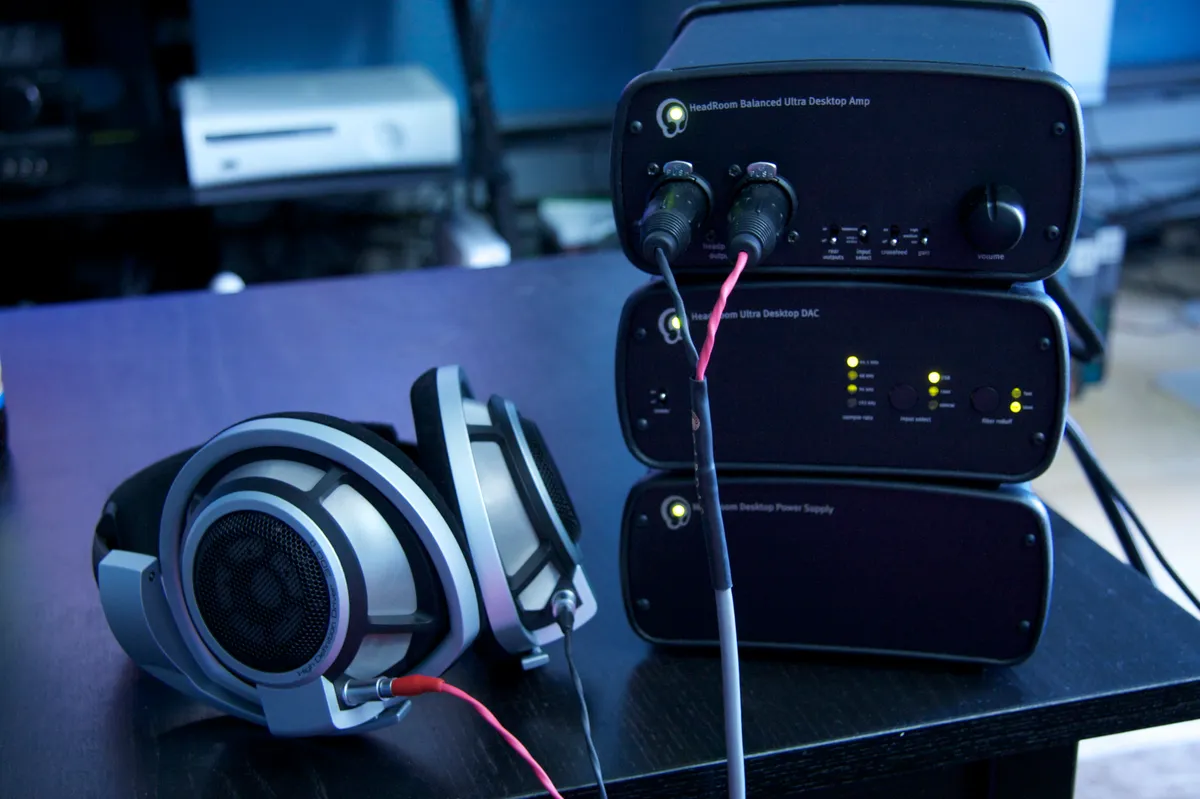
Desktop DAC/amp listening setup — Wikimedia Commons
Key Specs That Actually Affect Pairing
Marketing sheets list chip names; buyers need power, noise, and impedance behavior. FiiO’s published figures (verify on FiiO’s K7 parameters page before purchase):
| Spec | 6.35 mm single-ended | 4.4 mm balanced |
|---|---|---|
| Output power (THD+N < 1%) | ≥1,220 mW per channel @ 32 Ω | ≥2,000 mW per channel @ 32 Ω |
| Output power @ 300 Ω | ≥140 mW per channel | ≥560 mW per channel |
| THD+N (typical lab condition) | < 0.0003% @ 1 kHz, 32 Ω | Similar ultra-low distortion class |
| Output impedance | < 1 Ω | < 1 Ω |
| Recommended headphone Z | 16–300 Ω (manufacturer guidance) | Same |
How to read this table:
- 32 Ω power matters for planars and many modern dynamics — the K7 has headroom to spare.
- 300 Ω power matters for Sennheiser HD 600/650/660S-class headphones that need voltage, not just current. The balanced path’s 560 mW @ 300 Ω is the spec that separates “loud enough” from “controlled and dynamic.”
- Output impedance under 1 Ω is good for IEMs and multi-driver designs — use low gain first.
USB playback supports PCM 384 kHz / 32-bit and native DSD up to DSD256 on the XMOS path. Optical and coaxial inputs cap at lower rates (192 kHz / 24-bit coax; 96 kHz / 24-bit optical per FiiO docs) — fine for TV, old consoles, and disc transports.
Build, Design, and Desk Ergonomics
The K7 chassis is CNC aluminum, roughly 120 × 168 × 55 mm and ~610 g — heavier and longer than the K5 Pro ESS, but still one-box tidy compared with separate DAC + amp stacks. The front panel centers on a large volume knob surrounded by an RGB ring that indicates sample rate (blue for standard PCM, yellow for high-rate PCM, green for DSD) and plays animated light effects on power/input changes. Love it or hate it, the ring is functional, not purely cosmetic.
Rear and side connectivity is practical for a desktop:
- USB-B for PC/Mac (driverless on macOS; Thesycon driver optional on Windows)
- Optical and coaxial for TVs, consoles, or a transport
- RCA line in for analog sources (turntable with phono stage, older CD player, etc.)
The three-position output switch is more useful than it looks:
- HP — routes the volume-controlled signal to headphone jacks.
- LO — fixed-level RCA out to feed a separate power amp or powered monitors with their own volume control.
- PRE — volume-controlled RCA out for active speakers or amps without gain knobs.
That flexibility lets the K7 anchor a desk even if you later add powered monitors — a nuance many “headphone only” combos skip.
Tradeoffs are honest: no remote, no Bluetooth on the base K7, and an external power brick that adds cable clutter. If your desk is minimalist and wireless-first, this is the wrong product — wireless ANC headphones like the Sony WH-1000XM5 or Bose QuietComfort Ultra already include their own DAC/amp chain; this review is for wired listening.
Sound Character — What Changes vs Your Laptop Jack
The K7 is not a “warm tube glow” box. Dual AK4493SEQ DACs lean natural and slightly musical in FiiO’s tuning — community impressions and measurement-focused forums (Head-Fi, Audio Science Review threads) generally describe low noise, stable imaging, and neutral-to-gently smooth treble rather than harsh brightness.
What you should expect when upgrading from a phone, laptop, or cheap dongle:
Noise floor and IEM use
On low gain, reported noise floors in the microvolt range translate to silent backgrounds with sensitive IEMs — a real upgrade over noisy motherboard 3.5 mm jacks. If you hear hiss, check gain, source volume, and balanced vs single-ended cabling before blaming the amp.
Dynamics and control on hard-to-drive headphones
On HD 600-class 300 Ω headphones or moderate planars, the balanced output typically delivers tighter bass, better macro-dynamics, and more headroom than single-ended — not because balanced is magic, but because the K7’s fully differential path and higher balanced power spec are what you paid for. Running those same headphones single-ended still works; you just leave performance on the table.
DAC coloration vs bottleneck removal
The K7 will not fix a bad recording or make $80 headphones sound like electrostatics. It removes power and noise bottlenecks and gives you a stable, measured desktop source. If your problem is tonality (too dull, too sharp), try EQ in your player or different pads/cables before buying another DAC.
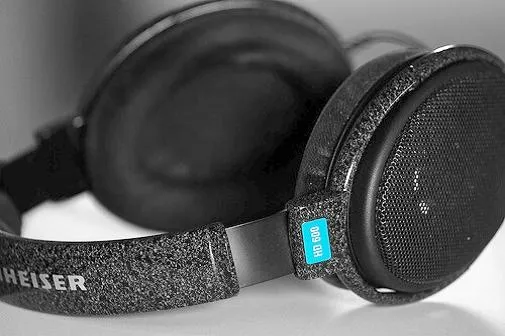
Reference-grade wired headphones — Wikimedia Commons
Who Should Buy the FiiO K7?
Strong fits
- Balanced-cable owners — If you already run 4.4 mm on HiFiMAN Sundara/Edition XS, many Focal/Dynamic pairs with aftermarket cables, or balanced IEMs, the K7 is the price/performance anchor in FiiO’s line.
- 300 Ω dynamic listeners — HD 600/650/660S, Beyerdynamic DT 880/990 (with appropriate balanced cable), and similar benefit from voltage headroom on the 4.4 mm port.
- Multi-source desks — USB for a MacBook Air M4 or PC, optical from a TV, coax from a transport — all into one volume knob.
- Stack-curious but stack-shy — You want K9 Pro amplifier topology (THX AAA 788+) without flagship pricing, and accept fewer extras.
Who should skip (or buy something else)
| Profile | Better direction |
|---|---|
| Single-ended only, no cable plans | FiiO K5 Pro ESS — stronger SE power per dollar |
| Bluetooth + remote on the desk | FiiO K7 BT or Topping DX3 Pro+ class |
| Travel / phone-only listening | USB-C dongle or portable DAC — not a desktop brick |
| Already own a great DAC | Dedicated amp stage; don’t pay for duplicate DAC |
| Wireless ANC as primary cans | Skip desktop amps entirely — see wireless reviews above |
This FiiO K7 review is intentionally blunt on that last row: desktop amps help wired chains. They do not upgrade Bluetooth headphones you never plug in.
FiiO K7 vs K5 Pro ESS — The Decision Most Buyers Face
FiiO’s own comparison sheet makes the fork clear. These are sibling products, not “old vs new” in a straight line.
| K5 Pro ESS | FiiO K7 | |
|---|---|---|
| Typical street price | ~$149–170 | ~$199–230 |
| DAC | Single ESS ES9038Q2M | Dual AK4493SEQ |
| Amp | Proprietary high-power stage | Dual THX AAA 788+ |
| Balanced headphone out | No | Yes (4.4 mm) |
| SE power @ 32 Ω | ≥1,250 mW | ≥1,220 mW |
| Balanced power @ 32 Ω | — | ≥2,000 mW |
| Gain steps | Three (H/M/L) | Two (L/H) |
| Remote | Optional accessory ecosystem | None |
Rule: If you will never use 4.4 mm balanced headphones, the K5 Pro ESS is the rational save — you gain a mid gain step and slightly higher advertised single-ended power. If balanced is part of your present or planned setup, the K7 is the correct buy even though single-ended specs look similar on paper.
FiiO K7 vs K7 BT vs Topping DX3 Pro+
K7 vs K7 BT: Same core analog performance family; BT adds wireless convenience and app features. If you stream from a phone across the room, pay the BT premium. If the K7 sits wired under a monitor, save money with the base K7.
K7 vs Topping DX3 Pro+ (~$149 class): Topping wins size, Bluetooth LDAC, and remote on many listings. The K7 wins balanced headphone output, higher power into demanding loads, and the PRE/LO/HP routing flexibility. They serve different desks — not a simple “which measures better” contest for typical 300 Ω dynamics, where both often sound “enough” if level-matched.
K7 vs separate stack (DAC + amp): Stacks shine when you want independent upgrade paths. The K7 is for listeners who value one power supply, one knob, and proven integration over modularity.
Setup Tips (Windows, macOS, and Gain Discipline)
- Start on low gain with IEMs; switch to high gain only when volume runs out around 2–3 o’clock on hard-to-drive cans.
- macOS — USB audio is typically plug-and-play; set sample rate in Audio MIDI Setup if you chase bit-perfect playback.
- Windows — FiiO/Thesycon drivers optional; many users run UAC2 driverless. Install official drivers if you need specific ASIO behavior.
- Firmware — Watch FiiO’s download page for XMOS updates; occasional fixes matter for niche USB hosts.
- Balanced cables — Buy from reputable brands with correct pinout for your headphone model; a bad cable causes silence or channel imbalance, not “DAC failure.”
- PRE vs LO — Use LO into a power amp; use PRE into active speakers that expect a volume-controlled source.
Pros and Cons (Owner-Realistic)
| Pros | Cons |
|---|---|
| True balanced 4.4 mm with 2 W-class headroom @ 32 Ω | No wireless on standard K7 |
| Dual AK4493SEQ + THX AAA 788+ at ~$200 | Weaker SE value vs K5 Pro ESS |
| Excellent noise performance for IEMs on low gain | RGB ring may distract minimalist desks |
| Multiple digital + analog inputs | External PSU adds clutter |
| PRE/LO/HP modes extend lifespan in a system | No balanced XLR line-out |
FAQ
Is the FiiO K7 the same as the FiiO K7 BT?
No. The K7 BT adds Bluetooth (including LDAC) and app control. The base K7 reviewed here is wired-only and usually costs less.
Does the FiiO K7 need drivers on Windows?
Often works driverless via USB UAC2. FiiO provides Thesycon drivers if you need them for specific playback modes.
Is the FiiO K7 worth it for HD 600 / HD 650?
Yes if you use balanced 4.4 mm — the 300 Ω power spec is where the K7 earns its price. Single-ended still works, but you compete with cheaper FiiO options.
Can the FiiO K7 power planar magnetic headphones?
Generally yes for mid-tier planars (Sundara, Edition XS, many ~32 Ω planars). Exotic low-sensitivity flagships may want more voltage/current — check your model’s sensitivity and impedance first.
FiiO K7 vs K5 Pro ESS — which should I buy?
K5 Pro ESS for single-ended-only setups on a budget. K7 if balanced 4.4 mm is in play now or soon.
Does balanced always sound better?
Not automatically. On the K7, balanced is the properly implemented high-power path — the reason to buy this SKU. On some cheap gear, “balanced” is cosmetic wiring.
Can I use the K7 with powered speakers?
Yes. PRE mode sends a volume-controlled signal to active monitors; LO feeds a fixed-level line to a power amp.
Will the K7 fix quiet Bluetooth headphones?
No. Bluetooth headphones use their internal electronics. The K7 is for wired analog headphones or line-level routing.
What sample rates do the RGB colors indicate?
FiiO uses blue for standard PCM (44.1/48 kHz), yellow for high-rate PCM, and green for DSD — handy sanity-checking, not an audiophile feature in itself.
Is this medical or financial advice?
No — this is audio gear guidance. Prices and firmware change; confirm on FiiO’s site and authorized retailers before buying.
Verdict
The FiiO K7 remains one of the most rational ~$200 desktop upgrades in 2026 for wired listeners who can use 4.4 mm balanced headphones. Dual AK4493SEQ DACs and THX AAA 788+ amplification deliver measured, low-noise performance with real headroom into both 32 Ω and 300 Ω loads — the combination that makes HD 600-class and planar setups feel “properly fed” instead of merely loud enough.
It is not the universal desktop DAC/amp: single-ended-only buyers should save with the K5 Pro ESS, Bluetooth-first desks should look at K7 BT or compact Topping units, and wireless-only headphone owners should ignore desktop amps altogether. Within its lane, though, the K7 is the balanced baseline FiiO designed it to be — and the clearest answer to “what next after dongle hell?” in our amp reviews cluster.
Score: 8.6/10 — Best Balanced Desktop DAC/Amp Under $250