Pros
- Transparent Glyph aesthetic with real glass back and IP64 upgrade over Phone (2a)
- 50MP main plus 50MP 2x telephoto at ~$379 — rare in sub-$400 Android
- 6.77-inch 120Hz OLED with 3,000-nit peak brightness and LTPO-style 30–120Hz range
- 5,000mAh battery with 50W wired charging and strong day-two endurance
- Three major Android OS updates and six years of security patches promised
Cons
- US sales still tied to Nothing Beta Program; AT&T/Verizon band gaps remain
- Snapdragon 7s Gen 3 is fine for daily use but underwhelms versus Phone (2a) in gaming
- Essential Space and Essential Key are promising but still beta-grade in late 2026
- No wireless charging; ultrawide is an 8MP secondary, not a flagship wide
If you searched nothing phone 3a review after seeing Nothing’s glyph-lit back panels in short-form video, you are looking for a specific product: the Nothing Phone (3a) — the March 2025 midrange Android handset from Nothing Technology Ltd., not the flagship Phone (3) line, not Phone (2a), and not unrelated “transparent phone” clones on marketplaces. This NexReview guide is written in November 2026, more than eighteen months after launch, when street pricing, software maturity, and US availability patterns are easier to judge than on day one.
Nothing Phone (3a) sits where Nothing wants design-led buyers who refuse a boring slab but cannot stretch to $700+ flagships. It ships with Nothing OS 3.1 on Android 15, adds an Essential Key for AI-assisted note capture, and keeps the smaller Glyph Interface strip from Phone (2a) rather than the full-back LED matrix of Phone (1) and Phone (2). Pair it in your head with ecosystem accessories — our Nothing Ear Open review covers the open-ear hooks that match this industrial design language — but treat the phone as its own SKU with its own compromises.
Design-led smartphone context — Wikimedia Commons
Nothing Phone 3a Review Snapshot (November 2026)
| Question | Short answer |
|---|---|
| What is it? | Midrange Android phone — Phone (3a) base model in the 3a series |
| Launch | Preorders 4 March 2025; open sale 11 March 2025 |
| US price (verify live) | $379 for 12GB RAM / 256GB at nothing.tech (Beta Program) |
| UK/EU entry | £329 / €329 for 8GB / 128GB; 12/256 at £379 / €379 |
| Chipset | Qualcomm Snapdragon 7s Gen 3 (4 nm) |
| Display | 6.77-inch flexible AMOLED, 2392×1080, 30–120Hz, up to 3,000 nits peak |
| Cameras | 50MP main (OIS) + 50MP 2x tele + 8MP ultrawide; 32MP selfie |
| Battery / charge | 5,000mAh; 50W wired; 7.5W reverse wired |
| Durability | IP64; glass backplate (upgrade from 2a plastics feel) |
| Software pledge | 3 OS upgrades (to Android 18 class) + 6 years security updates |
| Sister SKU | Phone (3a) Pro — periscope tele, brighter sensors, higher MSRP |
| NexReview score | 8.3/10 — standout design and cameras for the money; US friction and gaming hold it back |
Editorial stance: Most nothing phone 3a review pieces in 2025 celebrated the spec jump from Phone (2a). In 2026, the fair question is durability of Nothing’s update track record, whether Essential Space became indispensable or ornamental, and whether carrier-limited US distribution still makes sense beside discounted Google Pixel 9 Pro tiers and mainstream Samsung A-series promos.
What Is the Nothing Phone (3a)?
Nothing launched Phone (3a) as the affordable half of a two-phone wave alongside Phone (3a) Pro. Both share the same core platform: Snapdragon 7s Gen 3, 6.77-inch high-brightness OLED, 5,000mAh cell, 50W charging, stereo speakers, in-display fingerprint reader, NFC, Wi-Fi 6, Bluetooth 5.4, and dual nano-SIM 5G. Differentiation is mostly camera hardware, Pro-only grey colorway, a heavier chassis on Pro, and telephoto reach (2x on 3a vs 3x periscope on Pro).
The (3a) is the phone Nothing positions against Galaxy A36-class and Motorola G Power pricing while stealing telephoto features from phones that usually stop at main + ultrawide under $400. Tom’s Guide and Android Central both noted that trajectory at launch: at $379, you are paying $30 more than Phone (2a)’s introductory US price, but you gain Qualcomm silicon (replacing MediaTek on 2a), brighter glass-backed build, IP64, and a proper short tele module.
Colors at launch: White, Black, and Blue (Blue not in every region). US buyers typically see 12GB/256GB only through Nothing’s store — no 128GB tier domestically.
Naming hygiene: Retailers write “Nothing Phone 3a,” “Phone (3a),” and “Nothing Phone (3a)” interchangeably. All mean this midrange 2025 model. Do not confuse it with Nothing Phone (2) or Phone (2a Plus, which are older generations with different camera stacks and no Essential Key.
Design, Build, and Glyph Interface
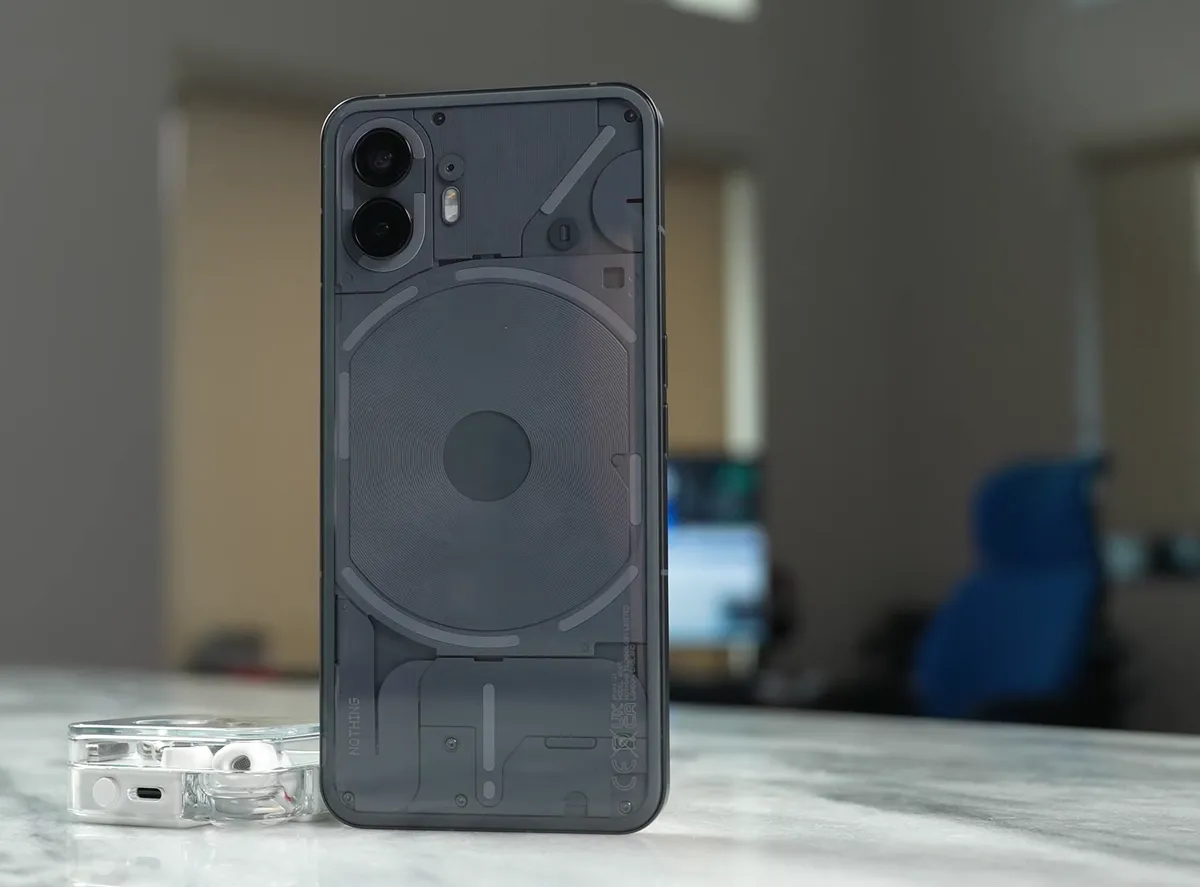
Nothing’s identity is semi-transparent materials, precise typography, and the Glyph Interface — programmable LEDs that visualize notifications, charging, timers, ringtones, volume steps, and music playback. On Phone (3a), the Glyph zone is the compact three-zone strip inherited from Phone (2a), not the expansive rear layout on Phone (1)/(2). That is a conscious trade: lower manufacturing complexity at this price, still enough surface for Glyph Composer custom alert melodies and third-party hooks (Uber, Zomato, Google Calendar integrations showed up in Nothing OS settings during 2025 reviews).
The back now uses glass with improved scratch resistance versus the all-polycarbonate feel of 2a. IP64 means dust tight and splash resistant — not swim-safe. Treat it as “rain and pocket lint,” not pool photography. Weight lands around 201 g; the phone is tall (163.5 mm) but not unwieldy for one-handed scrolling with reachability gestures enabled.
On the right edge, below the power button, sits the Essential Key — a glossy physical control that Nothing treats as seriously as a camera shutter on other brands. It is the hardware entry point for Essential Space (covered below). Combined with flat aluminum sides and rounded corners, the in-hand vibe is closer to a pocketable gadget from a boutique label than a carrier rebate special.
Glyph at night: Nothing OS lets you schedule Glyph off-hours. If you sleep beside a partner, do that on day one — default medium LED brightness is genuinely piercing in a dark room.
Transparent industrial design — Wikimedia Commons
Display: Bright Enough to Matter Outdoors
The 6.77-inch AMOLED panel is a headline upgrade from Phone (2a): LTPO-style adaptive refresh between 30 Hz and 120 Hz, HDR10, claimed 1,300 nits high-brightness mode, and 3,000 nits peak for HDR highlights — more than double 2a’s advertised ceiling in Nothing’s launch materials. Resolution stays 1080p-class (2392×1080, ~388 ppi) — sharp enough for social video and mobile games, not pixel-dense like a Pixel 10 Pro panel.
PWM dimming at 2,160 Hz targets flicker-sensitive users; your eyes may still prefer higher brightness indoors over minimum dim settings. Touch sampling ramps to 480 Hz normally and 1,000 Hz in gaming mode — meaningful for rhythm games even if the SoC cannot sustain 120 fps in heavy 3D titles.
Color tuning in Nothing OS leans neutral with optional saturation boost. Nothing ships without aggressive blue-light marketing modes; use Android’s built-in extra-dim and bedtime schedules if night reading matters.
Performance: Snapdragon 7s Gen 3 in Daily Life
Nothing moved Phone (3a) to Snapdragon 7s Gen 3, claiming roughly 33% general performance and 92% AI task uplift versus Phone (2a)’s MediaTek Dimensity platform. In Geekbench terms repeated across 2025 reviews, single-core gains were modest (~5%) — the chip is efficient, not explosive. The CPU mixes Cortex-A720 performance cores with A520 efficiency cores; Adreno 710 handles GPU duties.
What feels fast: App launches, Chrome tab churn, Instagram/export pipelines, Essential Space transcription, and camera processing. What feels mid: Extended Genshin Impact or Honkai sessions, where Phone (2a) oddly held its own or won in some GPU-bound scenes according to Android Central’s head-to-head — thermal throttling and driver maturity matter as much as spec slides.
You get 8GB or 12GB LPDDR5X RAM depending on region; US buyers typically live with 12GB, which helps Nothing’s RAM retention and multi-window Android 15 features. Storage is UFS 128GB or 256GB — not expandable. Plan cloud offload for 4K telephoto clips once you enable later 4K telephoto video updates Nothing pushed in spring 2025 changelogs.
For buyers comparing flagship silicon, this is not iPhone 16 Pro terrain. It is smoother than many $299 carrier promos with older midrange chips, and cooler than those phones during navigation plus podcast playback — the 7s Gen 3’s sweet spot is always-on lifestyle, not mobile esports.
Camera System: Telephoto Is the Story
Main 50MP sensor
The primary camera uses a 50MP Samsung sensor around 1/1.57-inch class with f/1.88, OIS, and PDAF. Daylight shots show the high-contrast Nothing look: crisp edges, slightly cool white balance, good dynamic range for price. Night mode stacks frames aggressively; under streetlamps, later Nothing OS builds (April 2025 onward) specifically mention reduced flicker and improved tele low light — install security patches before you judge night tele.
50MP 2× telephoto
This is Phone (3a)’s competitive wedge. A 50MP f/2.0 tele with 2× optical reach beats crop-zoom main cameras on most sub-$400 rivals. Portrait mode uses depth mapping from the tele + main pair; skin tones stay natural if you avoid beauty sliders cranked to maximum.
8MP ultrawide
The 120° ultrawide is the weak leg — resolution and low-light noise trail the main and tele. Use it for group shots and architecture, not moon photos. Pro model buyers get better sensor sizing; if ultrawide quality is non-negotiable, compare Pro pricing before you commit to base 3a.
Front 32MP
Selfies are sharp for video calls and creators; firmware notes from Nothing mention improved facial detail in 2025 updates. There is no autofocus on the base selfie module — arm’s-length vlogging is fine; macro face close-ups may soften.
Video
Main and ultrawide record 4K30 at launch; community changelogs added 4K on the telephoto module post-release — verify your build. Electronic stabilization on tele is acceptable for walking vlog pace, not action cam replacement.

Android smartphone in use — Wikimedia Commons
Battery, Charging, and Thermals
5,000mAh is the modern Android baseline done right. Mixed 2025–2026 reviewer loops — 120 Hz, 5G on, two hours of screen-on camera and maps — land around full-day-plus with 20–30% evening reserve. Nothing’s 50W wired charging hits majority fill in under an hour with the bundled or certified adapter; there is no wireless charging, which separates it from some Samsung midrangers.
7.5W reverse wired via USB-C can rescue earbuds or a friend’s dead phone slowly. Thermals during 50W top-ups warm the lower back — normal for this class. Gaming heat concentrates near the camera bump; a case improves grip more than cooling.
Nothing OS, Essential Key, and Essential Space
Nothing OS 3.1 on Android 15 keeps the monochrome launcher, dot-matrix widgets, and restrained bloat — no third-party app folder dumps like some carrier SKUs. Nothing’s update pledge (3 OS + 6 years security) matches or beats many peers near $379 and matters if you keep phones four-plus years.
Essential Key workflows
- Long press on home/lock screen: start a voice memo routed to Essential Space with transcription and AI summaries (Nothing account required for full analysis).
- Long press in other apps: screenshot capture with haptics.
- Continue holding after screenshot: attach spoken notes to the capture.
- Double tap: jump into Essential Space to review items.
Essential Space in 2026
Essential Space is Nothing’s bet that physical capture beats yet another chatbot icon. It clusters screenshots, voice notes, and extracted reminders — e.g., surfacing expiry dates from coupon images. Android Central’s launch review called it “very cool, albeit less useful than initially hoped.” By late 2026, Play Store-side Essential Space updates added reminder editing and faster analysis, but it still starts from Essential Key captures — you cannot spawn a blank note entirely in-app per early documentation.
Privacy-conscious users should note cloud AI processing when logged into a Nothing account. If you refuse account linkage, you lose intelligent summaries but keep local capture.
Other notable OS additions from 2025 changelogs: Privacy Space in the app drawer, hotspot manager, separate privacy passwords for app locker, and 50MP filter support on stills — small quality-of-life pieces that add up.
US Availability and Carrier Reality
The elephant in every nothing phone 3a review for American readers: distribution. Nothing still routes US buyers through its Beta Program store flow as of our 2026 check because missing LTE/5G bands on AT&T and Verizon remain unresolved in launch documentation. Review units on T-Mobile reported stable 5G; your mileage on MVNOs depends on profile support.
That friction pushes pragmatic shoppers toward Pixel A-series or Samsung deals you can buy at Best Buy with instant SIM swap. Nothing wins when you value design + telephoto and accept direct-ship wait times plus potential service-center unfamiliarity.
International buyers in UK, EU, and India get broader colorways and the 8/128 price ladder. India also carried distinct RAM/storage SKUs at launch — confirm SKUs if you import.
Phone (3a) vs Phone (3a) Pro — Which Nothing?
| Feature | Phone (3a) | Phone (3a) Pro |
|---|---|---|
| US MSRP (12/256) | $379 | $459 |
| Telephoto | 50MP 2× | 50MP 3× periscope |
| Main sensor tier | Samsung 1/1.57" class | Larger / dual-pixel PDAF spec |
| Selfie | 32MP | 50MP |
| Weight | 201 g | 211 g |
| Colors | White, Black, Blue (region) | Grey, Black |
Choose 3a when $80 matters and 2× portraits satisfy you. Choose Pro for 3× concert zoom and selfie vlogging headroom — but recognize both share the same SoC and display, so performance parity remains.
Who Should Buy — and Who Should Skip
Good fit
- Design-first Android users tired of anonymous black rectangles
- Photographers who want optical tele under $400
- T-Mobile US customers comfortable ordering direct from Nothing
- Owners pairing with Nothing Ear Open for a matched ecosystem aesthetic
- Students needing big battery + bright screen without financing a flagship
Skip if
- You need Verizon/AT&T simplicity day one
- Mobile gaming performance is your primary metric
- Wireless charging and IP68 swimming confidence are must-haves
- You want mature AI assistants out of the box — Essential Space still trails Google’s on-device Gemini depth on Pixel phones
FAQ
Is this Nothing Phone 3a review about the Phone (3) flagship?
No. Phone (3) is Nothing’s higher-tier line. Phone (3a) is the midrange March 2025 model with Snapdragon 7s Gen 3 and a smaller Glyph strip.
How much does the Nothing Phone (3a) cost in 2026?
US MSRP launched at $379 for 12GB/256GB. Regional promos vary — check nothing.tech before buying. UK/EU still list £329 / €329 entry configs when in stock.
Does Nothing Phone (3a) work on Verizon or AT&T?
Nothing’s launch guidance warned that full band support for AT&T and Verizon was incomplete, pushing US buyers toward the Beta Program and T-Mobile-friendly configurations. Confirm current band lists and community reports for your exact MVNO before you order.
How many software updates does Phone (3a) get?
Nothing promises three major Android OS upgrades (through the Android 18 generation) and six years of security patches — competitive for a $379 phone if Nothing executes on schedule.
What is the Essential Key on Phone (3a)?
A dedicated side button for screenshots, voice memos, and quick entry to Essential Space — Nothing’s AI-organized notes hub — without opening a separate assistant app first.
Does Phone (3a) have wireless charging?
No. Charging is 50W wired USB-C with 7.5W reverse wired output.
How is Phone (3a) different from Phone (2a)?
3a upgrades the SoC to Snapdragon 7s Gen 3, adds glass back, IP64, brighter 6.77-inch display, 50MP 2× telephoto, Essential Key, and faster 50W charging. 2a used MediaTek silicon and lacked the tele module and Essential hardware.
Is the Glyph Interface the same as on Nothing Phone (2)?
No. 3a uses the narrow three-LED Glyph strip like Phone (2a), not the full-back Glyph matrix from Phone (2).
Can Nothing Phone (3a) replace a Pixel for camera purists?
For zoom and fun, it competes well near $379. For computational HDR, Night Sight consistency, and on-device Google AI, a Pixel A-series or older Pixel 9 Pro discount still wins — especially if you need carrier retail support.
Where should I buy Phone (3a) in the US?
Through Nothing’s official store (Beta Program flow) — not typical carrier installment plans. Avoid third-party listings that confuse 2a, 3a, or Pro SKUs.
Final Verdict
After eighteen months on the market, Nothing Phone (3a) earns its niche: it is one of the few sub-$400 Android phones that feels intentionally designed, ships a credible 2× telephoto, and brightness-bombs outdoor readability without pretending to be a flagship killer. Snapdragon 7s Gen 3 is adequate, not thrilling; Essential Space is clever hardware in search of daily habit; US distribution still punishes anyone outside T-Mobile-friendly setups.
We rate it 8.3/10 — a strong design and camera-value pick for patient buyers, docked for gaming headroom and stateside availability. If Nothing ever lands full US carrier band support at retail, the score likely ticks upward without changing a single camera lens.
Pair the phone with open-ear Nothing Ear Open buds if you are building a cohesive kit; compare pocket cameras against discounted Pixel 10 Pro pricing if pure imaging pipelines matter more than Glyph light shows. Either way, confirm you are ordering Phone (3a) — the real midrange SKU — not a lookalike transparent case on a unrelated brand.