Pros
- 230+ unique project cards create genuinely different corporate engines every session
- Global parameters tie every player to the same Mars timeline without direct combat
- Corporate Era in the base box adds asymmetric corporations and a deeper default mode
- Milestone and award races add sharp mid-game interaction on an otherwise parallel puzzle
- Solo Corporate Era mode is a complete experience, not a tacked-on variant
Cons
- First teach routinely exceeds two hours with four or five newcomers
- Player boards and cubes feel utilitarian compared with modern premium productions
- Animal and microbe tracking slows turns once engines get complex
- Card draw luck can decide tight games unless your group drafts
- Table footprint and generation length punish cramped weeknight schedules
Terraforming Mars is Jacob Fryxelius’s corporate sci-fi engine-builder — a competitive tabletop game where rival CEOs raise temperature, oxygen, and ocean coverage on the Red Planet while stacking project cards that turn steel into cities, jovian moons into income, and microbes into end-game points. This Terraforming Mars board game review (updated September 2026) covers how generations and global parameters work, why Corporate Era belongs in every first session, who should buy Prelude immediately, and whether the 2016 Stronghold Games release still earns a top-ten BoardGameGeek slot next to newer euros like Ark Nova.
If you searched for a terraforming mars board game review because a friend mentioned “trading three heat for a temperature bump,” you are in the right place. This is Terraforming Mars (2016) from FryxGames, distributed in North America by Stronghold Games — not the unrelated mobile city-builder called TerraGenesis, not the upcoming Shadowlands Terraforming Mars reboot on Kickstarter, and not any Mars video-game strategy spin-off. Same red planet, different boxes.
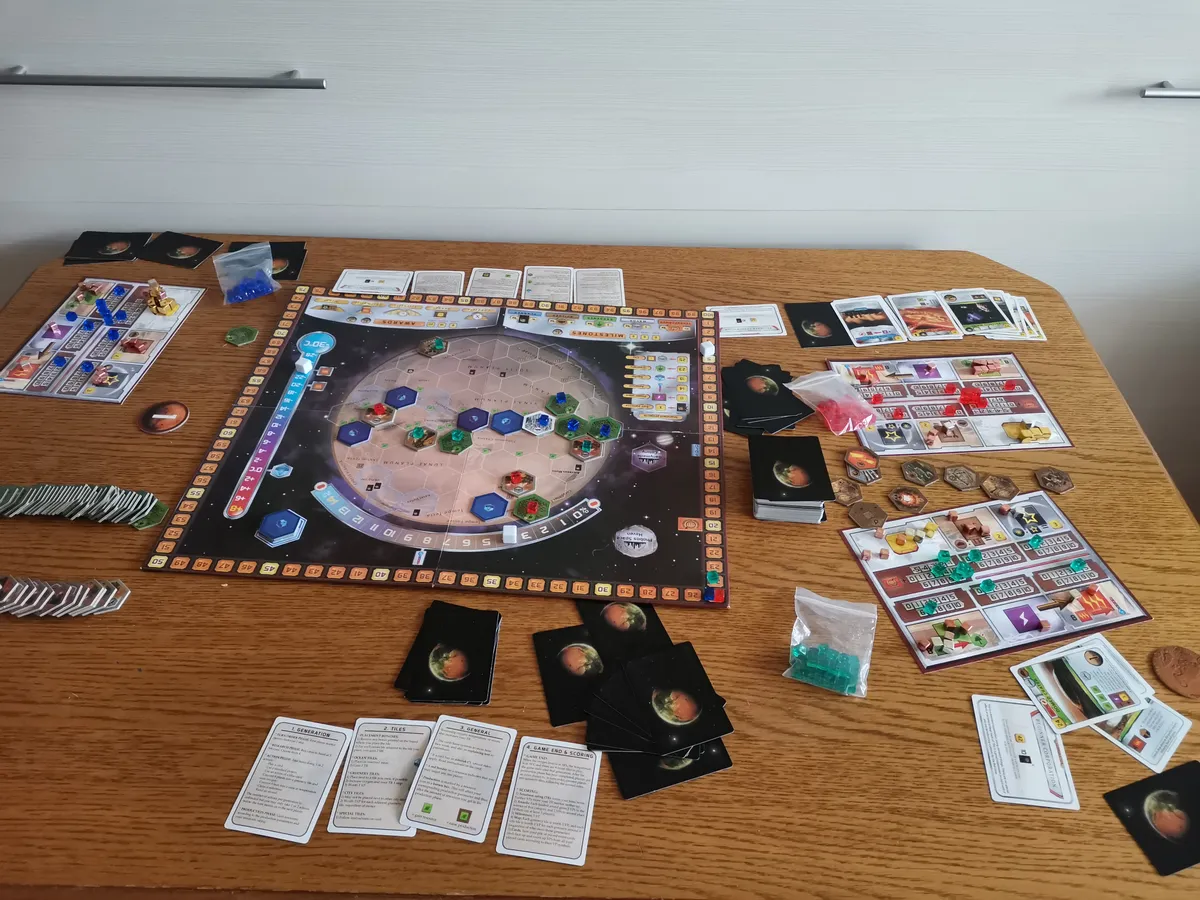
Terraforming Mars on the table — photo via Wikimedia Commons
Quick Verdict (For Skimmers)
| Field | Detail |
|---|---|
| Designer | Jacob Fryxelius |
| Publisher | FryxGames / Stronghold Games (US) |
| Players | 1–5 (solo Corporate Era supported) |
| Play time | ~90–120 minutes (Corporate Era often 150+ with newcomers) |
| Age | 12+ |
| Type | Heavy card-driven engine-building euro |
| Standout feature | Global parameters + 230+ project cards + asymmetric corporations |
| MSRP | $69.95 USD (Stronghold Games, 2026 listing) |
| NexReview score | 8.8/10 |
Buy it if your group loves planning multi-generation engines, enjoys indirect competition on a shared Mars map, and does not mind cube-pushing once the combo snowball starts. Skip it if you need sub-90-minute weeknight fillers, hate card-draw variance, or want direct confrontation instead of racing milestones.
What Is Terraforming Mars?
Terraforming Mars casts each player as the CEO of a megacorporation sponsored by Earth’s World Government in the 2400s. Mars is cold, airless, and dry. Your job is not purely altruistic: you must contribute to making the planet habitable while outscoring rivals in prestige — measured mostly through Terraform Rating (TR), infrastructure on the surface, awards, milestones, and end-game card bonuses.
Fryxelius, a Swedish economist and game designer, built the system around real planetary science concepts simplified for play: greenhouse gases raise temperature, photosynthesis raises oxygen, ice melts into oceans, and only then can advanced biology thrive. The theme is not pasted on. Card titles reference actual proposed terraforming ideas — asteroid redirection, orbital mirrors, nitrogen import, lichen colonies — and many cards gate behind global parameter thresholds, so the planet’s physical state drives what your hand can do.
Stronghold’s English edition arrived in 2016 and quickly collected mainstream praise (Ars Technica, Polygon, The Guardian) alongside hobby awards. By 2026 the title remains a BoardGameGeek fixture with a weight near 3.27/5 and tens of thousands of ratings — rare longevity for a card-heavy euro that asks three hours on a bad teach night.
Components are functional rather than flashy: a large Mars board with hex ocean and city tiles, player boards tracking six resource types, cardboard markers for temperature and oxygen, three-dimensional resource cubes, milestone and award tiles, and a thick project deck numbering 230+ unique cards in the base box. Art by Isaac Fryxelius and Daniel Fryxelius reads utilitarian-scientific, not cinematic. Insert quality is mediocre; veteran owners sleeve cards and bag cubes within a few sessions.
The base box also includes Corporate Era, originally marketed as an expansion but now the default mode for experienced groups. It adds starting corporations with asymmetric powers and a harsher economy where production begins at zero. If someone tells you Corporate Era is “optional advanced mode,” treat that as outdated advice — it is the game most hobbyists mean when they say Terraforming Mars.
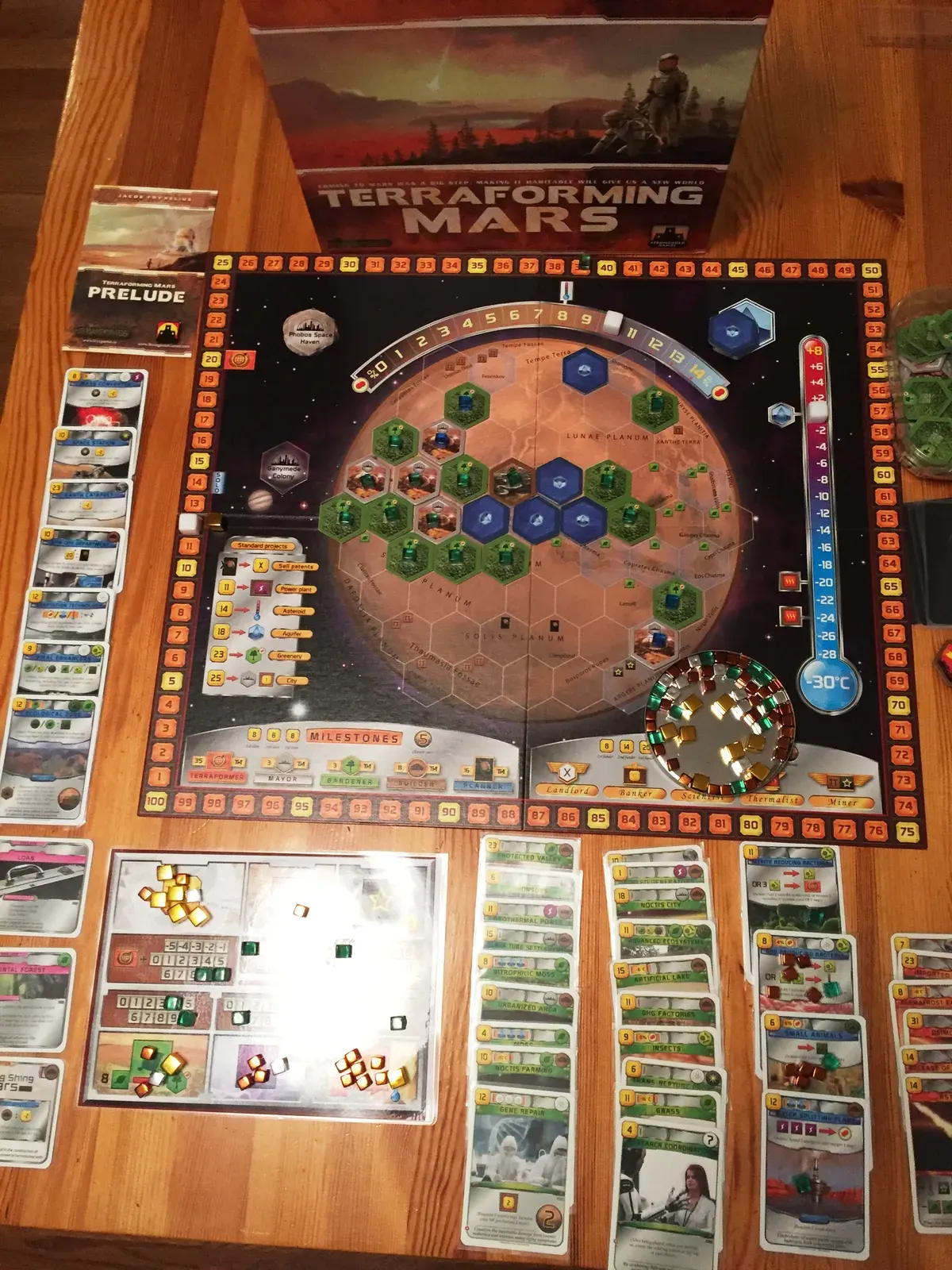
Terraforming Mars with Prelude expansion — Wikimedia Commons
How a Generation Feels (Core Loop)
Understanding the generational rhythm matters more than memorizing every card icon on day one. Terraforming Mars plays out over a series of generations (rounds). Each generation has four phases:
- Player order — determined by TR, with high TR acting first (a catch-up brake that still rewards terraforming).
- Research phase — draw four project cards, optionally buy any of them for 3 megacredits (MC) each, discard the rest.
- Action phase — players take turns performing one action until everyone passes consecutively. Actions include playing a project card, using a standard project, claiming a milestone, funding an award, converting plants into greenery tiles, spending eight heat to raise temperature, or using a card action printed on a played card.
- Production phase — gain MC and resources based on your production tracks, then advance the generation marker.
That loop repeats until all three global parameters hit their maximum: temperature reaches +8°C, oxygen reaches 14%, and nine ocean tiles are placed. The game ends after that generation’s production phase. Final scoring adds TR (which has been rising all game), tile VP, card VP, milestone VP, and award VP.
The Three Global Parameters
| Parameter | Starts at | Goal | Why it matters |
|---|---|---|---|
| Temperature | −30°C | +8°C | Unlocks heat-dependent cards; each step raises everyone’s TR |
| Oxygen | 0% | 14% | Gates advanced plant and animal projects |
| Ocean tiles | 0 placed | 9 on board | Opens coastal bonuses and certain card requirements |
Every time you raise a parameter, your TR increases by the same amount — and TR is both income and points. That dual role is the design’s spine: terraforming is never purely generous because it also pays you. When a parameter maxes out, further raises on that track stop increasing TR, pushing players toward alternate VP engines before the clock stops.
Resources and Production
Six tracked resources define your corporation:
- Megacredits (MC) — currency for cards, milestones, awards, and standard projects
- Steel and titanium — discounts building tags on cards (steel for ground, titanium for space)
- Plants — convert eight plants into a greenery tile that raises oxygen
- Energy — converts to heat at a 1:1 ratio during production
- Heat — spend eight to raise temperature one step
Production markers on your player board compound over generations. A corporation that reaches +5 plant production early will flood the map late even if it did little terraforming in the middle — classic engine-builder satisfaction, and the main reason Terraforming Mars still hooks Wingspan graduates who want more crunch.
Project Cards: The Real Game
If global parameters are the shared clock, project cards are the private puzzle. Each card can represent factories on Io, pets in a biodome, a capital city, or an anti-gravity experiment — and each has a cost, tags, requirements, immediate effects, ongoing production bumps, and sometimes end-game VP.
Tags matter because many cards care about them: building a jovian engine might reward every jovian tag you own; a city might multiply greenery adjacency. Synergy hunting across a hand of purchased cards is where Terraforming Mars earns its reputation as a “crunchy brain-burner.”
Buying vs Playing
Research phase forces a budgeting decision every generation: cards cost 3 MC each to keep, but playing them can cost 0–41+ MC depending on the project. New players hoard purchases and stall; veterans buy selectively and play aggressively. Standard projects — always available actions like selling patents, building a city, or releasing gases — prevent dead turns when your hand misfires.
Requirements and Timing
Many powerful cards require global thresholds (“oxygen must be 6%”) or player state (“must have 3 city tiles”). Holding a card for five generations while you set up its condition is normal. Dumping an unplayable card to avoid paying its upkeep cost next research phase is also normal. Hand management is as important as production math.
Corporations and Corporate Era
Corporate Era deals each player a starting corporation with a unique ability and sometimes a modified starting resource profile. Examples from the base roster include:
- Credicorp — extra MC when you pay for cards during research
- Ecoline — plant production head start for greenery rush strategies
- Mining Guild — steel production and cheaper steel-based builds
- Tharsis Republic — city-focused VP that rewards urban sprawl
Corporations push divergent openings without a full faction system. Two games with different CEOs feel like different routes through the same card pool — essential replay fuel.
Standard beginner rules give each player 1 production of every resource at start. Corporate Era sets production to zero and adds more aggressive economic cards. Play Corporate Era once your table understands basic actions; the zero start punishes sloppy buys and rewards planning.
Milestones, Awards, and Interaction
Terraforming Mars is mostly parallel optimization — you do not attack opponents’ tiles — but milestones and awards inject race tension.
Milestones (three per game, claimable once each) grant 5 VP to the first player who meets a condition — three greenery tiles, three city tiles, three terraform rating steps in one generation, etc. Claiming costs 8 MC and can happen during your action phase if you qualify.
Awards (three per game, fundable once each) score at end-game for whoever leads a category — most tiles, highest heat production, most science tags, etc. Funding costs 8–14+ MC escalating as more awards are funded, and only funded awards score.
Experienced groups fight over Mayor (city tiles) or Landlord (tiles total) while denying opponents cheap milestone claims. Neglecting awards loses tight games; over-funding them starves your engine. That push-pull is Terraforming Mars at its most interactive.
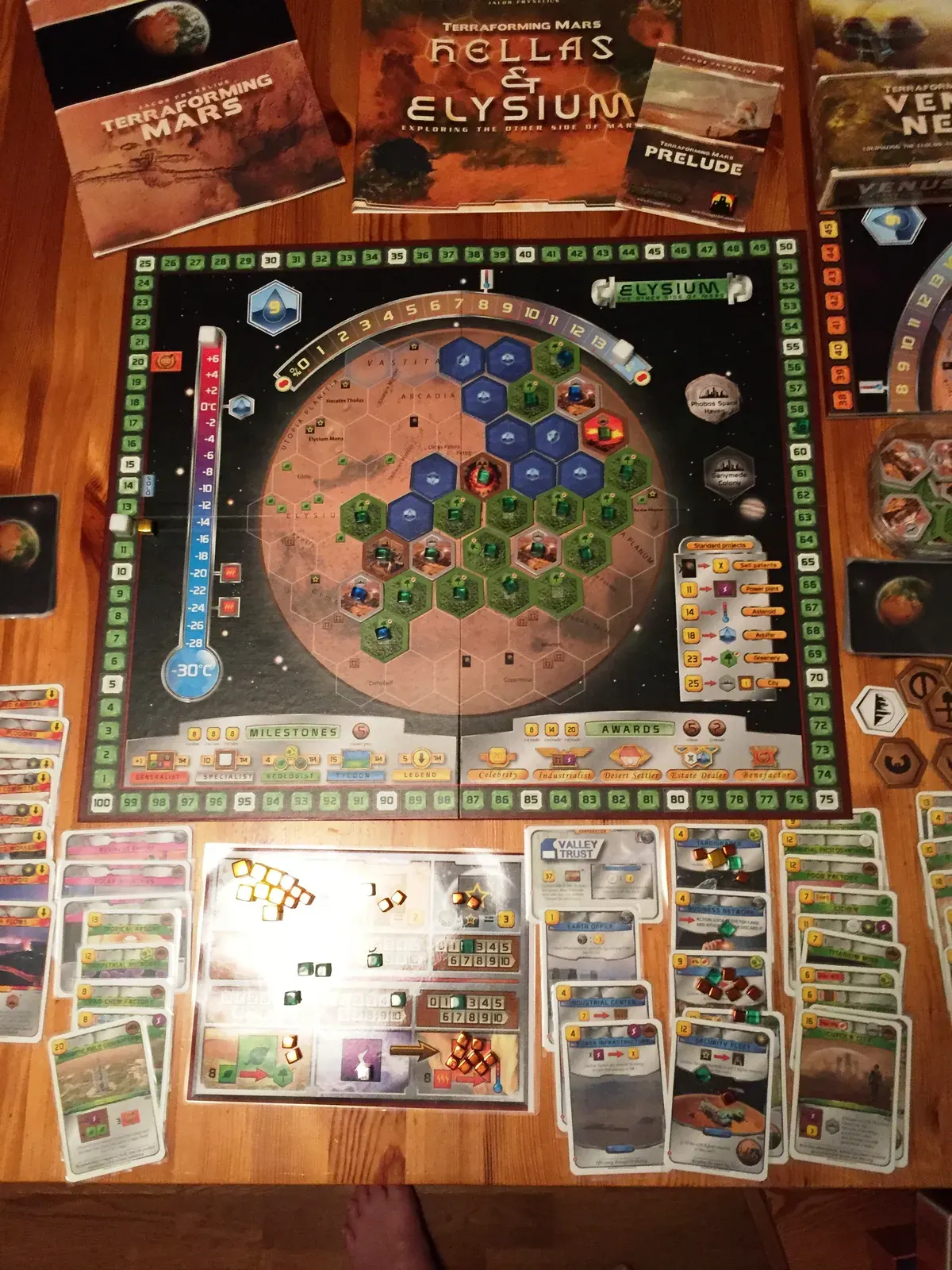
Terraforming Mars with expansions — Wikimedia Commons
Player Count and Pacing
| Players | Experience |
|---|---|
| 1 (solo) | Corporate Era solo: TR starts at 14, 14 generations to max all parameters; tight, excellent puzzle |
| 2 | Fastest multiplayer; less milestone contention, more engine freedom |
| 3 | Sweet spot for many groups — enough race tension, manageable downtime |
| 4 | Strong but action phase lengthens as engines grow |
| 5 | Maximum downtime; budget extra time and consider draft variant |
Solo mode is not an afterthought. You chase a personal score after fully terraforming within the generation limit — a complete brain-burner in 60–90 minutes once fluent. For groups allergic to multiplayer downtime, solo Corporate Era is how many owners learned the card ecosystem.
Teaching Terraforming Mars Without Losing the Table
Rules complexity is the most common complaint in any honest terraforming mars board game review, so teach in layers:
- Win condition — most VP from TR, tiles, cards, milestones, awards after all parameters max
- One action per turn in the action phase until everyone passes
- Research — draw four, buy at 3 MC each
- Global parameters — raising them raises TR (income + VP)
- Production — happens once per generation, not per action
- Tags and requirements — learn by playing, not by lecture
Do not explain every card icon before the first research phase. Run a shortened two-generation teaching script if needed, then restart. First full Corporate Era games with four new players can exceed three hours; warn the table upfront.
Quality-of-Life Upgrades
- Sleeve project cards — the deck sees heavy shuffling
- Separate discard and played-card areas per player
- Phone timer for slow action phases if analysis paralysis appears
- Draft variant — each player drafts four cards before buying; adds ~30 minutes but cuts bad-luck feels
Expansions: What to Buy and When
Six major expansions exist as of 2026. Our priority list for real tables:
Prelude (Essential)
Prelude deals two small prelude cards before the game begins, jump-starting production and trimming early-generation dead air. Most groups never play without it once they try it — games start faster and feel less punishing without removing depth. BoardGameGeek’s community rating for Prelude sits near 8.85, unusually high for an expansion.
Prelude 2 (For Regulars)
Fresh prelude cards and corporations for owners who know the base card pool cold. Buy after a dozen base sessions, not before your first box.
Colonies (Recommended Next)
Adds floating colony tiles and trade fleets that generate alternate income streams. More strategic depth, modest time increase (~15 minutes). Strong for three-player groups who want richer decision space.
Hellas & Elysium (Map Variety)
Two alternate Mars boards with new placement rules and ocean/temperature layouts. Buy when the standard Tharsis map feels solved.
Venus Next (Optional)
Adds a Venus track and more cards. Extends playtime; best for enthusiasts who want maximum card variety.
Turmoil (Niche)
Introduces political parties, turmoil events, and chairman mechanics. Heavier and longer (+30 minutes, weight near 3.68). Only for dedicated groups who want politics layered onto an already dense game.
Budget advice: base box + Prelude covers most players for years. Add Colonies when engines feel familiar; skip Turmoil until you crave new friction.
Terraforming Mars vs Similar Games
| Game | Vibe | Choose it instead when… |
|---|---|---|
| Terraforming Mars | Corporate Mars engine + shared timeline | You want card combos, science theme, indirect racing |
| Ark Nova | Zoo conservation engine | You prefer action-card slots and dual-track scoring over global parameters |
| Wingspan | Bird habitat gateway engine | You need lighter rules and faster teach for mixed groups |
| Spirit Island | Cooperative anti-colonial puzzle | You want teamwork, not VP racing |
| Race for the Galaxy | Simultaneous card tableau | You love card engines but hate turn-by-turn downtime |
| Gaia Project | Heavy space euro on hex map | You want deeper spatial conflict and faction asymmetry |
Terraforming Mars sits between gateway engines and all-evening gaia-level spatial wars. It is heavier than Wingspan, lighter to teach than Ark Nova for some groups (fewer icon systems), and more interactive than pure solitaire-style optimizers because milestones and awards create shared clocks.
Who Should Buy It in 2026?
Perfect For
- Engine-builder fans who enjoy compound production over direct combat
- Sci-fi tables that like plausible Mars rhetoric between turns
- Groups that can schedule 2–3 hour sessions monthly
- Solo players wanting a deep Corporate Era puzzle
- Collectors building a “modern classics” shelf beside Ark Nova and Spirit Island
Not Ideal For
- Casual party-game nights needing 45-minute caps
- Players who hate card-draw variance without draft fixes
- Component snobs expecting Stonemaier-level table presence in the base box
- Groups that need constant direct interaction or negotiation
- Anyone expecting a quick teach for five absolute newcomers on a weekday
Pros and Cons
| Pros | Cons |
|---|---|
| Enormous card-driven replay | Long teach and playtime with new players |
| Theme and science feel integrated | Basic components vs price point |
| Corporate Era adds asymmetry in the box | Cube tracking gets fiddly late game |
| Milestones/awards create sharp races | Card luck can swing tight tables |
| Strong solo mode included | Large table footprint |
Strategy Tips (Without Spoiling Every Combo)
- TR is income and points — early terraforming pays for itself, but pure TR rushes lose to diversified VP if you ignore cards and awards.
- Buy cards with a plan to play them — paying 3 MC to hold dead weight bleeds you across generations.
- Watch the parameter clock — cards gated at 6% oxygen are useless if someone will max oxygen before your engine activates.
- Fund awards you can win, not awards you hope to win — 14 MC wasted on second place hurts.
- Steel and titanium are discounts, not victory — convert production into playable projects, not hoarded cubes.
- Claim milestones before opponents notice — Mayor and Gardener disappear fast in city/plant-heavy metas.
- Draft if swingy hands ruin your group’s fun — the variant is official and smooths variance.
Digital Edition and Future Releases
Asmodee Digital published a Terraforming Mars app and Steam version with cross-platform play. It automates bookkeeping — resource conversion, parameter tracking, card tags — and is excellent for learning icons. Community reviews in 2025–2026 still mention occasional bug patches; treat digital as a teaching lab, not a replacement for cardboard if your group loves table talk.
Shadowlands Games ran a successful Kickstarter for a revised Terraforming Mars edition with updated art and components, targeted around 2026 delivery. That product is separate from the 2016 Stronghold box this review covers. If you already own Fryxelius’s original, you are not obsolete — the core card ecosystem remains the hobby standard until a revised edition proves otherwise in long-term rankings.
Mobile-Friendly Buying Notes
Reading this terraforming mars board game review on a phone? Condensed checklist:
- Confirm MSRP $69.95 but expect street prices near $55–65 USD at online retailers (September 2026)
- Buy the Stronghold/FryxGames base box first — verify Corporate Era contents inside (standard in current prints)
- Add Prelude before Colonies unless you play solo only
- Sleeve the project deck if you play weekly
- Schedule 2+ hours for first Corporate Era teach with three or four players
- Use solo mode to learn corporations without peer pressure
FAQ — Terraforming Mars Board Game Review
Is Terraforming Mars a board game or a video game?
This review covers Jacob Fryxelius’s Terraforming Mars board game (2016), published by FryxGames and Stronghold Games. Digital ports exist, but search intent for “terraforming mars board game review” almost always means the tabletop original.
Is Terraforming Mars worth it in 2026?
Yes — if your group enjoys heavy engine-builders and can tolerate long sessions. It remains a top-ten strategy title on BoardGameGeek for good reason: card variety and corporate asymmetry still feel fresh after dozens of plays.
How long does Terraforming Mars take?
Standard Corporate Era multiplayer runs 90–150+ minutes depending on player count and familiarity. Solo Corporate Era often finishes in 60–90 minutes. First teaches add time.
What player count is best?
Three players hit the best balance of interaction and downtime for most groups. Two is brisk; five is slowest. Solo is excellent.
Should I use Corporate Era for my first game?
Learn basic actions with standard starting production if your table is all new, then switch to Corporate Era for the second session. Most hobbyists consider Corporate Era the real long-term mode.
Is the Prelude expansion necessary?
Not strictly, but nearly every experienced group recommends it. Prelude shortens the early-game slog and is the best expansion value in the line.
Terraforming Mars vs Ark Nova — which should I buy?
Buy Terraforming Mars for Mars sci-fi, global parameter racing, and a mature card pool at lower complexity than Ark Nova. Buy Ark Nova if you want zoo theming, action-card timing, and maximum euro depth in the 2020s style.
Does Terraforming Mars have direct combat?
No. Interaction is indirect — milestone races, award contests, tile placement blocking, and competing for ocean or city spots on the shared map.
Can Terraforming Mars be played solo?
Yes. Corporate Era solo is official: start at TR 14, terraform completely within 14 generations, then score VP. It is one of the better solo modes in modern euros.
Why do people criticize the components?
Player boards are thin, cubes are standard, and art is functional. The design prioritizes card breadth over miniature spectacle. Sleeves and third-party inserts help; component quality does not reflect strategic quality.
Final Verdict
Terraforming Mars endures because it trusts players to build stories out of spreadsheets. Your corporation is not a pre-written campaign — it is the combination of a mining guild opening, a jovian tag engine mid-game, and a desperate award fund on the generation Mars hits 8% oxygen. The global parameters keep everyone staring at the same thermometer, while milestones and awards ensure you are never fully isolated in your engine fantasy.
In 2026 the hobby offers prettier boxes, faster engines, and tighter teach times. Terraforming Mars still earns a shelf slot by delivering unmatched card-combo depth inside a theme that actually constrains your hand. Teach it patiently, add Prelude when you are ready, draft if variance angers your table, and play Corporate Era at three players on a night with no clock. Do that, and this Terraforming Mars board game review ends where most good sessions do — with someone calculating whether eight heat this generation is worth more than funding Landlord.
Score: 8.8/10 — Best Heavy Engine-Builder for Mars-Obsessed Strategists
Related on NexReview
Want more engine-builders after this Mars deep dive? Compare card pacing in our Wingspan board game review, zoo-scale crunch in Ark Nova, and browse the full Game Reviews hub. For PC performance checks when you switch back to digital strategy titles, open NexCheck and NexPass.