Pros
- 128 unique critter and construction cards create genuinely different city engines
- Ever Tree, chunky resources, and Andrew Bosley art sell the woodland fantasy instantly
- Seasonal worker refresh keeps pacing tight without feeling rushed
- Solo Rugwort mode is official, thematic, and better than many dedicated solo boxes
- Expansion line (Pearlbrook, Spirecrest, Bellfaire, Newleaf, Mistwood) scales with your group
Cons
- Exclusive location blocking can frustrate at four players without house rules
- First teach runs long — icon vocabulary and pairing rules need a reference pass
- Analysis paralysis spikes when the Meadow offers too many tempting combos
- Complete Collection storage is a project, not a zip-lock bag affair
- Low direct confrontation — you race in parallel, not attack each other's cities
Everdell is James A. Wilson’s woodland city-builder — a competitive tabletop game where anthropomorphic critters gather twigs, resin, pebbles, and berries across four seasons to erect constructions, recruit workers, and score a flourishing forest settlement before winter returns. This Everdell board game review (updated September 2026) covers how the seasonal worker loop works, why the 2018 Starling Games release still anchors cozy-engine-builder lists, who should buy the base box versus Pearlbrook or The Complete Collection, and where the hobby’s “just pretty Wingspan” takes miss the point.
If you searched for an everdell board game review because a friend posted a photo of a three-dimensional tree stuffed with cards, you are in the right place. This is Everdell (2018) from Starling Games / Tabletop Tycoon — not Everdell: Farshore (the nautical standalone), not Silverfrost (the frost-season standalone), not Everdell Duo (the two-player spin-off), and not the Dire Wolf Digital app adaptation (excellent companion, different product). Same designer family, different boxes.
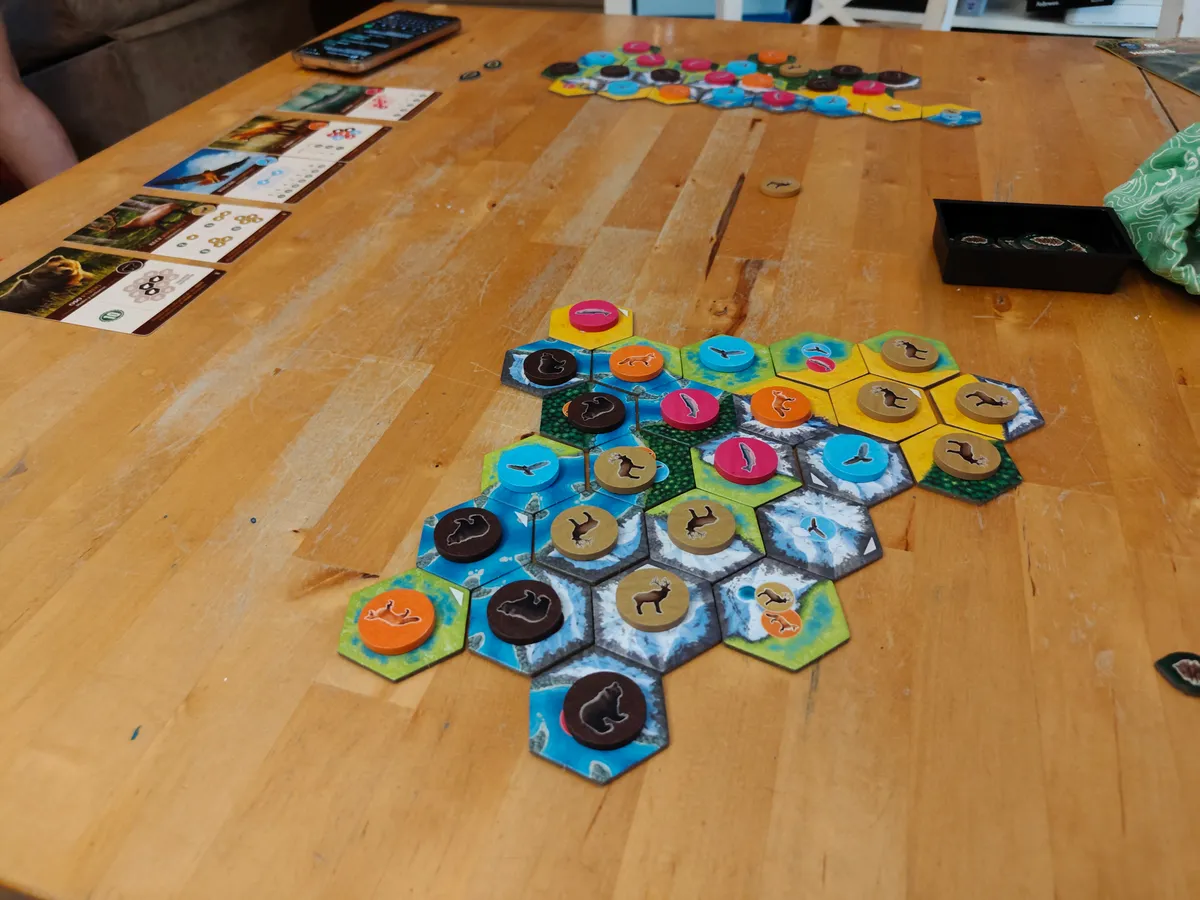
Woodland tabletop atmosphere — photo via Wikimedia Commons
Quick Verdict (For Skimmers)
| Field | Detail |
|---|---|
| Designer | James A. Wilson |
| Publisher | Starling Games (Tabletop Tycoon) |
| Players | 1–4 base (1–6 with Bellfaire) |
| Play time | ~40–80 minutes once fluent |
| Age | 13+ |
| Type | Worker placement + tableau / engine building |
| Standout feature | Seasonal worker refresh + critter/construction card pairing |
| NexReview score | 8.9/10 |
Buy it if you want a medium-weight engine-builder with premium tactile components, gentle competition, and years of modular expansion content. Skip it if your group needs direct conflict, teaches in five minutes flat, or hates losing a turn because someone blocked the only twig spot you planned around.
What Is Everdell?
Everdell casts you as a leader of a forest critter community building a personal city along a shared river valley. Over the course of a year — late winter through autumn — you deploy wooden workers to board locations, pay resources to play cards from your hand or the public Meadow, and trigger production chains that accelerate as your tableau grows.
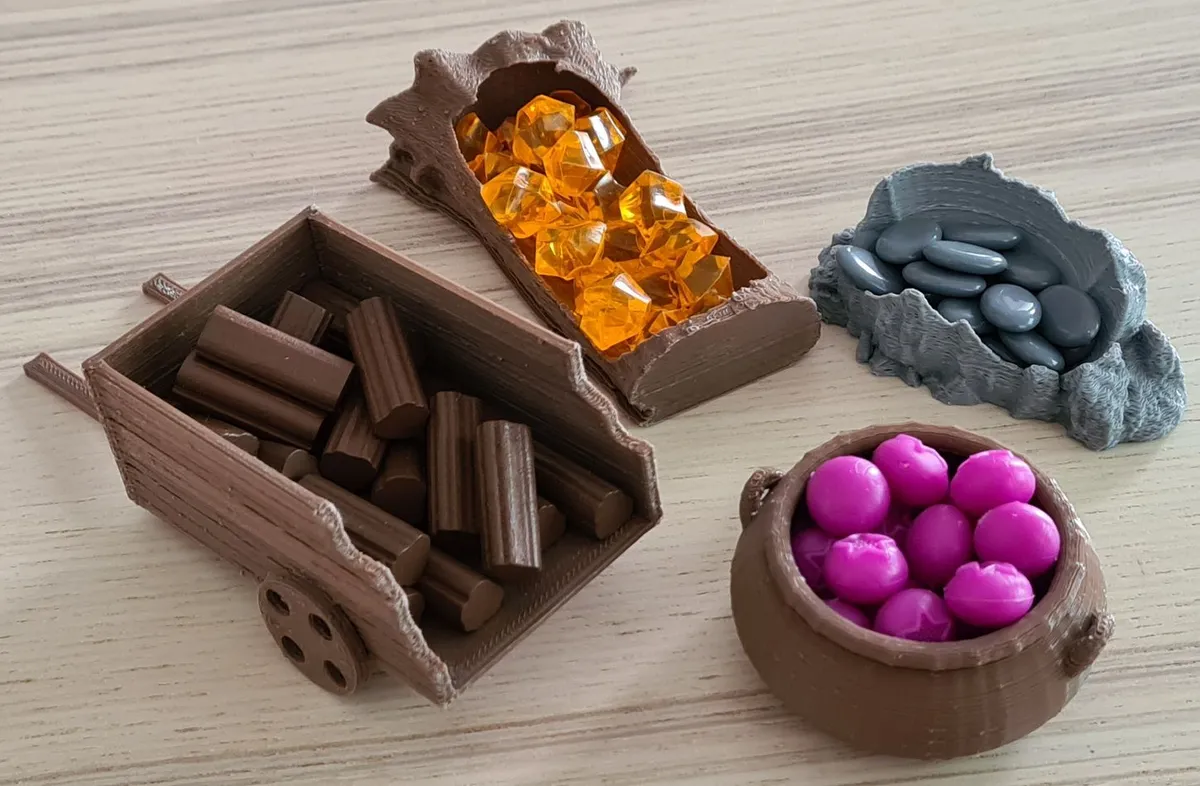
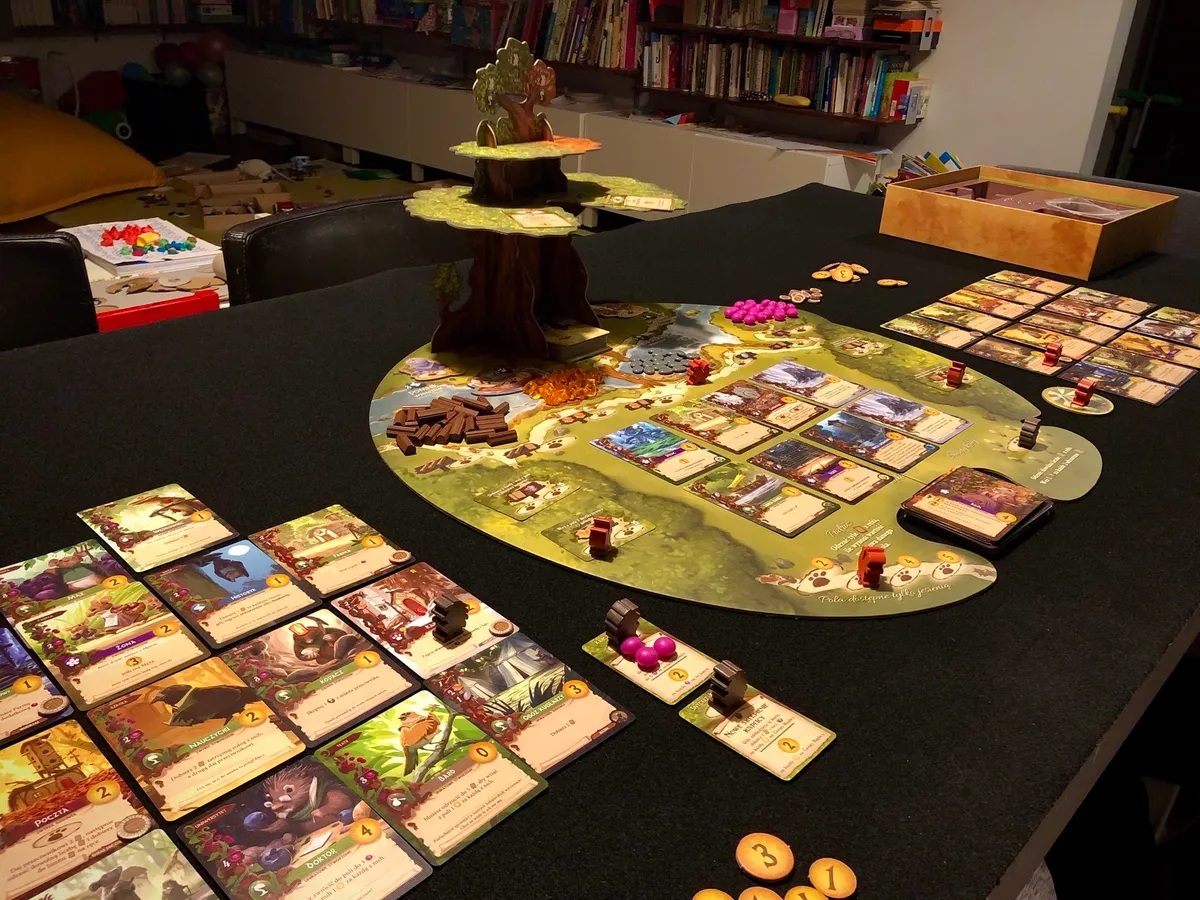
The fantasy is pastoral rather than cutthroat. Squirrels operate post offices. Frogs run theaters. Beavers construct dams. Andrew Bosley’s illustration (with graphic design by Dann May) makes every card feel like a storybook page, and the production leans into that mood: a cardboard Ever Tree (or wooden upgrade in deluxe editions) holds the draw deck, berries are satisfyingly squishy, resin looks like amber, and pebbles clack like river stones.
Mechanically, Everdell sits between gateway euros and mid-weight engine games. It is heavier than Ticket to Ride, lighter than Ark Nova, and more spatial than Wingspan because your city spreads across the table in a limited grid. The hook is pairing: many Critter cards can be played for free if you already built their matching Construction, turning card sequencing into a satisfying puzzle rather than pure luck.
Forest board-game components — Wikimedia Commons
How a Turn Works (Core Loop)
Every turn you choose exactly one of three actions:
- Place a worker on a board location (exclusive or shared) and take the listed benefit immediately.
- Play a card from your hand or the Meadow by paying its resource cost, then resolve its effect.
- Prepare for Season — but only after all your current workers are deployed.
That third action is Everdell’s pacing engine. When you prepare, you alone recall every worker you placed, gain new workers from the Ever Tree according to the upcoming season, and trigger season bonuses. Spring adds one worker and activates green Production cards. Summer adds one worker and lets you draw up to two Meadow cards. Autumn adds two workers and activates Production again. There is no winter prepare step — autumn is your final seasonal refresh before the endgame scoring sprint.
Resources and Card Types
Four resources drive the economy:
| Resource | Typical use | Thematic flavor |
|---|---|---|
| Twigs | Construction costs | Building frames and structures |
| Resin | Construction costs | Sticky amber glue for assembly |
| Pebbles | Construction costs | Foundations and stonework |
| Berries | Critter costs | Feeding and hiring woodland folk |
Construction cards (tan backs) usually cost twigs, resin, and pebbles. Critter cards (green backs) usually cost berries — unless you already own their paired building, in which case the critter moves in for free. Some cards break the pattern with discounts, wild resources, or alternate payment paths, which keeps experienced tables hunting for off-type engines.
Production cards (green banner icon) generate resources or draw cards when activated — at the moment you play them during spring or autumn, and again whenever you prepare for those seasons. Stacking Production early creates the “engine hum” that defines a good Everdell session.
Locations, the Meadow, and Blocking
The main board offers resource spots, card draws, journey tokens, and event hosting. Exclusive locations accept one worker total; shared locations accept multiple. At two players, blocking is occasional. At four, the twig forest and pebble beach can become a quiet turf war — not aggressive take-that, but real opportunity cost when your plan assumed a spot that someone else reached first.
The Meadow holds eight face-up cards from the main deck. Anyone can buy from it on their turn, which creates a public market of combo pieces. When the Meadow empties, refill it. Cards cycle fast in mid-game, so hesitation hurts: the critter you wanted may vanish while you gather one more berry.
Forest cards (setup-dependent count by player number) add modular locations with stronger effects. Event tiles along the river reward the first player to meet a public goal — extra points, resources, or special tokens — which nudges groups toward visible milestones without forcing a single strategy.
Seasonal Arc: Why the Game Feels Cozy but Tense
Everdell’s thematic calendar is more than window dressing. Early winter (setup) feels sparse: two workers, a handful of cards, and a Meadow full of possibilities you cannot yet afford. Spring is expansion — new worker, Production kick — and the city’s first real shape appears. Summer is tempo: extra Meadow draws let you fish for pairs. Autumn is explosion: two new workers plus another Production wave, and suddenly you are placing three or four cards in a turn while opponents do the same.
That arc mirrors how engine-builders should feel. The first third is planning; the middle is pivoting when the Meadow refuses to cooperate; the final third is executing a combo chain while counting remaining actions. Games routinely end with players wishing for “just one more autumn worker,” which is a compliment to the pacing design.
Hand Limits and Tableau Rules
You may hold up to eight cards (seven with some expansion modules). Cities have a fifteen-card soft cap with occupancy tokens marking shared spaces — certain buildings let multiple critters stack, which matters for point engines and event completion. Exceeding limits forces discards, so hoarding without playing is punished gently but consistently.
Components, Production, and Table Presence
Everdell’s reputation rests partly on how it looks on a table. The Ever Tree is a vertical centerpiece; the river board segments resources cleanly; critter meeples (or standees in some printings) populate a growing diorama. Starling Games targeted the “display shelf” crowd without sacrificing playability — a harder balance than it sounds.
The base box includes 128 critter and construction cards, 11 forest cards, 16 special event cards, 4 basic event tiles, 24 workers (six per player color), resource piles, point tokens, occupied tokens, an 8-sided die for solo play, and the victory card. Card stock is decent; sleeving is recommended if you play weekly because Meadow handling is constant.
Storage is the hidden tax. Once you add expansions, baggies or a custom insert become practical necessities. The Complete Collection bundles content beautifully but demands organization discipline. For apartment dwellers, budget shelf space before you impulse-buy every module.

Animal-themed card play — Wikimedia Commons
Teaching Everdell Without Losing the Magic
Rules complexity is the most common friction point in any everdell board game review, so teach in layers:
- Goal: Most points after everyone finishes autumn and cannot act.
- Turn options: Place worker, play card, or prepare (only when all workers are out).
- Resources: Twigs/resin/pebbles for buildings, berries for critters.
- Pairing rule: Matching critter + construction = free critter placement.
- Production: Green cards pay out in spring and autumn when played and when preparing.
- Meadow: Public shop; refill when empty.
- Events: First to qualify claims the tile.
Save forest location edge cases, journey token scoring, and occupied-token stacking for mid-game examples. The rulebook is complete but dense; the Dized tutorial app or a watch-through teach beats reading every exception aloud before turn one.
First-Game Pitfalls
New players often over-worker early — placing every piece before they have resources to play cards — then stall. Remind them that preparing for season is an action, not a punishment. Others ignore events entirely and lose five to eight points to a sharper neighbor. Critter/construction pairing clicks around mid-game; once it does, eyes light up. Budget 75–90 minutes for a first four-player teach; subsequent plays often land in the 50–65 minute range.
Solo Mode: Rugwort and Beyond
Everdell includes an official solo mode against Rugwort, a rat automaton with six workers and scenario cards that define his goals. Rugwort takes simplified turns — placing workers, playing cards, scoring events — and scales via difficulty cards. It is not as deep as dedicated solo roguelikes, but it is far better than the token-effort solo modes many 2018 euros shipped with.
Mistwood (2023 expansion) replaces Rugwort with Nightweave, a spider queen automaton with personalities, plans, and plots that create campaign-like variety. If solo or two-player Everdell is your primary use case, Mistwood is the upgrade worth researching after you know the base loop. Nightweave reportedly plays tighter than Rugwort at higher difficulties, with modular tweaks that keep repeated sessions from feeling solved.
Player Count Guide
| Players | Experience |
|---|---|
| 1 (solo) | Rugwort is charming; Mistwood elevates repeat solo play |
| 2 | Sweet spot for blocking awareness without chaos; many fans’ favorite |
| 3 | Balanced market competition and reasonable downtime |
| 4 | Maximum Meadow churn; exclusive spots hurt more; add 10–15 minutes |
Bellfaire officially supports five and six players with adjusted hand sizes and a modular market board. Higher counts extend playtime toward 90–120 minutes and dilute location blocking tension — better for party-flavored groups than optimization purists.
Expansions and the Everdell Line
Pearlbrook
Pearlbrook adds a river board extension, pearls as a fifth resource, an ambassador meeple, adornment cards, and four three-dimensional Wonder pieces with high point ceilings. Complexity rises moderately; strategy widens without breaking the base teach. Choose Pearlbrook if you want “more Everdell” with a fresh resource axis.
Spirecrest
Spirecrest is the mountain expedition module: a trail board, Discovery cards, Weather that modifies seasons, and rideable large animal meeples. Prepare-for-Season gains steps, and planning horizons lengthen. Best for groups that want the highest mechanical lift without leaving the Everdell ecosystem.
Bellfaire
Bellfaire adds critter player powers, a Market board, Garland endgame awards, new cards and events, and components for five to six players. It is modular — add only what your table wants. Powers personalize strategies without fully splintering player goals.
Newleaf
Newleaf is the heaviest base-game expansion for many tables: a train station, Visitor scoring cards, Ticket and Reservation tokens, extra Meadow spaces, and dozens of new cards. It opens planning tools (reserve a Meadow card at a discount) and shifts multiplayer dynamics more than Pearlbrook or Bellfaire. Add it when the base box feels familiar.
Mistwood
Beyond Nightweave solo content, Mistwood includes seasonal farm variants and optional legendary card modules aimed at experienced groups. Treat legendary modules as spice, not day-one additions.
Standalone Siblings
The line has grown beyond expansions:
- Farshore (2023) — nautical map exploration standalone
- Silverfrost (2025) — frost seasons and terrain tiles standalone
- Everdell Duo — condensed two-player box
- Emerland (announced 2026) — jungle-themed standalone region
These share DNA but do not require the original box. If you love the art and want a fresh map, Farshore or Silverfrost may suit you; if you want the classic river valley, start here.
Everdell vs Similar Games
| Game | Vibe | Choose it instead when… |
|---|---|---|
| Everdell | Cozy woodland worker placement + city tableau | You want tactile production and critter pairing |
| Wingspan | Bird engine-builder, card rows | You prefer card habitats over spatial cities |
| Ark Nova | Heavy zoo euro, dual scoring tracks | You want three-hour depth and action-card timing |
| Spirit Island | Cooperative area control | You want teamwork, not parallel racing |
| Terraforming Mars | Corporate Mars engine | You prefer sci-fi and longer economic snowballs |
| My Village | Dice-driven village builder | You want lighter randomness and faster teaches |
Everdell occupies a cozy middle: more interactive than pure multiplayer solitaire, less confrontational than area control, prettier than most euros in its weight class.
Who Should Buy It in 2026?
Perfect For
- Wingspan graduates ready for spatial planning and tighter blocking
- Families with teens who outgrew Catan but aren’t ready for Gloomhaven
- Solo players who want a polished automaton and expansion path to Nightweave
- Collectors who appreciate table photography and component tactility
- Groups that enjoy engine satisfaction without direct sabotage
Not Ideal For
- Wargamers or take-that fans who need combat or theft mechanics
- Players who hate losing a planned worker spot to an opponent
- Budget shoppers — MSRP typically lands around $55–65 USD for the base box, with Complete Collection bundles substantially higher
- Groups allergic to any rules lookup after the first teach
Strategy Tips (No Spoilers)
- Plan seasons backward. Count how many worker placements remain before your next prepare — autumn’s +2 workers is your scoring turn.
- Pair early when cheap. A free critter saves berries for harder purchases later.
- Watch the Meadow between turns. If a pairing piece appears, someone will take it.
- Production before points. One extra berry per season compounds; pretty zero-production cards can lag.
- Events are public races. A three-point swing matters in tight games — track what opponents can fulfill.
- Do not over-draw. Hitting the eight-card hand limit wastes draws; play or discard with intent.
- Block with purpose at 3–4 players. Taking the exclusive twig spot is fair play when it protects your engine.
Pricing and Where to Buy
Retail pricing fluctuates by region and print run. The base game commonly lists between $55 and $65 USD at major hobby retailers; sales dip during holiday seasons. The Complete Collection — bundling the base game and major expansions — targets enthusiasts who already know they want the full line and often lists well above the base MSRP.
Check your local game store first if teach-and-play matters; many shops run demo copies. Online retailers and marketplace listings help when local stock is thin. Confirm you are buying Starling Games’ Everdell (critter city-builder), not similarly named standalones, before checkout.
Mobile-Friendly Buying Checklist
Reading this everdell board game review on a phone? Quick decisions:
- Confirm player count: 2–3 is the competitive sweet spot; 4 needs patience
- Budget 60–80 minutes for early sessions
- Buy base box first unless you already love a friend’s copy
- Add Pearlbrook for variety, Spirecrest for complexity, Bellfaire for higher player counts
- Sleeve cards if weekly play is likely
- Download Dized or watch one teach video — faster than solo rulebook study
FAQ — Everdell Board Game Review
Is Everdell a board game or a video game?
This review covers the Starling Games tabletop edition (2018). Dire Wolf Digital publishes a licensed digital app; same theme, different product.
Is Everdell worth it in 2026?
Yes — if you want a medium-weight engine-builder with standout components and a deep expansion catalog. It remains one of the defining cozy euros of the late 2010s.
How long does Everdell take?
Most fluent groups finish in 40–80 minutes. First teaches and four-player tables with expansions run longer.
Is Everdell good for two players?
Excellent. Blocking is meaningful but not suffocating; many veterans prefer two-player for tempo control.
Everdell vs Wingspan — which first?
Wingspan teaches faster with less blocking; Everdell adds spatial city building and location competition. Many hobbyists start with Wingspan and graduate to Everdell.
Which Everdell expansion should I buy first?
Pearlbrook for moderate novelty; Bellfaire for player powers and higher counts; Newleaf for the biggest mechanical shake-up; Mistwood for solo-focused tables.
Does Everdell have a solo mode?
Yes. Rugwort in the base box; Nightweave in Mistwood for a deeper automaton experience.
Is Everdell family-friendly?
Publisher guidance is 13+. Theme is wholesome; complexity suits teens and adults more than young children.
Can I combine all expansions at once?
Physically yes, practically careful. Deck dilution and table sprawl increase; most groups rotate one or two modules per session.
What is Everdell Complete Collection?
A bundled edition packaging the base game with major expansions and upgraded components. Ideal for committed fans, overwhelming for first purchases.
Final Verdict
Everdell endures because it treats coziness as a design constraint, not a excuse for simplicity. The Ever Tree, berry resources, and critter illustrations create immediate emotional buy-in; the seasonal worker loop and construction pairing create the slow-burn satisfaction engine-builders promise. It is not the deepest euro on the shelf, nor the most interactive. It is one of the best at making a medium-weight optimization puzzle feel like a storybook afternoon.
In 2026 the line spans nautical standalones, frost-season spin-offs, and a spider queen solo rival. The original river valley box still earns first-place recommendation for newcomers because everything else assumes you already love the core rhythm. Teach it patiently, play it at two or three when possible, and add expansions one at a time. Do that, and this Everdell board game review ends the way most good sessions do — with everyone arranging their city cards for a photo before clearing the table.
Score: 8.9/10 — Best Cozy Woodland Engine-Builder With Premium Table Presence
Related on NexReview
Looking for more tabletop coverage after this everdell board game review? Compare engine-building paths in our Wingspan board game review, heavier euro depth in Ark Nova, and cooperative tension in Spirit Island. Browse the full Game Reviews hub for more verdicts.