Pros
- Two-layer puzzle — habitat corridors plus modular wildlife goals — stays fresh for years
- Rules teach in minutes; depth arrives through scoring cards, not rule bloat
- Premium wooden wildlife tokens and Beth Sobel art sell the Pacific Northwest mood
- Strong solo mode, family variant, and achievement scenarios reward repeat plays
- Landmarks expansion adds 5–6 player support without replacing the base box
Cons
- Minimal direct interaction — you draft in parallel, not against opponents
- Wildlife scoring cards demand reference checks until patterns become familiar
- Downtime between turns grows at four players when someone optimizes elk formations
- Insert is functional, not deluxe — expect baggies for a frequently played copy
- Not a negotiation or conflict game; euro veterans may want sharper player friction
Cascadia is Randy Flynn’s award-winning tile-laying puzzle about building Pacific Northwest habitats and populating them with bears, elk, salmon, hawks, and foxes — published by Flatout Games and Alderac Entertainment Group (AEG). This Cascadia board game review (updated September 2026) covers how the dual-layer scoring works, why the 2022 Spiel des Jahres winner still outsells many newer nature titles, who should buy the base box versus Landmarks, and where it sits next to Wingspan on a modern hobby shelf.
If you searched for a cascadia board game review because a friend compared it to a calm Wingspan night with hex tiles instead of bird cards, you are in the right place. This is the tabletop game Cascadia (2021) — not a video game, not the geopolitical “Cascadia” independence concept, and not Calico’s cat quilt sequel (though same design studio). Flatout Games and artist Beth Sobel built this box for players who want a forgiving teach, a satisfying spatial puzzle, and wildlife art that looks like a field guide spread across your table.
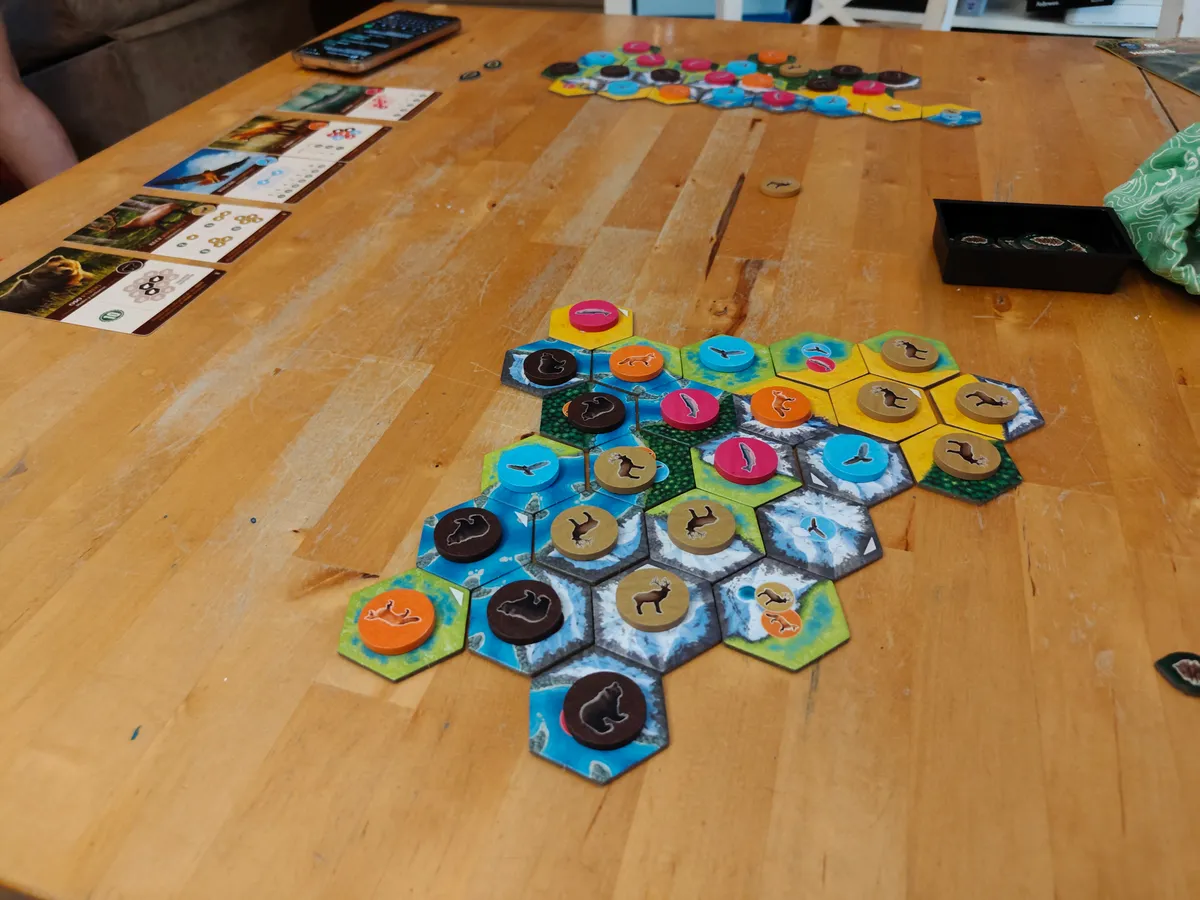
Cascadia on the table — photo via Wikimedia Commons
Quick Verdict (For Skimmers)
| Field | Detail |
|---|---|
| Designer | Randy Flynn |
| Publisher | Flatout Games / AEG (Kosmos in some regions) |
| Players | 1–4 base (1–6 with Landmarks) |
| Play time | ~30–45 minutes (teach adds 10–15 on game one) |
| Age | 10+ |
| Type | Medium-light tile-laying / token drafting |
| Standout feature | Modular wildlife scoring cards + habitat corridor majority |
| NexReview score | 8.9/10 |
Buy it if you want a beautiful, low-conflict nature puzzle that welcomes families and still challenges hobbyists through rotating objectives. Skip it if your group needs negotiation, take-that, or direct blocking — or if parallel solitaire optimizers bore you even when the puzzle is excellent.
What Is Cascadia?
Cascadia takes its name from the Pacific Northwest bioregion — loosely British Columbia, Yukon, Washington, Oregon, and Idaho between the Rockies and the Pacific. In the box, that geography becomes a personal mosaic: each player expands a hex-map of mountains, forests, prairies, wetlands, and rivers, then places wooden wildlife tokens onto tiles that support those species.
The elevator pitch from Flatout Games is accurate: pick one tile-and-token pair, place both. That simplicity is the hook. The depth lives in two simultaneous scoring tracks that tug against each other every turn:
- Wildlife scoring cards — one random card per species each game, defining how bears, elk, salmon, hawks, and foxes want to sit on your map (pairs, runs, lines of sight, adjacency puzzles).
- Habitat corridors — at endgame you score your largest connected group per terrain type, plus bonus points for having the biggest (or second-biggest) corridor at the table depending on player count.
You are never just “matching hex colors.” You are deciding whether this turn’s elk token helps tomorrow’s bear card, whether expanding wetlands steals a majority from your neighbor, and whether spending a Nature Token to decouple tile from token is worth the flexibility.
Flatout Games, a Seattle-area studio, co-published with AEG after the success of Point Salad and Calico. Cascadia launched from a 2020 Kickstarter and hit retail in 2021 with a suggested price around $39.99 USD — competitive for 85 habitat tiles, 100 wooden wildlife tokens, 21 scoring cards, and a cloth bag. Beth Sobel’s illustrations (also known from Calico and Verdant) give each terrain type a distinct palette without sacrificing readability at arm’s length.
The game won the Spiel des Jahres in 2022 — Germany’s family-game-of-the-year award — beating heavier competition by pairing approachable turns with genuinely modular scoring. That award matters for buyers in 2026: Cascadia is not a hype-cycle Kickstarter that aged out; it is a reference tile-lighter that stores, teaches, and replays like a modern classic.

Nature-themed board game atmosphere — Wikimedia Commons
How a Turn Feels (Core Loop)
Understanding the rhythm beats memorizing every elk formation on day one. Setup deals each player a starter habitat tile (three hexes in a fixed shape), reveals four habitat tile + wildlife token pairs in a central market, and draws five wildlife scoring cards — one per species — from a deck of twenty-one variants.
Each player takes exactly twenty turns over the game. When the habitat tile supply cannot refill the market after someone drafts, the game ends immediately — no sudden-death round, no extra phase. That fixed length keeps table time honest.
Turn Steps (Standard Game)
- Check overpopulation — if three or four market tokens show the same species, the active player may wipe and redraw them (rules differ slightly for three versus four duplicates).
- Optional Nature Token spend — before drafting, spend a Douglas-fir-cone token to either take any tile with any token separately, or wipe and replace market wildlife.
- Draft one pair — take a habitat tile and its paired wildlife token from the four available combinations.
- Place tile — adjacent to your existing map; tiles never move afterward.
- Place token — on any empty compatible hex in your map (including the tile you just placed). If you cannot or choose not to place, return the token to the bag.
- Keystone bonus — placing wildlife on certain keystone tiles earns a Nature Token for future flexibility.
- Refill market — replace the taken tile from the stack and the token from the bag without shuffling the remaining pairs.
Play passes clockwise. Everyone builds in parallel. There is no combat, no trading, and no shared board — only shared market denial when a tile-token pair you wanted disappears.
Why “Pick One, Place One” Still Creates Tension
The rule is simple; the decision is not. A market might offer a perfect salmon for your run-scoring card but pair it with a wetland tile that fractures your prairie majority. Another pair might extend your forest corridor beautifully while handing you a fox you cannot place legally yet. Holding out for flexibility sounds smart until turn eighteen arrives and the tile stack runs dry.
Nature Tokens are the pressure valve. They reward keystone placements and can be hoarded for one point each at endgame — so spending them is always a mini-equation: is decoupling tile from token worth more than the guaranteed point? Experienced tables burn tokens aggressively in the midgame and only bank them when a scoring card demands a specific species late.
Wildlife Scoring Cards — The Modular Brain
This Cascadia board game review spends time here because the cards are the replay engine. Each species has four standard scoring variants (labeled A–D in the rulebook) plus family and intermediate teaching cards. Only five cards hit the table each session — one per animal — so the same physical box plays like a different puzzle every time.
Bears
Bear cards reward isolated groups of exact sizes — pairs, trios, or mixed collections. Groups cannot touch; two bear clusters side by side score separately only if the card allows multiple groups. Bear puzzles teach spatial separation early: you are carving negative space on a crowded map.
Elk
Elk are the formation specialists. Many cards require specific shapes — straight lines across hex flat edges, rings, or abstract silhouettes printed on the card. Elk groups may neighbor each other, but each elk scores once. When multiple legal interpretations exist, you always take the highest-scoring layout — a subtle rule that rewards careful inspection, not guesswork.
Salmon
Salmon want runs: chains where each salmon touches at most two others, with no extra salmon adjacent outside the run. Triangle trios can qualify; spaghetti branches do not. Cards differ on minimum run length, maximum counted size, and whether adjacent non-salmon animals add bonus points. Salmon cards push you toward river and wetland expansion — thematic and mechanical at once.
Hawks
Hawks score from spread, lines of sight, or pairs separated by other species. Line-of-sight lines travel across hex flat sides and stop when they hit another hawk. Hawk puzzles feel the most “geometric” on the table — less about blob size, more about sight lines across your growing ecosystem.
Foxes
Foxes care about what neighbors them — unique animal types, pairs of neighbors, or abundant adjacent species. Some fox cards score pairs of foxes together with adjacency conditions across eight neighboring hexes. Foxes are the social animals of Cascadia scoring: they read the whole map, not just fox hexes.
Family and Intermediate Variants
First-teach groups should use the Family Variant card: one shared scoring table for all wildlife by group size, no species-specific logic. Move to Intermediate, then full modular cards, once placement rules feel automatic. Skipping straight to four elk shape cards on game one is the fastest way to sour a newcomer on an otherwise gentle design.
Habitat Corridors and Majorities
Wildlife cards get the headlines, but habitat majorities win tight games. At scoring, each player counts their largest connected group per terrain type (edges must match along hex sides). You gain one point per tile in that largest group — only the biggest blob counts per habitat, not every forest cluster.
Then come majority bonuses by player count:
| Players | Majority scoring |
|---|---|
| Solo | +2 per habitat type where your largest group is size 7+ |
| 2 | +2 for largest corridor per type; tied leaders split 1 each |
| 3–4 | +3 for largest, +1 for second largest; tie rules in rulebook |
In a three-player game, a single extra wetland hex can swing three bonus points and increase your corridor base score. That is the hidden interaction Cascadia offers: you cannot block directly, but you watch which terrains opponents are growing and draft pairs that starve their plans while feeding yours.
Mountains and rivers often fragment; prairies and wetlands blob. Smart play sometimes accepts a “bad” wildlife token to take a tile that extends a contested corridor before the supply runs out.
Components, Production, and Table Presence
Cascadia’s production punches above its price tier without reaching Stonemaier-level insert luxury.
- 85 habitat hex tiles — single-terrain and dual-terrain mixes, plus keystone art for Nature Token rewards.
- 100 wooden wildlife tokens — screen-printed bears, elk, salmon, hawks, and foxes; satisfying to handle, easy to read from across the table.
- 25 Nature Tokens — Douglas fir cone art; functional currency for market manipulation.
- Cloth bag — speeds setup and teardown; also makes overpopulation redraws feel tactile rather than fiddly.
- Scorepad — corridor tracking grid prevents endgame math arguments.
Tiles are 42 mm hexes — large enough for Sobel’s landscape art, small enough that four player maps fit a standard dining table if players sit at corners. The box is modest compared with Everdell’s tree or Wingspan’s birdfeeder tower, but Cascadia’s table identity is the spreading map of greens, blues, and tans — a calm visual even when scores stay tight.
Storage is the weak point: baggies, stacked tiles, and a loose bag are fine for home use but invite setup sorting if you play weekly. Sleeve the scoring cards if your group drinks near the table; they are standard tarot-sized stock.

Pacific Northwest forest atmosphere — Wikimedia Commons
Solo Mode, Achievements, and Scenarios
Cascadia ships with a proper solo mode, not an afterthought paragraph. Solo uses a two-player tile count, a four-pair market that discards the far pair each turn (accelerating tile depletion), and a score chart rating your performance from “A good start!” to “Ascended!!”
Beyond single-session benchmarks, the rulebook includes Achievement hiking tracks and fifteen base-game scenarios — each specifying exact scoring cards, minimum points, and side objectives (largest prairie corridor, unused Nature Tokens, etc.). Scenarios 1–10 work with the base box; later ones assume Landmarks components.
That structure gives solo players a campaign spine without a legacy sticker book. Multiplayer groups can also pick a scenario for a themed night. If you mainly play alone, Cascadia justifies its shelf space better than many parallel-drafting euros that bolt solo on via an automa PDF.
Fan-made automa opponents exist on BoardGameGeek for players who want competitive pressure rather than score-chasing; they are unofficial but popular in the community. The official design leans into “beat your best puzzle” rather than simulating a rude opponent — know that going in.
Player Count Guide
| Players | Experience |
|---|---|
| 1 | Excellent — scenarios, achievements, and discard-market tension |
| 2 | Strong — market denial matters; majorities are swingy |
| 3 | Sweet spot — scoring spreads without long waits |
| 4 | Still good — turns stay quick, but optimization pauses add up |
At four, teach players to announce “thinking” only when genuinely stuck; the game is meant to flow. At two, watch for repetitive drafting when one player ignores majorities — remind them corridor bonuses decide close games.
Teaching Cascadia Without Overwhelming
Layer the teach like the Family Variant layers scoring:
- Goal — twenty turns, most points from wildlife cards + habitats + Nature Tokens.
- Draft — take a tile-token pair; replace from stacks and bag.
- Placement — tile adjacent; token on matching empty hex or discard token.
- Run one practice turn with open hands before revealing scoring cards.
- Introduce scoring cards one species at a time, or start Family Variant for kids.
- Explain Nature Tokens and overpopulation after turn two when the table has context.
Do not read every elk shape card aloud on turn zero. Point to the icons, confirm “largest legal score wins,” and keep the rulebook open for hawk lines of sight. First game with full modular cards takes 45 minutes; later games often finish under 35.
Cascadia vs Similar Games
| Game | Vibe | Choose it instead when… |
|---|---|---|
| Cascadia | Dual-layer habitat + wildlife puzzle | You want SdJ-caliber simplicity with modular depth |
| Wingspan | Bird engine-building card game | You prefer card powers and resource dice over spatial maps |
| Calico | Patchwork quilt tile-laying | Your group wants a brain-burner with pattern constraints |
| Ark Nova | Heavy zoo-building euro | You crave multi-hour planning, not a 30-minute puzzle |
| Spirit Island | Cooperative area control | You want teamwork against the board, not parallel scoring |
| Everdell | Tableau + city building with critters | You want engine combos and a three-dimensional table presence |
Cascadia occupies the same gift-shop niche as Wingspan — nature theme, premium components, approachable rules — but replaces engine chains with a spatial draft. Players who find Wingspan’s card text walls exhausting often prefer Cascadia’s “look at the map” decisions. Players who need constant interaction may find both too solitary.
If you already own Calico from the same studio, Cascadia feels like the gentler sibling: less constraint angst, more map growth, similar hex DNA.
Landmarks Expansion — Worth It?
Cascadia: Landmarks (2023, MSRP around $34.99) adds landmark tokens placed on keystone tiles, new habitat and wildlife content, landmark scoring cards, and enough components for five to six players. It also extends solo with scenarios 11–20 and landmark-specific achievements.
Buy Landmarks when:
- Your regular group has five or six players
- You want landmark endgame bonuses layered onto corridor math
- Solo scenario climbing is already part of your routine
Skip Landmarks for now when:
- You play mostly at two or three and the base box still feels fresh
- Table space is already tight — larger maps need room
- You prefer keeping the SdJ-winning base experience pure
The expansion integrates cleanly; nothing obsoletes the core box. That matters for budget-conscious shelves in 2026 when so many games ship “replace the base” part twos.
Who Should Buy Cascadia in 2026?
Perfect For
- Families moving up from Ticket to Ride or Catan who want a nature theme without rules bloat
- Wingspan households looking for a second calm puzzle with less card rules overhead
- Solo puzzlers who enjoy scenario ladders and high-score chasing
- Teachers and librarians running STEM or ecology clubs — habitat corridors spark real geography talk
- Collectors who want a Spiel des Jahres winner that actually hits the table, not a display trophy
Not Ideal For
- Groups that need direct conflict, trading, or negotiation every turn
- Players who dislike endgame scoring audits across five species cards
- Anyone seeking a one-hour-plus heavy euro — Cascadia stays intentionally brisk
- Kids under ten unless you commit to the Family Variant and patient coaching
Pros and Cons
| Pros | Cons |
|---|---|
| Modular wildlife cards create years of replay | Low direct player interaction |
| Teaches in minutes, scales depth with variants | Elk/hawk cards need reference until memorized |
| Wooden tokens and art elevate table mood | Four-player AP can slow pacing |
| Strong solo and scenario content | Basic insert for frequent players |
| Fair MSRP for component count | Parallel play may bore confrontation fans |
| Landmarks expands cleanly to six players | Expansion not mandatory for most two-player homes |
Strategy Tips (Without Overthinking Turn One)
- Read all five scoring cards before turn one. Identify which species are “free points” versus layout-intensive.
- Corridor majorities decide close games. Track one terrain type opponents are ignoring and grow it deliberately.
- Nature Tokens are tools, not trophies. Spending two midgame for the perfect salmon often beats hoarding for two endgame points.
- Legal discards are valid. Returning a wildlife token you cannot place is better than fracturing your map with a forced bad hex.
- Watch the tile stack. Turn eighteen urgency is real — do not wait for a perfect bear pair if wetlands majority is one hex away.
- Elk shapes reward pre-planning. Leave hex holes early when your card wants lines or rings.
- Fox cards love diversity. Spread species types before planting foxes on empty prairie edges.
Mobile-Friendly Buying & Play Notes
Reading this cascadia board game review on a phone? Quick checklist:
- Confirm you want the Flatout/AEG board game, not unrelated “Cascadia” search results
- MSRP ~$40 base; shop sales often land near $32–38
- First session: use Family Variant or recommended “A” scoring cards from the rulebook
- Base box is enough for 1–4; buy Landmarks only if you need five-six or extra solo scenarios
- Bag the wildlife tokens — setup is faster than sorting from a flat tray
FAQ — Cascadia Board Game Review
Is Cascadia a board game or a video game?
This review covers the Cascadia tabletop game by Randy Flynn and Flatout Games — a physical tile-laying puzzle, not a digital title.
Did Cascadia win Spiel des Jahres?
Yes. Cascadia won the main Spiel des Jahres award in 2022, recognizing its accessible rules and modular wildlife scoring.
How long does Cascadia take?
Most groups finish in 30–45 minutes after one learning game. Solo scenarios can run shorter or longer depending on objectives.
Is Cascadia good for two players?
Yes — two is a strong count with meaningful market denial and swingy corridor majorities. Solo and three-player are also excellent.
Cascadia vs Wingspan — which should I buy first?
Buy Wingspan if you want card-driven engine building with famous bird facts. Buy Cascadia if you prefer hex maps, spatial scoring, and faster teach with similar nature calm.
Does Cascadia have a solo mode?
Yes. Official solo uses a discard-market rule, score benchmarks, scenarios, and an achievement track. Landmarks adds more solo content.
What age is Cascadia for?
Box says 10+. Younger kids can play the Family Variant with adult help on placement rules.
Do I need the Landmarks expansion?
No for most buyers. Get it if you regularly play five or six or want landmark scoring and extended solo scenarios.
Is Cascadia like Calico?
Same studio and hex DNA, but Calico is a tighter patchwork puzzle; Cascadia is more forgiving and map-focused. Many households own both.
Is Cascadia still worth it in 2026?
Yes — if you want a proven, award-winning tile-lighter with deep replay through scoring cards rather than rule complexity. It remains a top gateway into modern hobby games.
Final Verdict
Cascadia earns its Spiel des Jahres crown by respecting your time and your brain in equal measure. The turns are fast enough for weeknights; the scoring cards are varied enough for years of “one more map.” It will not simulate cutthroat negotiation or cooperative apocalypse — and it should not try.
What it does — teach in ten minutes, bloom into a dual-layer habitat and wildlife puzzle, look gorgeous with wooden tokens spread across Beth Sobel terrain — it does better than almost any nature-themed competitor at this weight. Pair it with Wingspan for bird-and-mammal shelf harmony, add Landmarks when your player count grows, and keep the Family Variant in the box for cousins who arrive mid-rules explanation.
For most readers landing on this Cascadia board game review, the recommendation is straightforward: if your group likes calm optimization with real scoring depth, buy the base box and play scenario one solo while everyone else is running late. You will know within twenty turns whether Cascadia belongs in your permanent rotation — and for most tables, it does.
Score: 8.9/10 — Best Spiel des Jahres Tile Puzzle for Nature Lovers
Related on NexReview
Want more nature on the table after this cascadia board game review? Read our Wingspan board game review for bird engine-building, Spirit Island for cooperative ecosystem defense, and Everdell for critter tableau charm. Browse the full Game Reviews hub for weekly verdicts.