Pros
- First 1-inch sensor in DJI's Mini line — real step up from Mini 4 Pro for stills and low light
- Forward LiDAR plus omnidirectional vision makes night and urban flying less nerve-wracking
- 249.9g with standard battery keeps EU C0 classification where regulations allow
- 42GB internal storage and 4K/120p slow motion suit travel creators who hate fumbling SD cards
- O4+ transmission and 36-minute rated flight time are class-leading for this weight
Cons
- Not sold officially in the United States at launch — gray imports and support risk
- Plus battery (52 min) is not sold in Europe and pushes weight past 250g anyway
- Launch pricing lands in premium compact territory; Fly More + RC 2 bundles sting
- 1-inch sensor and pro codecs reward editing skill — beginners may not use the headroom
- Geofencing, Remote ID, and national drone laws still matter more than any spec sheet
Searching for a DJI Mini 5 Pro review usually means you outgrew phone footage or a toy quadcopter, but you do not want a full-size cinema drone backpack on every hike. DJI answered that crowd on 17 September 2025 with the Mini 5 Pro: a folding camera drone that slots into the sub-250 gram weight class on its standard battery, yet carries a 50-megapixel 1-inch CMOS sensor — a first for the Mini family. This NexReview guide explains what changed versus the Mini 4 Pro, how EU C0 certification works with the Intelligent Flight Battery Plus caveat, where you can legally buy it, and whether the imaging jump justifies another drone in an already crowded bag.
Below: snapshot scores, camera and safety tech, real-world bundles and street pricing (verify at checkout), comparison tables, who should upgrade, who should skip, and an FAQ tuned to how people actually search dji mini 5 pro review before spending four figures.
Compact camera drone in flight — Wikimedia Commons
DJI Mini 5 Pro Review Snapshot (2026)
| Question | Short answer |
|---|---|
| What is it? | DJI's flagship Mini drone with 1-inch sensor, LiDAR, O4+ link |
| Weight (standard battery) | 249.9 g — designed for light-weight regulations |
| Flight time | Up to 36 min (standard); up to 52 min with Plus battery (not EU) |
| US official sale? | No at global launch — DJI confirmed no US product page |
| Launch price (base) | About £689 / €799 / AU$1,119 with RC-N3 |
| Worth vs Mini 4 Pro? | Yes if stills, night flight, and ISO headroom matter to you |
| NexReview score | 8.8/10 — imaging leader; docked for US gaps and bundle cost |
Editorial stance: Judge the Mini 5 Pro as a travel cinema camera that happens to fly, not as a cheap starter toy. The flight stack is friendlier than ever, but the price and codecs assume you care about dynamic range — similar to how we frame prosumer gear in our Pixel 10 Pro and Galaxy S25 Ultra camera guides.
What the Mini 5 Pro Actually Is
The Mini line has always been DJI's answer to regulation-shaped design: pack the most camera and autonomy you can under weight thresholds that unlock simpler registration in many countries. The Mini 3 and Mini 4 generations proved that a Type 1/1.3 sensor and omnidirectional obstacle sensing could live in a palm-folded airframe. The Mini 5 Pro pushes the ceiling by cramming a Type 1 (1-inch) sensor into essentially the same lifestyle — fold it, slip it into a shoulder bag beside a MacBook Air M4, and you still have room for ND filters.
Physically, DJI lists folded dimensions around 157 × 95 × 68 mm and unfolded wingspan near 304 × 380 × 91 mm with propellers mounted. Takeoff weight is 249.9 g ±4 g with the standard 2788 mAh Intelligent Flight Battery. That number is not accidental: in the European Union, the drone ships as a C0 unmanned aircraft with a notified-body type certificate when you stay on the standard pack. Swap to the Intelligent Flight Battery Plus (higher capacity, longer flights) and you climb past the 250 g C0 line — DJI does not sell that Plus pack in Europe partly for that reason, and the firm has stated it will not re-label class after purchase.
On the software side, you get the familiar DJI Fly ecosystem: geofencing maps, return-to-home logic, QuickShots, waypoint flights, and firmware-gated features. None of that removes your obligation to know local airspace — this review is not flight training or legal advice — but the Mini 5 Pro's safety stack is meaningfully thicker than earlier Minis, which matters when creators push golden-hour and blue-hour sessions.
Camera: Why the 1-Inch Sensor Dominates the Headlines
The imaging story is why most DJI Mini 5 Pro review traffic exists. The drone uses a 50MP effective 1-inch CMOS sensor behind a 24 mm equivalent f/1.8 lens with focus from about 0.5 m to infinity. Compared with the Mini 4 Pro's smaller sensor (~68% less area per DJI's own marketing math), you should expect:
- Cleaner shadows in sunrise and sunset brackets where phones and smaller drones crunch black levels
- Higher usable ISO when city lights or campfire scenes force you off base ISO
- More aggressive crop room in 50MP stills without immediate mud
- 14 stops of dynamic range in HDR video modes (manufacturer claim — still validate on your monitor)
Stills ship in 12MP or 50MP, JPEG or DNG RAW, up to 8192 × 6144. Shutter speeds run from 1/8000 s down to multi-second long exposures in 12MP modes — handy for controlled night landscapes when wind cooperates.
Video is where creators either fall in love or drown in file sizes:
| Mode | Typical use | Notes |
|---|---|---|
| 4K up to 60 fps HDR | Travel reels, graded Rec.709 | Strong default for social |
| 4K 120 fps | Slow motion b-roll | H.265 only per DJI spec |
| 1080p 240 fps | Extra slow mo | Eats storage; plan cards |
| 10-bit H.265 | D-Log M, HLG | ISO cap 3200 in log modes |
| 8-bit H.264 | Fast turnaround | Max ISO 12800 (noisier) |
Bitrate tops out around 130 Mbps. That is not raw cinema territory, but it is respectable for a drone that weighs less than a tall lunch. Internal 42 GB storage means you can record a full afternoon and offload later over USB — a practical upgrade for hikers who hate opening the microSD tray with cold fingers.
New gimbal tricks include 225° roll rotation, true vertical capture without cropping, QuickShot Rotate, Spotlight, and upgraded ActiveTrack 360° that tries to pick sports modes (cycling versus hiking pace) automatically. Med-Tele portrait framing and skin-tone tuning are clearly aimed at influencers who vertical-post from the trail. If your workflow already lives in DaVinci Resolve or Lightroom, the Mini 5 Pro finally gives Mini owners a sensor worth grading. If you only post unedited clips to Stories, a discounted Mini 4 Pro or even a great phone on a handheld gimbal might suffice.
Outdoor aerial photography — Wikimedia Commons
Flight Performance, Batteries, and Transmission
Spec sheets are measured in wind tunnels; your canyon gusts are not. Still, DJI's published numbers set expectations:
- Max horizontal speed (Sport): about 18 m/s standard battery, 19 m/s with Plus
- Wind resistance: up to 12 m/s
- Max takeoff altitude: 6000 m standard / 4500 m Plus (thin air reduces lift)
- Operating temp: -10 °C to 40 °C
The standard pack targets 36 minutes of flight under DJI's forward-flight test; the Plus pack claims 52 minutes but is not available in Europe and bumps weight beyond C0. Real-world mixed hovering, RTH, and wind usually shave those figures — budget 22–28 minutes of useful shooting per standard battery unless you fly conservatively.
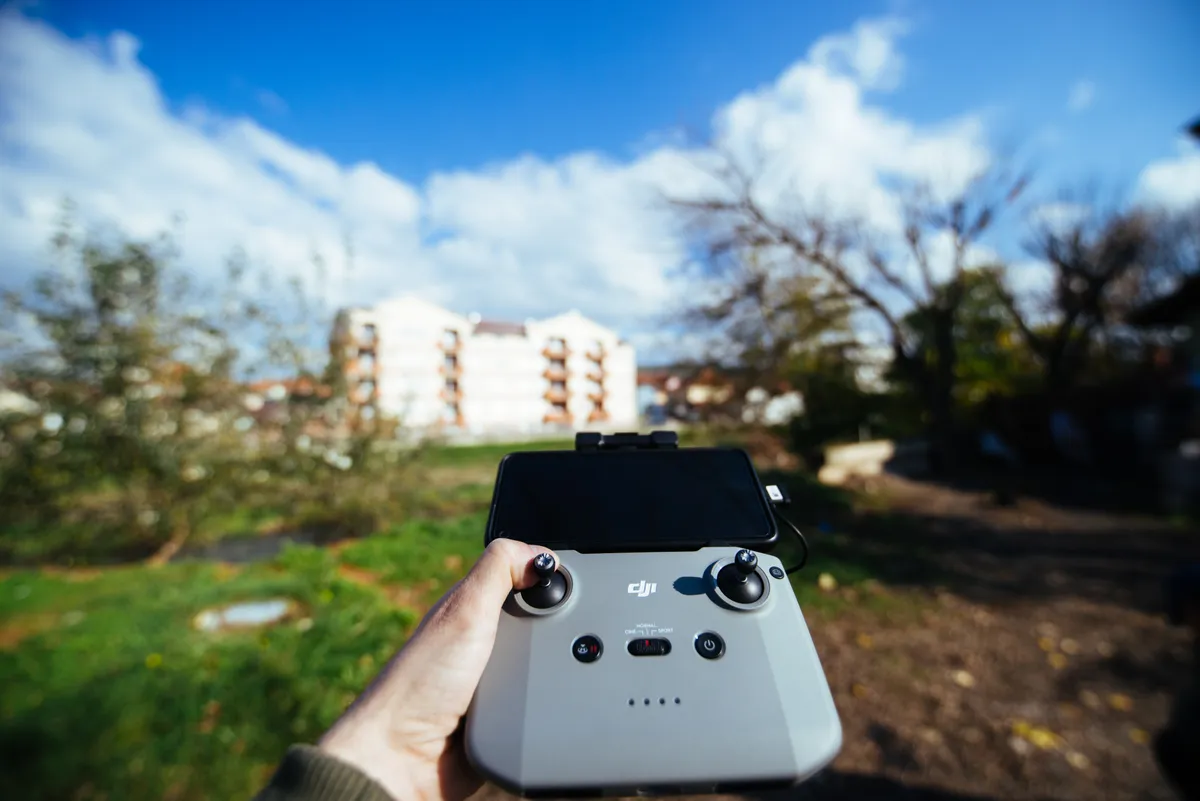
O4+ video transmission advertises up to 20 km one-way under ideal FCC conditions and 10 km under CE/SRRC/MIC limits, with latency around 120 ms. That is excellent for a Mini — until you remember aviation rules in most jurisdictions cap line-of-sight distances far below 20 km. Treat the number as link robustness in crowded RF environments, not permission to disappear over the horizon.
Positioning blends GPS, Galileo, and BeiDou with vision-aided hover. The headline safety upgrade is forward-facing LiDAR married to binocular vision on multiple sides plus a downward infrared sensor. DJI markets this as nightscape omnidirectional sensing — meaning return-to-home and obstacle weaving remain active in dim city glow where earlier Minis felt like flying blind. It is not a substitute for scouting your landing zone with a flashlight, but it reduces the "I clipped a tree branch on RTH" genre of crash reports.
Pricing, Bundles, and Regional Availability
Always confirm live prices before purchase — retailers run seasonal bundles. As of the 2025 global launch wave, credible UK and EU outlets quoted roughly:
| Configuration | UK (approx.) | EU (approx.) | Australia (approx.) |
|---|---|---|---|
| Drone + 1 battery + RC-N3 | £689 | €799 | AU$1,119 |
| Fly More Combo (3 batteries, hub, ND set, bag, RC-N3) | £869 | €999 | ~AU$1,419–1,549 |
| Fly More with RC 2 (built-in screen) | £979 | €1,129 | ~AU$1,699 |
The RC 2 upgrade is the sleeper line item. Flying with a phone jammed into RC-N3 works, but brightness, cable wear, and notifications murder flow state. If you fly weekly, the integrated 5.5-inch RC 2 display pays for itself in fewer missed shots — similar to how we tell editing-focused readers to budget real displays in our reMarkable Paper Pro versus tablet comparisons.
United States: DJI told press the Mini 5 Pro would not launch officially in the US on day one — no first-party product page, uncertain warranty paths. Third-party importers sometimes stock units, but firmware, support, and future accessory compatibility become your problem. Our US Availability subscore reflects that reality, not hatred of the hardware.
Mini 4 Pro overlap: Retailers discounted the Mini 4 Pro after launch. If you are US-based and need a store-with-a-door, a sale Mini 4 Pro remains the pragmatic DJI compact choice until policy shifts. International buyers cross-shopping should compare sensor size, LiDAR, and internal storage against the Euro or Pound delta.
Mini 5 Pro vs Mini 4 Pro (and When to Ignore Both)
| Feature | Mini 5 Pro | Mini 4 Pro |
|---|---|---|
| Main sensor | 1-inch, 50MP | Smaller 1/1.3-type, 48MP class |
| Low-light / ISO headroom | Stronger | Good, not class-leading |
| Forward LiDAR | Yes | No LiDAR |
| Internal storage | 42 GB | Typically microSD-first workflows |
| Max slow motion | 4K 120p, 1080p 240p | 4K 100p class generation |
| EU C0 on standard battery | Yes | Yes (generation-dependent labeling) |
| US official channel | No (launch stance) | Established |
Upgrade if you already fly a Mini 4 Pro weekly and hit noise floors in dusk footage, or if obstacle anxiety keeps you grounded after sunset. Skip if you fly twice a year on vacation — rent or buy a used Mini 3 Pro instead. Also skip if you need a sub-250g camera platform for mapping or inspection; enterprise lines exist for a reason.
Do not confuse this drone with unrelated "Mini" products in other categories — DJI's naming is consistent, but accessory listings on marketplaces mix generations. Verify model code on the battery tray and firmware compatibility before buying spare packs on clearance.
Safety, Regulation, and Responsible Flying
A quality DJI Mini 5 Pro review must mention rules, because the best sensor cannot refund an aviation authority fine.
- EU C0 labeling simplifies some open-category operations only while you meet weight and firmware obligations. The Plus battery story is not academic — swapping packs can change which training or registration applies.
- Remote ID, altitude caps, and no-fly zones vary by country and change faster than drone generations.
- Privacy: omnidirectional cameras and logging features mean bystander consent matters in dense neighborhoods.
- Insurance: homeowner policies rarely cover commercial drone work; event videographers should carry proper liability coverage.
DJI Fly still enforces geofencing and authorization workflows, but pilots remain legally responsible. Treat the Mini 5 Pro's LiDAR as risk reduction, not a license to buzz crowds.
Who Should Buy, Who Should Skip
Buy if
- You are a travel creator who edits footage and wants the smallest 1-inch aerial sensor available
- You fly in UK, EU, Australia, or other supported regions with clear warranty channels
- Night city B-roll is part of your brand, and you will use obstacle sensing instead of guessing
- You already own RC 2 hardware or plan the Fly More bundle to avoid phone-as-screen friction
Skip if
- You live in the US and need official DJI support — wait for policy clarity or buy Mini 4 Pro on sale
- You want a $400 impulse drone for backyard fun — Mini SE class hardware is kinder to wallets
- You will never grade log footage — savings on Mini 4 Pro or phone gimbals stay in your pocket
- Your locality bans sub-250g exemptions you thought applied — check civil aviation sites first
Stretch alternatives
- DJI Air 3 / Air 3S if dual cameras and higher wind margins beat absolute miniaturization
- Autel Nano+ or other brands only where firmware support and parts are proven locally — we favor ecosystems with predictable updates, similar to how we compare Steam Deck OLED versus boutique handhelds

Drone and camera gear outdoors — Wikimedia Commons
Real-World Shooting Tips (From Field Reports, Not the Brochure)
Third-party reviews from Trusted Reviews, Digital Camera World, Space.com, and T3 converge on a few practical notes worth repeating:
- ND filters matter — DJI includes sets on Fly More bundles; without them, shutter speeds stay too high for cinematic motion blur in bright noon light.
- Log is not mandatory — D-Log M rewards colorists; travelers posting same-day clips should lean on HDR auto modes to save hotel Wi-Fi upload times.
- Download before you charge — internal storage fills fast at 4K/120; establish an offload ritual to a laptop or phone with fast USB.
- Propeller guards change aerodynamics — DJI lists lower max altitude with the Quick-Release 360° Propeller Guard; use them near people, not for mountain ridge penetration.
- Firmware day-one updates — bookmark release notes; ActiveTrack and geofence databases evolve weekly.
FAQ
Is the DJI Mini 5 Pro worth it in 2026?
For international creators who edit their footage and need sub-250g compliance on the standard battery, yes — the 1-inch sensor and LiDAR are the largest jumps in the Mini lineage since obstacle sensing arrived. US buyers without gray-market tolerance should wait or buy a discounted Mini 4 Pro instead.
Can I buy the DJI Mini 5 Pro in the United States?
DJI stated at launch that the Mini 5 Pro would not be officially available in the US with no domestic product page. Unofficial imports may appear, but warranty and long-term support are uncertain compared with prior Minis.
Does the Plus battery still count as sub-250 grams?
No. The Intelligent Flight Battery Plus increases flight time to a rated 52 minutes but pushes takeoff weight above 250 g, and DJI does not sell that battery in Europe. You cannot treat C0 privileges as portable across battery swaps.
How does the Mini 5 Pro compare to the Mini 4 Pro for video?
Both shoot sharp 4K social footage, but the Mini 5 Pro adds 4K/120p slow motion, more internal storage, brighter stills, and LiDAR-assisted night flight. The Mini 4 Pro remains capable — especially on sale — if you only need daylight reels.
What controller should I get — RC-N3 or RC 2?
RC-N3 is fine for occasional pilots who already trust their phone screen. Frequent flyers should budget the RC 2 Fly More bundle: integrated display, fewer cables, and faster startup reduce missed moments.
Do I still need a microSD card with 42GB internal memory?
Helpful but not mandatory for afternoon trips. For multi-day shoots or 10-bit log workflows, carry a fast U3/V30 microSD as backup — cards are cheaper than re-flying a location.
Is the 1-inch sensor overkill for beginners?
Beginners benefit from forgiving exposure and stronger auto modes, but the price premium assumes you care about image headroom. Absolute novices learning stick inputs may prefer a cheaper Mini or simulator time first.
What wind can the Mini 5 Pro handle?
DJI rates 12 m/s resistance. Gusty coastal cliffs will force you to fly in Normal or Cine modes and shorten flight plans. Heavier Air-class drones remain better for consistently windy jobs.
Does LiDAR eliminate crashes at night?
It reduces certain obstacle classes during RTH and low-light hovering, but wires, reflective glass, and moving people still fool sensors. Scout takeoff and landing zones manually.
Will DJI Mini 5 Pro firmware lock me out of future batteries?
DJI's EU compliance messaging emphasizes no class re-labeling after purchase when swapping unauthorized packs. Buy genuine batteries for the exact model generation to avoid authentication errors.
Bottom Line
The DJI Mini 5 Pro is the most capable Mini DJI has shipped: a credible 1-inch stills and video platform, meaningful night sensing, and travel-friendly folding — held back only by regional sales gaps, premium bundle math, and the eternal truth that pilot judgment beats any spec table. NexReview scores it 8.8/10 for creators outside the US dilemma; US readers should treat this DJI Mini 5 Pro review as a benchmark machine to watch, not an automatic checkout click.
Confirm current prices on DJI's store for your country, read your aviation authority's open-category rules, and fly like your insurance deductible is real — because it is.