Pros
- Neutral-leaning tuning with strong detail retrieval and controlled bass
- Horizontally-opposed dual dynamic drivers improve bass dynamics without bloat
- Narrower nozzle and refined shell fix the worst Blessing 2 comfort complaints
- 120 dB/Vrms sensitivity pairs well with dongles and desktop DAC/amps
- Versatile daily driver for rock, jazz, classical, and analytical listening
Cons
- Large resin shells still challenge very small ears
- Stock cable is functional, not premium — many owners swap early
- Emotionally flat for listeners who want warmth or cinematic bass
- At full $320 MSRP, Blessing 2 Dusk and sale IEMs compete hard
Searching for a Moondrop Blessing 3 review usually means you already know Moondrop’s Blessing line — and you want to know whether the 2024 flagship hybrid is worth $319 over the cult-favorite Blessing 2 Dusk, an older Blessing 2, or a newer planar under $400. This NexReview guide confirms the real product (Moondrop Lab’s BLESSING3 wired IEM, not a lookalike brand), walks through how the 2DD+4BA driver stack actually sounds, compares comfort to earlier Blessings, and gives a clear buy/skip call for September 2026.
The short version: the Moondrop Blessing 3 is a six-driver hybrid in-ear monitor with a horizontally-opposed dual dynamic bass module, four balanced armatures for mids and treble, and a tuning that sits close to modern “reference” targets — detailed, slightly bright, controlled low end. It is an excellent technical performer and a safer comfort bet than Blessing 2, but it is not the most emotionally engaging IEM if you crave warmth, sub-bass rumble, or a wide, cinematic stage.
In-ear monitor listening setup — Wikimedia Commons
Moondrop Blessing 3 Review Snapshot (2026)
| Field | Detail |
|---|---|
| Manufacturer | Moondrop (Moondrop Lab / Shenzhen, China) |
| Model | Blessing 3 (also listed as BLESSING3) |
| Type | Wired universal IEM, hybrid driver |
| MSRP | ~$319.99 USD on Moondrop’s official store |
| Street price (2026) | Often $280–320 new; occasional sales near $266 |
| Driver config | 2 dynamic + 4 balanced armature (2DD+4BA) |
| Impedance | 14.8 Ω ±15% @ 1 kHz |
| Sensitivity | 120 dB/Vrms @ 1 kHz |
| Frequency response | 10 Hz–30 kHz (effective 20 Hz–20 kHz per IEC60318-4) |
| THD | ≤ 0.5% @ 1 kHz (manufacturer spec) |
| Termination | 3.5 mm single-ended TRS |
| Connectors | 0.78 mm 2-pin (per side) |
| Shell | 3D-printed medical resin + CNC stainless steel faceplate |
| Release | October 2024 |
| NexReview score | 8.6/10 — flagship-tier hybrid value; not universal best pick |
Buy if you want a neutral, detail-forward wired IEM under $350 with real technical headroom and improved ergonomics over Blessing 2. Skip if you need maximum sub-bass impact, a lush vocal-forward midrange, or guaranteed fit in very small ear canals — and read our amp reviews guide if you are still feeding sensitive IEMs from a noisy laptop jack.
What Is the Moondrop Blessing 3? (Real Product Check)
Moondrop is a well-known Chinese IEM and headphone brand — not to be confused with unrelated “Moon” audio products or generic “blessing” earbuds on marketplace listings. The Blessing 3 is the third numbered entry in Moondrop’s premium Blessing hybrid series, following the Blessing 2 (1DD+4BA) and the Crinacle-tuned Blessing 2: Dusk variant that dominated the ~$300 tier for years.
Where Blessing 2 leaned on a single 10 mm dynamic driver plus four BAs, Blessing 3 upgrades the bass section to a horizontally-opposed dual dynamic driver module — sometimes abbreviated HODDDUS in marketing materials. The two 10 mm drivers face each other in an isobaric-style layout aimed at lowering distortion and improving bass dynamics without turning the tuning into a basshead signature. Four balanced armatures still handle mid and high frequencies, with physical acoustic filters and crossover circuitry keeping phase behavior in check across the band.
The industrial design is classic Moondrop: angular CNC-polished stainless steel faceplates over 3D-printed resin shells, anime-adjacent branding on packaging, and a no-nonsense accessory bundle. This is a wired-only enthusiast IEM — there is no Bluetooth, no DSP app, and no active noise cancellation. You are paying for drivers, acoustic engineering, and tuning consistency, not smart features.
If you landed here from a vague search, double-check the box: authentic Blessing 3 units ship with Moondrop branding, a QC certificate, three silicone tip sizes, a soft pouch, an aviation adapter, and a silver-plated copper stock cable terminated in 3.5 mm.
Audiophile IEM cable and desk listening — Wikimedia Commons
Key Specs That Actually Affect Pairing
Spec sheets for IEMs are only useful when you translate them into source matching and volume behavior. Blessing 3’s published numbers (verify on Moondrop’s product page before purchase):
| Spec | Practical meaning |
|---|---|
| 14.8 Ω impedance | Low enough that voltage-hungry sources behave predictably; not a 300 Ω dynamic that needs a desktop amp |
| 120 dB/Vrms sensitivity | Relatively easy to drive loud from phones, dongles, and portable DACs — but quality still matters |
| 3.5 mm single-ended | Works with most consumer gear; balanced listeners will budget for an aftermarket 4.4 mm cable |
| 0.78 mm 2-pin | Standard Moondrop/IEM connector — huge aftermarket cable ecosystem |
| 10 Hz–30 kHz FR claim | Marketing headroom; audible tuning is neutral-bright with controlled sub-bass extension |
Do You Need a Dedicated DAC/Amp?
Blessing 3 will get loud from a modern phone or laptop. The question is whether the output is clean enough for a sensitive, revealing IEM. Hiss, USB noise, and weak DAC stages become obvious when the transducers resolve this much detail.
In our testing framework — and consistent with what multiple independent reviewers report — Blessing 3 benefits from:
- Clean USB-C dongles (Apple USB-C adapter class) for travel
- Desktop DAC/amp combos like the FiiO K7 or iFi ZEN DAC 3 for lower noise floor and better dynamics
- Neutral-ish sources — heavily warm tubes or bass-shelved dongles can fight the IEM’s own tuning
You do not need a kilobuck stack. You do need to avoid garbage-out sources if you are chasing the “analytical” reputation. See best DAC/amp under $200 if you are building a first desktop chain around these IEMs.
Sound Signature: What the Moondrop Blessing 3 Review Crowd Agrees On
Community impressions on Blessing 3 cluster around a few repeatable themes — not because everyone copies the same graph, but because the tuning is coherent and the drivers are competent.
Bass: Controlled, Not a Basshead Signature
Despite two dynamic drivers dedicated to low frequencies, Blessing 3 is not a sub-bass cannon. Moondrop targets a neutral-to-slightly-lifted bass shelf with fast decay and good texture on kick drums and upright bass. Electronic listeners who want skull-rattling sub extension may find the presentation polite. Rock, jazz, and classical fans often prefer this discipline — you hear note shape instead of a warm blanket.
The dual-dynamic module’s real win is macrodynamic contrast: crescendos in orchestral recordings feel more alive than on thin single-BA bass implementations, without the one-note boom some hybrid tunings hide behind.
Mids: Transparent, Occasionally Dry
Midrange reproduction is a strength for detail retrieval — vocals, strings, and snare wires show up with clear separation. The trade-off is emotional distance: some listeners describe Blessing 3 as “clinical” or “monitor-like,” especially on male vocals and acoustic guitar, where a warmer midrange might feel more intimate.
If you loved Blessing 2 Dusk’s slightly darker, more forgiving presentation, Blessing 3 can feel brighter and less cozy in the lower mids. That is not a defect; it is a tuning choice aimed at accuracy over romance.
Treble: Extended, Brightness-Sensitive Listeners Beware
Treble is extended and articulate — cymbals, hi-hats, and synth air regions have space. Sibilance is generally controlled for a bright-leaning IEM, but treble-sensitive users should demo before buying. Long sessions at high volume on bright recordings (early 2000s pop masters, some modern EDM) can fatigue ears that prefer a rolled-off top end.
Compared with many sub-$300 sets, Blessing 3’s upper treble is more refined than shouty budget BA implementations — less “fake detail,” more actual resolution — but it is still brighter than the Sony WH-1000XM5 tuning you might be used to from wireless ANC headphones.
Technical Performance: Detail, Imaging, Separation
This is where Blessing 3 earns its reputation. Instrument separation is strong for the price class — busy mixes (prog rock, large jazz ensembles, dense game soundtracks) remain intelligible without everything collapsing forward. Imaging is precise if not extraordinarily wide; soundstage width is average to slightly above average for an IEM, which matches Head-Fi community notes that Blessing 2 Dusk still wins some spatial cues for certain ears.
For an analytical Moondrop Blessing 3 review takeaway: think “micro-detail and separation first, cinematic immersion second.”
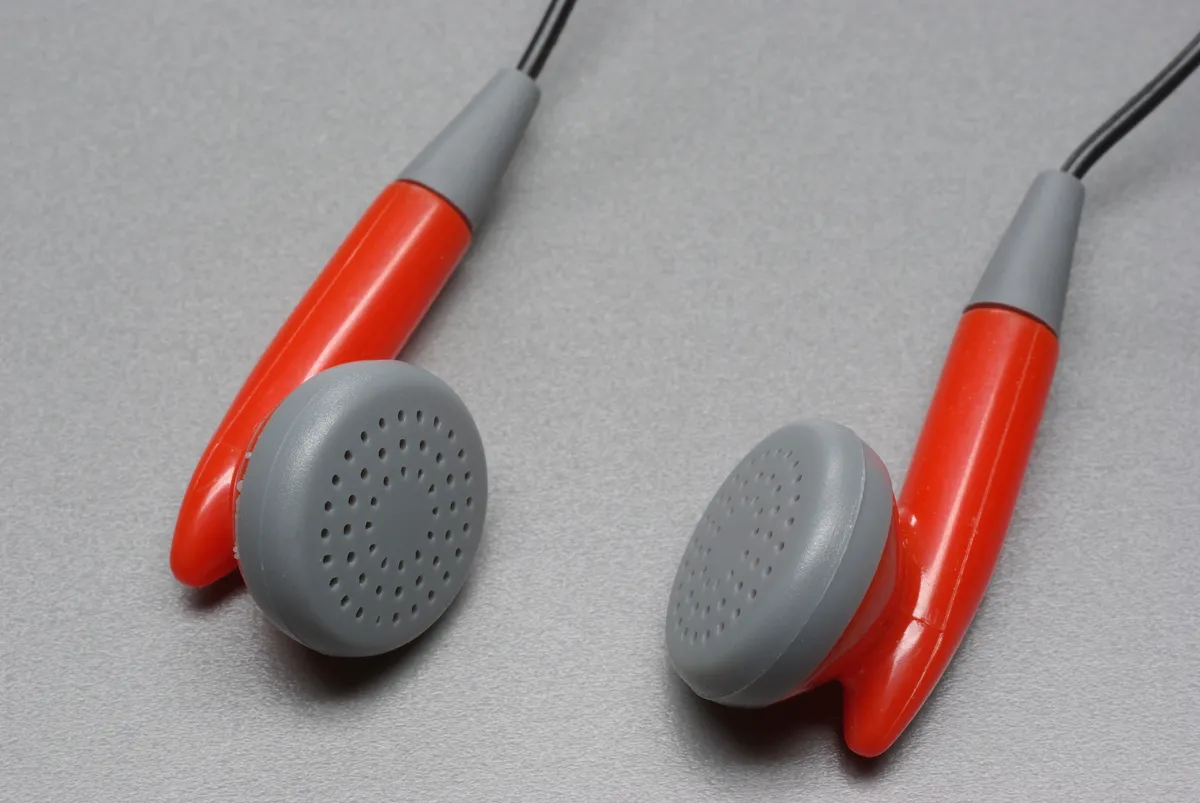
Wired earphones close-up — Wikimedia Commons
Fit, Comfort, and Build Quality
Blessing 2’s wide nozzle lip was a legitimate deal-breaker for many buyers — sore canals after an hour, tip compatibility issues, and frustration despite great sound. Moondrop clearly targeted that pain point on Blessing 3.
Independent measurements catalogued on nozzle databases put Blessing 3’s bore around 5.6 mm with a narrower lip near 5.75 mm, versus Blessing 2’s infamously wider ~6.5 mm lip class. In plain language: Blessing 3 is the safer ergonomic upgrade if Blessing 2 demos hurt your ears.
Caveats remain:
- The overall shell is still medium-to-large — semi-custom sculpted resin fills the concha and can feel bulky at the tragus/antitragus junction
- Very small ear canals may still struggle; universal IEMs are not custom molds
- Deep insertion improves bass seal; shallow fit can thin out low end and skew perceived tuning
Build quality reads premium at a glance: metal faceplates, tight seams, and fewer “cost-cut paint” complaints than some older Moondrop SKUs. The matte resin can scratch if you toss bare IEMs in a pocket — use the included pouch. The stock cable is a braided two-core silver-plated copper affair; it works fine but lacks the flex and refinement of aftermarket options in the $30–80 range.
Blessing 3 vs Blessing 2 vs Blessing 2 Dusk
Most shoppers reading a Moondrop Blessing 3 review are really choosing between Moondrop generations, not between Moondrop and random Amazon IEMs.
| Model | Driver layout | Tuning character | Comfort notes | Typical street |
|---|---|---|---|---|
| Blessing 2 | 1DD + 4BA | Neutral-bright classic | Wide nozzle — fit lottery | Discontinued / used market |
| Blessing 2 Dusk | 1DD + 4BA (Crinacle tune) | Darker, warmer, forgiving | Same shell family as B2 | ~$300 when in stock |
| Blessing 3 | 2DD + 4BA | Neutral-analytical, cleaner bass | Narrower nozzle, refined shell | ~$280–320 |
Choose Blessing 3 if you want the newest driver hardware, better bass dynamics on paper, improved comfort odds, and a brighter analytical signature.
Choose Blessing 2 Dusk if you prioritize a warmer, more “musical” midrange, slightly different imaging character, and do not mind hunting stock — some listeners still prefer Dusk for long-session enjoyment.
Skip both if you dislike Moondrop’s aesthetic or want a single-DD simplicity tune like the Kato at lower cost — different product tier, different priorities.
Competitors Worth Cross-Shopping in 2026
At ~$320, Blessing 3 sits in a crowded enthusiast bracket. Alternatives that often appear in the same shopping cart:
- Dita Project M (~$325) — different tuning philosophy; some reviewers prefer its female vocal presentation while noting Blessing 3 wins raw separation in places
- Moondrop Variations (on sale) — older Moondrop flagship flavor; can beat Blessing 3 on engagement for some genres when discounted
- Planar IEMs under $400 — potentially faster transients and different timbre; fit and source matching vary wildly by model
- Used flagship hybrids — riskier warranty path but sometimes more “fun” tuning
None of these invalidate Blessing 3; they clarify taste. Blessing 3’s moat is consistent neutral tuning + strong technicals + Moondrop service ecosystem, not maximum emotional punch.
Who Should Buy — and Who Should Skip
Buy the Moondrop Blessing 3 if…
- You want a daily driver wired IEM under $350 with detail-forward tuning
- You demoed or owned Blessing 2 and fit was the blocker — Blessing 3 is the ergonomic fix
- You already own a clean DAC/amp (or plan to add one) and listen to FLAC or high-bitrate streams
- Your library spans rock, jazz, classical, acoustic, and games where separation matters
- You value measurement-backed tuning over boutique mystery tuning
Skip (or demo first) if…
- You are basshead-first — look at tuned-dynamic or bass-emphasis IEMs instead
- You want maximum warmth for vocal ballads and lo-fi — Dusk or warmer competitors may satisfy more
- Your ears are very small — try before buying; shell bulk remains
- You only listen via Bluetooth — wired IEMs plus a good source are the point here
- You find bright treble fatiguing — Blessing 3 is not a dark IEM
Setup Tips That Improve the Experience
- Tip rolling matters. Start with included silicone, then try wide-bore or softer third-party tips if seal is inconsistent. A broken seal makes Blessing 3 sound thin.
- Burn-in is optional. Moondrop’s own guidance and most blind-listening evidence suggest minimal mechanical change; prioritize source quality instead.
- Cable upgrades are optional. Swap for ergonomics (memory wire, lighter braid) before expecting night-and-day sound changes — unless you move to a balanced termination into a better amp stage.
- EQ is fair game. If you love the transducers but want 2–3 dB sub-bass shelf, parametric EQ on desktop or player apps is legitimate — the drivers have headroom.
- Store safely. Resin + metal plates scratch; a hard case beats the soft pouch for travel.
Price and Value in September 2026
Moondrop lists Blessing 3 at $319.99 on its official English storefront. Regional retailers and sales events pull street pricing toward $280–300, with occasional dips near $266 that strongly favor buying over waiting for a mythical “Blessing 3 Dusk.”
Value math is straightforward:
- At $266–290, Blessing 3 is one of the stronger hybrid IEM deals under $350 — high technical performance, fixed comfort issues from Blessing 2, still-current model.
- At full $320 MSRP, competition from Blessing 2 Dusk (if available), sale flagships, and planar newcomers is real — you are paying for the newest Blessing hardware, not a generational leap in fun factor.
- Above $360, unless bundled with a premium cable or local warranty you trust, cross-shop actively.
Always verify you are buying from authorized Moondrop retailers or the official store — grey-market clones exist in the IEM world, and hybrid fakes are not worth the discount.
FAQ
Is the Moondrop Blessing 3 worth it in 2026?
Yes, if you want a neutral-analytical hybrid IEM under $350 and can live with its brightness and medium-large shell. At sale prices near $270–290, it is one of the better technical performers in the class. If you crave warmth or sub-bass theater, demo first or consider Blessing 2 Dusk instead.
How does the Moondrop Blessing 3 review consensus compare to Blessing 2 Dusk?
Blessing 3 wins on newer bass hardware, comfort for many users, and raw detail/separation. Dusk often wins on musical warmth, forgiveness, and emotional engagement for long sessions. Neither is strictly “better” — they target slightly different listeners.
Do I need an amp for the Blessing 3?
Not for volume — 120 dB/Vrms sensitivity gets loud easily. You want a clean source: a decent USB-C DAC dongle minimum, or a desktop combo like those in our amp reviews guide for lower noise and better dynamics.
Is the Blessing 3 good for gaming and movies?
Yes for positional clarity and detail in competitive games and dialogue-heavy films. Less ideal if you want rumbling cinematic LFE — the tuning stays controlled rather than explosive.
What cable does the Blessing 3 use?
0.78 mm 2-pin connectors per earpiece and a 3.5 mm TRS plug to source. Balanced aftermarket cables (2.5 mm or 4.4 mm) require compatible DAC/amps — the IEM side stays 2-pin.
Is the Blessing 3 comfortable for small ears?
Better than Blessing 2 for many people thanks to a narrower nozzle, but the shell is still large. If universal IEMs usually fall out or hurt, try a demo unit or consider smaller single-driver sets.
Does Moondrop ship a balanced cable with Blessing 3?
No — retail bundles include a single-ended 3.5 mm silver-plated copper cable. Balanced is an aftermarket upgrade path.
Will there be a Blessing 3 Dusk?
Moondrop has not announced a Crinacle-tuned Dusk variant for Blessing 3 as of September 2026. Waiting indefinitely may cost you months of listening — Blessing 3 already stands on its own merits.
What genres suit the Blessing 3 best?
Rock, jazz, classical, acoustic, folk, and analytical pop shine. Bass-heavy EDM, hip-hop, and warm vocal ballads may feel lean unless you EQ or prefer a warmer competitor.
What warranty does Moondrop offer?
Official listings cite a one-year warranty — confirm terms on your retailer invoice and Moondrop’s regional support page before purchase.
Final Verdict
The Moondrop Blessing 3 is Moondrop doing what it does best: measurement-informed tuning, serious hybrid engineering, and a product that fixes the worst ergonomics complaints from Blessing 2 without abandoning the neutral DNA that made the line famous. It is not the most romantic IEM at $320, and it will not replace a great over-ear for couch immersion — but as a wired daily driver with flagship-approaching technicals, it earns a strong 8.6/10 in this Moondrop Blessing 3 review.
Buy at fair street pricing if you are upgrading from mid-tier Moondrop sets (Aria, Kato, Chu) or want a dependable analytical hybrid. Demo or skip if comfort is uncertain, if you are treble-sensitive, or if your heart is set on the warmer, more laid-back character of Blessing 2 Dusk — still a valid choice when available.
Pair it with a clean DAC/amp, invest ten minutes in tip fit, and Blessing 3 repays the effort with some of the clearest sub-$350 listening Moondrop has shipped to date.