Pros
- Fully discrete current-feedback amp — no off-the-shelf op-amp chips in the power stage
- 2.5W into 32Ω with three gain steps including −10dB for sensitive IEMs
- Modular Mesh DAC card turns it into a compact one-box desktop at $199 total
- 100% linear wall-wart supply, DC-coupled signal path, and headphone protection systems
- Made in USA with 3-year warranty at $119 — rare at this price
Cons
- No balanced headphone output — rivals like Topping DX1 II add 4.4mm at similar money
- DAC card is USB-only; no optical/coax for TV or disc transport without another box
- Still falls short on the hardest planars (HE6-class) despite strong wattage claims
- Preamp output is single-ended RCA only — no XLR for pro monitors
The Schiit Magni Unity is Schiit Audio’s fifth-generation Magni — a fully discrete headphone amplifier and variable preamp made in the USA, with an optional internal Mesh DAC card for a single-box desktop. This Schiit Magni Unity review (updated September 2026) walks through real specs from Schiit.com, explains who the amp-only and amp-plus-DAC versions serve, compares the Unity to stacks like Modi 5 + Magni and integrated rivals under $200, and gives a clear buy-or-skip call for wired headphone listeners.
If you searched schiit magni unity review because you saw the compact silver or black brick on a desk setup photo, you are looking at the correct product — Magni Unity from Schiit Audio in Corpus Christi, Texas, not a lookalike brand or an older Magni 3/3+ listing mislabeled on a marketplace. Schiit positions Unity as the one Magni line going forward: modular, linear-powered, and built around a new current-feedback discrete topology rather than the op-amp Magni Heretic path the company retired after blind listening tests favored Unity.
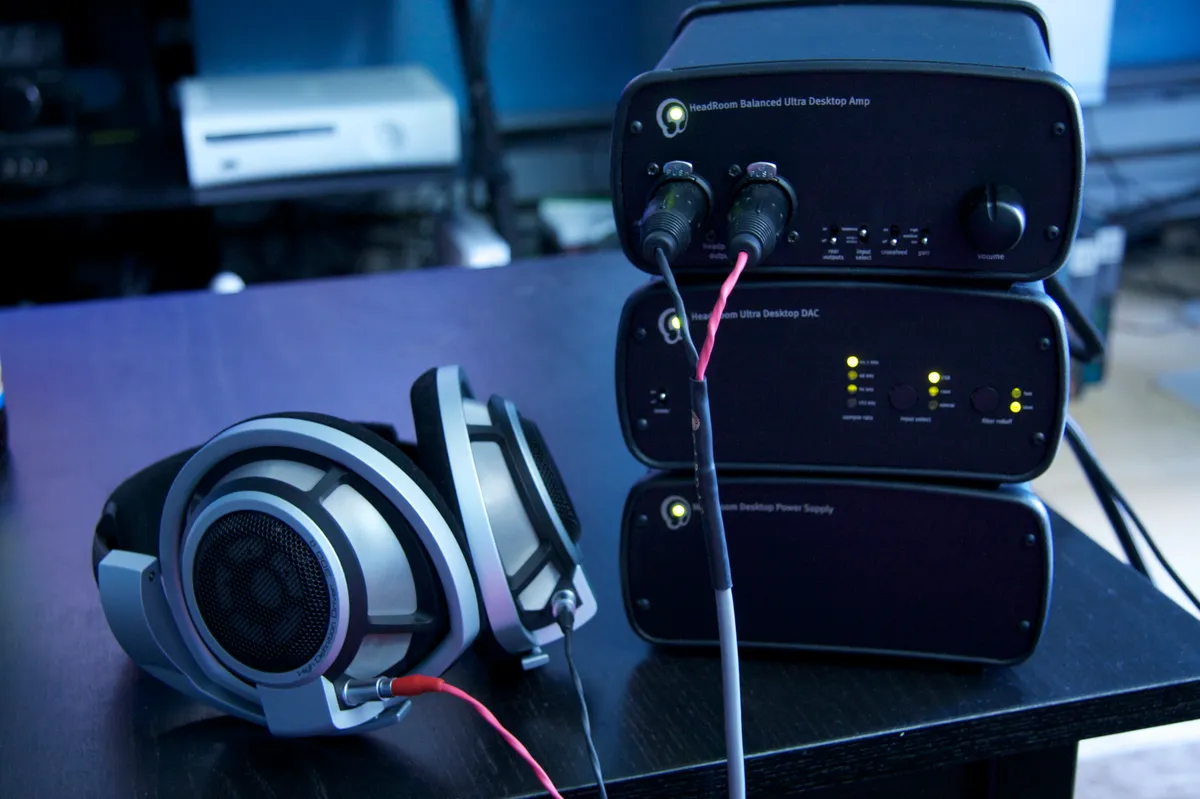
Headphone amplifier on a desktop listening setup — photo via Wikimedia Commons
Schiit Magni Unity Review Snapshot (2026)
| Field | Detail |
|---|---|
| Manufacturer | Schiit Audio (designed & assembled in USA) |
| Type | Headphone amp + variable RCA preamp; optional USB DAC module |
| Street price (USA) | $119 amp only (black); $129 silver; $199 with Mesh DAC card (+$10 silver) |
| Headphone out | Single-ended 6.35mm (¼") TRS, <0.1Ω output impedance |
| Inputs | RCA analog in; optional internal USB-C Mesh DAC |
| Preamp out | Variable RCA (75Ω), driven by front Alps potentiometer |
| Max power | 2.5W/ch @ 32Ω; 415mW @ 300Ω; 220mW @ 600Ω (RMS, both channels) |
| Gain steps | −10dB (0.3×), 0dB (1×), +15dB (5×) |
| Topology | Fully discrete, DC-coupled, current feedback, low loop feedback |
| Power supply | 100% linear regulated ±17V from 14–16VAC wall wart |
| Size / weight | 5 × 3.5 × 1.25 in; 2 lb |
| Warranty | 3 years limited; 15-day return (15% restocking fee) |
| NexReview score | 8.6/10 |
Buy it if you want a neutral, powerful discrete amp for IEMs through most planars, or a tidy one-box USB desktop when configured with the DAC card. Skip it if you need balanced drive, optical TV input, or guaranteed headroom for HE6-tier headphones without a separate beefier amp.
What Is the Schiit Magni Unity?
Magni Unity is Schiit’s answer to a question the headphone hobby keeps asking: why does every affordable amp use the same handful of integrated chips? Unity’s power stage is fully discrete — Schiit’s own current-feedback design with thin-film resistors, film capacitors, and a sorted Alps volume pot — rather than an off-the-shelf op-amp output chip dressed up in a fancy case.
Two configurations ship from Schiit.com:
- Magni Unity (amp only) — RCA analog input, headphone jack, variable RCA preamp outputs. You feed it from an existing DAC (Modi 5, an interface, a TV DAC, etc.).
- Magni Unity with Mesh DAC card — adds an internal USB-C digital input using Schiit’s Mesh filter plus an ESS delta-sigma modulator, OPA1656 output op-amps, and the same class of analog filtering Schiit puts in the standalone Modi 5 ($149). One box, one USB cable, headphones and powered speakers covered.
The name Unity reflects Schiit’s consolidation: after years of parallel Magni SKUs, this is the single Magni going forward — and, with the DAC card installed, a unified desktop rather than a mandatory Modi stack.
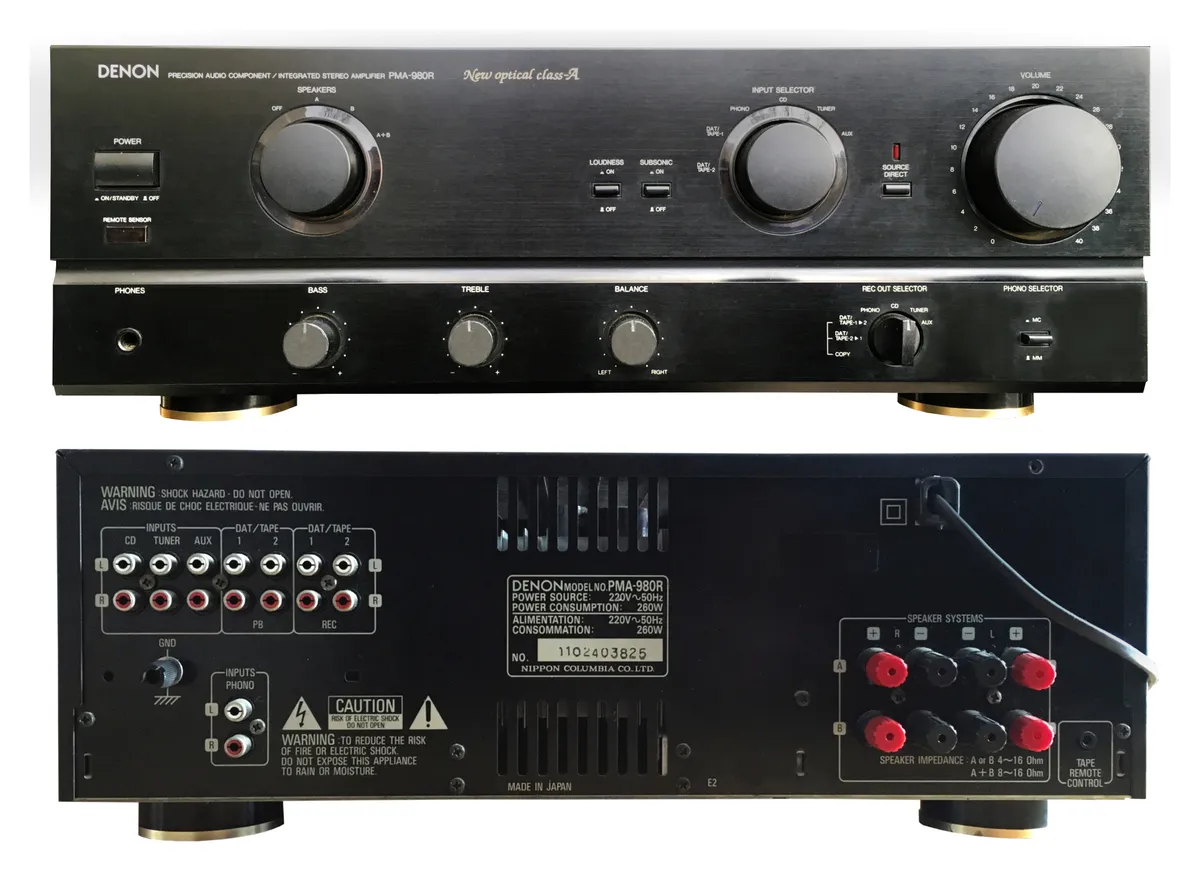
Desktop amp stack and headphones — Wikimedia Commons
Amplifier Design: Why Discrete Matters Here
Marketing slides love the word “discrete.” On Magni Unity it is structurally true: the amplification path is built from individual transistors in a current-feedback, low-loop-gain layout Schiit has refined for roughly half a decade. The company killed Magni Heretic, an op-amp design that measured within about 2dB but used far higher feedback, after blind listening panels consistently preferred Unity.
For listeners, the practical translation is less about audiophile religion and more about consistent neutrality:
- DC coupling — no series capacitors in the signal path; Schiit relies on DC servo and protection instead of blocking caps that can subtly shape low-frequency response.
- Linear power supply — a wall-wart AC transformer feeding regulated ±17V rails with over 8,000µF of filter capacitance. No switching supply hash on the desk.
- Transparent protection — overcurrent sensing for weird TRRS adapters, a muting relay on power events, and DC correction that lifts outputs if something fails catastrophically. Schiit claims these circuits stay out of the normal signal path.
Measured on an APx555 (published on Schiit’s product page), Unity posts THD+N below 0.0001% at 2V RMS into 300Ω on low gain and SNR above 122dB referenced to 2V. Those numbers exceed what typical headphones resolve; the meaningful claim is inaudible noise on sensitive IEMs combined with real wattage into 32Ω loads.
Power: Who Gets Enough Headroom?
Schiit rates Magni Unity at 2.5W RMS per channel into 32Ω (both channels driven, under 1% THD). That is not marketing peak power — it is the kind of figure that matters when you run planar magnetic headphones that dip low in impedance.
| Load | Rated max power (RMS/ch) | Typical headphones |
|---|---|---|
| 16Ω | 3.0W | Some IEMs / rare low-impedance loads — use low gain |
| 32Ω | 2.5W | Many planars, Grado, efficient dynamics |
| 50Ω | 1.5W | HD 6xx series territory |
| 300Ω | 415mW | HD 600/650/660S class |
| 600Ω | 220mW | High-impedance classics |
Schiit is honest about limits: HE6, Tungsten, and a handful of ultra-hungry planars can still want more than Unity comfortably delivers. For the vast middle — HD 560S, DT 1990, Audeze LCD-2 classics, most sub-$500 planars — Unity has headroom to spare without pinning the volume pot.
If your cans are in that extreme tier, start with our best DAC amp under 200 guide for higher-power integrated options like the FiiO K7, or plan a dedicated amp stack above this price class entirely.
Gain Switching: The Hidden IEM Feature
Older budget amps often treated IEMs as an afterthought — too much gain, hiss audible on sensitive multi-driver sets, volume pot usable only in the bottom 5% of travel. Magni Unity adds a −10dB gain position alongside 0dB and +15dB.
| Gain setting | Multiplier | Best for |
|---|---|---|
| Low (−10dB) | 0.3× | Sensitive IEMs, low-output DACs, late-night listening |
| Medium (0dB) | 1× | Most over-ear dynamics, moderate planars |
| High (+15dB) | 5× | Quiet recordings, high-impedance headphones needing extra swing |
On low gain with Schiit’s noise measurements, Unity behaves like a serious IEM amp — something that was not always true in the early Magni generations. If you rotate between Campfire / Moondrop IEMs and Sennheiser / Hifiman over-ears, the front-panel gain switch saves you from rewiring the desk every session.
Optional Mesh DAC Card: One Box vs Stack
The amp-only Unity at $119 is the value headline. The $199 Mesh DAC configuration is the convenience headline — and the number most schiit magni unity review searches implicitly ask about.
The internal card is not a generic USB dongle soldered inside. Schiit’s Mesh conversion combines a custom time- and frequency-domain optimized digital filter with an ESS modulator, then feeds the same discrete amp stage. Schiit states it performs in the same class as the standalone Modi 5, minus the extra digital inputs Modi 5 carries (TOSLINK, coax, Linear Override power tricks).
What you gain with the DAC card:
- USB-C from laptop or desktop — up to 32-bit / 384kHz PCM on the Mesh path
- Single-cable desk with volume on the front pot
- Preamp RCA outs for powered monitors alongside headphones
What you still do not get:
- Optical or coax for TV / game console without an external converter
- Balanced TRS or 4.4mm outputs
- Forkbeard DSP / PEQ (reserved for higher Schiit tiers like Mimir)
Unity DAC vs Modi 5 + Magni Unity Stack
Purists who already own digital sources might pair Modi 5 ($149) + Magni Unity ($119) for $268 and gain optical/coax plus Linear Override flexibility Modi offers. The all-in-one $199 Unity-with-DAC saves roughly $70 and one box worth of stack space at the cost of input versatility.
Choose the stack if your desk routes TV optical or you want Modi’s standalone resale value as a separate piece. Choose the internal card if your world is one PC or Mac and powered nearfields — the scenario Schiit clearly optimized for when they named the product Unity.
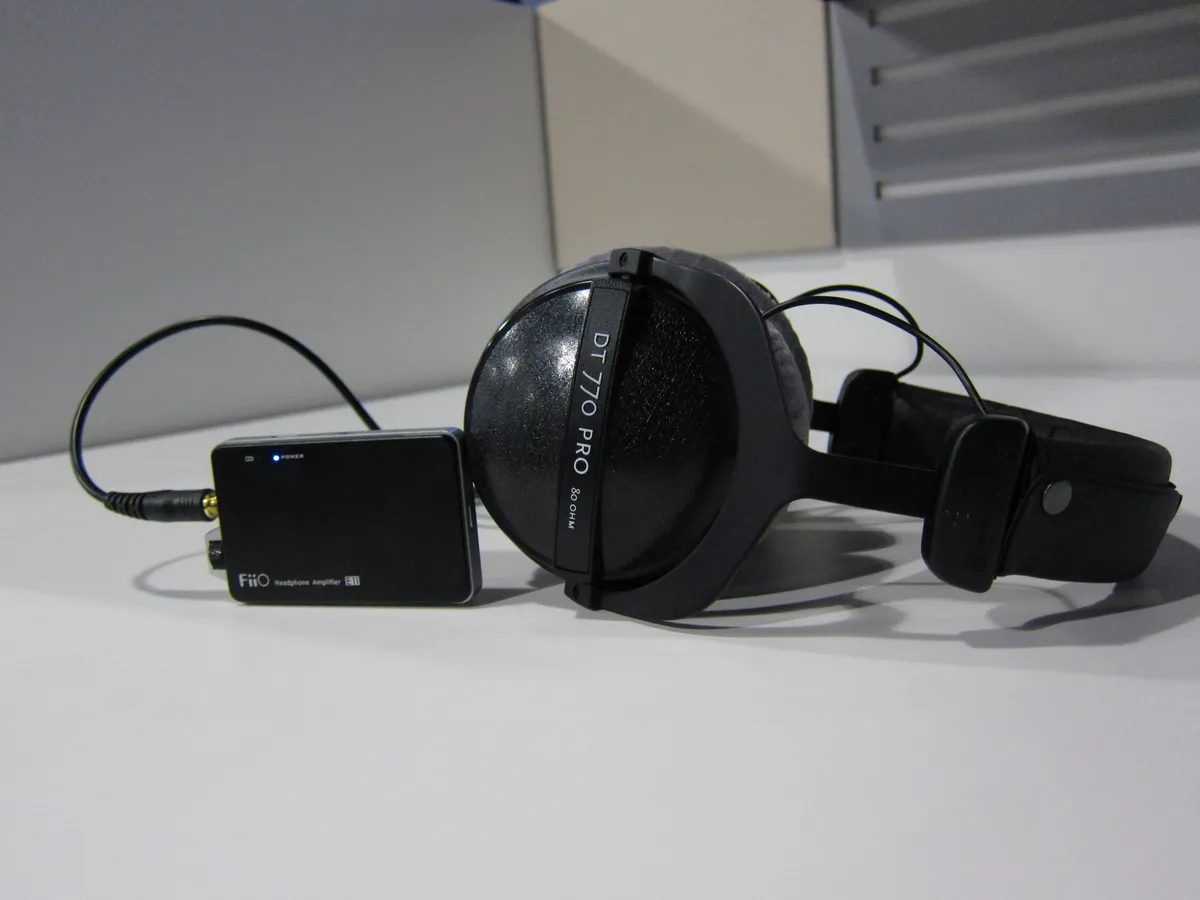
Audiophile desk headphones session — Wikimedia Commons
Listening Character & Pairing Notes
Schiit’s house sound on Unity is straightforwardly neutral — not the warm Burr-Brown tilt of the iFi ZEN DAC 3, not the slightly bright analytical edge some ESS-forward Topping units show on cheap recordings. Unity lets headphone tuning dominate. That makes it a strong match for:
- Neutral dynamics — HD 600/660S, DT 770/880, Sony MDR-7506
- Mid-efficiency planars — many Hifiman Sundara-era models, Philips Fidelio X2HR class
- IEMs on low gain — provided your source is not noise-shaped by a dirty USB port (rare on modern PCs)
Unity is less ideal as a “flavor box” if you want tubes or conspicuous analog coloration. Schiit sells tube and Class A Continuity amps upstream for that taste. Unity is the no-excuses solid-state baseline.
For gaming voice chat, note Unity has no microphone input. Streamers who need a mic loop should look at Schiit Hel 2E in our Amp Reviews cluster or the feature-rich Topping DX1 II — both integrate mic paths Unity deliberately omits to keep the signal path simple.
Build, Ergonomics, and Heat
The Unity chassis is a USA-stamped aluminum shell (California metalwork, Texas assembly and QC). It is smaller than a paperback — 5 inches wide — and sits stable under stiff headphone cables. The front pot is a custom-sorted Alps part; the gain switch is mechanical and positive.
Heat is worth mentioning because forum posts always ask: Unity runs slightly warm amp-only, moderately warm with the DAC card installed. Schiit’s guidance is blunt — they have shipped hotter-running amps for years without epidemic failure. Still, give it airflow if you stack it under a monitor stand with zero clearance.
Connectivity on the rear is minimal:
- RCA input (50kΩ input impedance)
- RCA variable preamp output (75Ω)
- AC jack for included linear supply
- USB-C (only when DAC card is fitted)
There is no balanced I/O. At $119–$199 that is the main spec trade versus Chinese integrated rivals, many of which now ship 4.4mm balanced headphone outputs and PEQ at similar prices.
Schiit Magni Unity vs Key Alternatives (2026)
| Model | Typical price | Why pick it over Unity | Why pick Unity instead |
|---|---|---|---|
| Magni Unity (amp) | $119 | — | Discrete USA amp, linear supply, IEM gain |
| Magni Unity + Mesh DAC | $199 | One-box Schiit desktop | Same |
| Modi 5 + Magni Unity | ~$268 | Optical/coax, separate upgrade path | Cheaper one-box USB if inputs enough |
| Topping DX1 II | ~$119 | Balanced out, PEQ, mic, more I/O | Discrete amp topology, USA warranty/support |
| FiiO K11 | ~$143–180 | Display, CS43198, balanced power | Prefer Schiit analog tuning & modularity |
| Schiit Hel 2E | ~$189 | Mic input, gaming-centric I/O | Cleaner purist amp path, lower amp-only price |
| iFi ZEN DAC 3 | ~$229 | 4.4mm balanced, XBass+, Burr-Brown flavor | More amp power into 32Ω, lower entry price amp-only |
None of these rows declare a universal winner — they map priorities. Unity wins when you value discrete amplification engineering and a linear supply at a sub-$120 amp price, or a credible Schiit one-box under $200. Rivals win when you need balanced drive, DSP, or digital input variety without stacking boxes.
Who Should Buy the Schiit Magni Unity?
Buy amp-only ($119) if…
- You already own a DAC you trust (Modi 5, interface, streamer with RCA out)
- You want a USA-made discrete amp with preamp outs for active speakers
- Your headphones sit in the IEM-to-moderate-planar band Unity covers
- You prefer upgrading DAC and amp separately over time
Buy with Mesh DAC card ($199) if…
- Your source is primarily USB from a computer
- You want one volume knob for headphones and powered monitors
- A Modi 5 + Magni stack’s extra inputs are not worth $70 and desk space
- You are stepping up from a dongle or motherboard jack and want Schiit’s neutral baseline
Skip or look elsewhere if…
- You require 4.4mm balanced for your existing cable ecosystem
- You need optical from a TV without buying another DAC
- You run HE6-class planars as daily drivers
- You want integrated mic processing for streaming — Hel 2E or DX1 II fit better
Setup Tips That Actually Help
- Match gain before chasing “better DACs.” Start on 0dB for most over-ears; drop to −10dB for IEMs before assuming you need a new source.
- Use the preamp outs intentionally. Unity’s RCA outputs are variable, tied to the front pot — ideal for powered desktop speakers, not for looping into another preamp expecting a fixed line level unless you discipline your volume setting.
- Cable quality sanity. Unity’s low output impedance (<0.1Ω) means thick, well-terminated ¼" cables matter more than exotic silver — avoid adapters that combine TRRS mic paths into pure headphone TRS in weird ways; Unity’s overcurrent protection helps, but clean mechanical connections still win.
- Stack placement. Keep the linear wall wart on the floor or a power strip; the transformer is part of the noise story Schiit sells — swapping in a random switching adapter is not supported and defeats the design.
- Confirm USB drivers. The Mesh DAC path is class-compliant on modern macOS, Windows, and Linux; if you run exotic pro audio ASIO setups, test latency in your DAW before committing.
Warranty, Support, and Buying Real Schiit
Schiit sells direct-first from Schiit.com with 3-year warranty coverage and 15-day returns (minus 15% restocking). Counterfeit and mislabeled listings appear on marketplaces — verify you are buying Magni Unity, not legacy Magni 3+ or unrelated “Magni” accessories.
International buyers may use Schiit’s regional partners (for example Schiit UK pricing runs higher once VAT is included — roughly £145 amp-only at authorized dealers). Always compare landed cost versus USA direct plus shipping.
Schiit’s long-running Head-Fi “Schiit Happened” thread remains the unofficial changelog for firmware-less analog gear — useful for confirming production revisions, though Unity is relatively new as of late 2025 / 2026 rollout waves.
FAQ
What is the Schiit Magni Unity?
Magni Unity is Schiit Audio’s fifth-generation Magni — a fully discrete headphone amplifier and RCA preamp made in the USA, with an optional internal Mesh USB DAC module for single-box desktop use.
How much does the Schiit Magni Unity cost in 2026?
USA direct pricing is $119 for the amp only (black), $129 for silver, and $199 with the Mesh DAC card installed (+$10 for silver with DAC). Street prices abroad vary with VAT and import fees.
Is the Schiit Magni Unity enough for planar magnetic headphones?
For most planars under roughly $500 — Sundara-class, LCD-2 heritage models, and similar — yes. Schiit explicitly excludes a handful of extreme loads like HiFiMAN HE6 and Tungsten from “all headphones” claims.
Does Magni Unity have balanced output?
No. Headphone and preamp outputs are single-ended (6.35mm and RCA). Balanced-focused shoppers should compare Topping DX1 II or FiiO K11 in our best DAC amp under 200 roundup.
What gain settings does Unity offer?
Three positions: −10dB, 0dB, and +15dB. The negative gain step makes sensitive IEMs usable without channel imbalance at the bottom of the volume knob.
Is the internal DAC the same as Modi 5?
Schiit states the Mesh DAC card is in the same class as Modi 5 — Mesh filter, ESS modulator, OPA1656 outputs — but with USB-only digital input instead of Modi 5’s wider port selection.
Can I add the DAC card later?
Schiit designed Unity as modular; check current Schiit.com listings for DAC card availability as an upgrade part if you buy amp-only first. Module availability can change with production runs.
Does Magni Unity work for gaming microphones?
No dedicated mic input. Gamers who need mic monitoring should consider Schiit Hel 2E or a separate interface — see our Amp Reviews hub for routing advice.
Where is Magni Unity made?
PCBs are assembled and tested in Corpus Christi, Texas; chassis metalwork is USA-stamped in California. Schiit emphasizes in-house QC rather than badge-engineered overseas amps.
Magni Unity vs Magni 3+ — should I upgrade?
If your Magni 3+ still meets your power needs, upgrade urgency is taste-dependent. Unity brings new discrete topology, modular DAC, three gain steps, preamp outs, and longer warranty — meaningful if you want IEM-friendly gain or a one-box USB desk.
Final Verdict
The Schiit Magni Unity earns its place as the sub-$120 amp reference for wired desktop listening in 2026 — not because it wins every spec sheet battle against feature-dense Chinese integrators, but because it delivers fully discrete amplification, a linear supply, sensible gain switching, and credible USA support at a price that still undercuts inflation-adjusted Magni stacks from a decade ago.
Buy the amp alone if you already solved digital inputs elsewhere. Pay $199 for the Mesh DAC card if you want Schiit’s neutral one-box without stacking Modi 5. Skip Unity if balanced outputs, TV optical, or HE6-grade planars define your daily use case — those requirements push you toward different entries in our best DAC amp under 200 guide or a higher-power stack entirely.
For most headphone owners upgrading from a laptop jack or cheap dongle, Unity is the rare product that feels underpriced for the amp stage while staying honest about what the DAC module does and does not replace.
Score: 8.6/10 — Best Discrete Amp Under $120 — Add DAC If You Need USB
Related on NexReview
Building a wider desktop chain? Compare integrated rivals in best DAC amp under 200, read our iFi ZEN DAC 3 review for warm balanced flavor, and browse the full Amp Reviews hub for pairing and power calculators.