Pros
- 1400 mW balanced into 32 Ω — real headroom for planars and dynamics at entry pricing
- USB-C, optical, and coax inputs plus RCA line-out in a slim 147 mm footprint
- Three gain levels with independent volume curves — better IEM-to-over-ear discipline than two-step rivals
- Custom LCD, RGB logo, and multi-function knob make daily desk use pleasant
- Driverless USB on Windows 10+ and console-friendly (PS5, Switch) without extra boxes
Cons
- Less power than FiiO K7 into 300 Ω — HD 600-class users should cross-shop carefully
- CS43198 tuning is clean and slightly clinical — warmth seekers may prefer K11 R2R
- Coaxial input and coaxial output share one physical jack — routing takes planning
- RGB logo and display read 'gadget' — minimalist desks may prefer understated Topping boxes
Searching for a FiiO K11 review usually means you want a compact desktop DAC/amp with balanced output, enough watts to drive real headphones, and a price that does not jump straight to the ~$200 FiiO K7 tier. This NexReview guide confirms the real product — FiiO’s CS43198-based K11 desktop DAC/headphone amplifier, not a lookalike brand or the separate K11 R2R resistor-ladder variant — walks through specs that matter for pairing, compares the K11 to the K7 and Topping DX1 II class, and gives a clear buy/skip call for 2026.
The short version: the FiiO K11 is an entry-level integrated DAC and headphone amplifier built around a Cirrus Logic CS43198 chip, with 1400 mW balanced / 520 mW single-ended into 32 Ω, USB-C plus optical and coaxial inputs, 4.4 mm and 6.35 mm headphone jacks, and a custom LCD with RGB logo lighting. It launched in late 2023 at $129.99 MSRP and remains one of the most complete sub-$150 desktop boxes for wired listeners who can use balanced cables. If you need maximum power into 300 Ω dynamics or want THX amplification, step up to the K7 — details below.
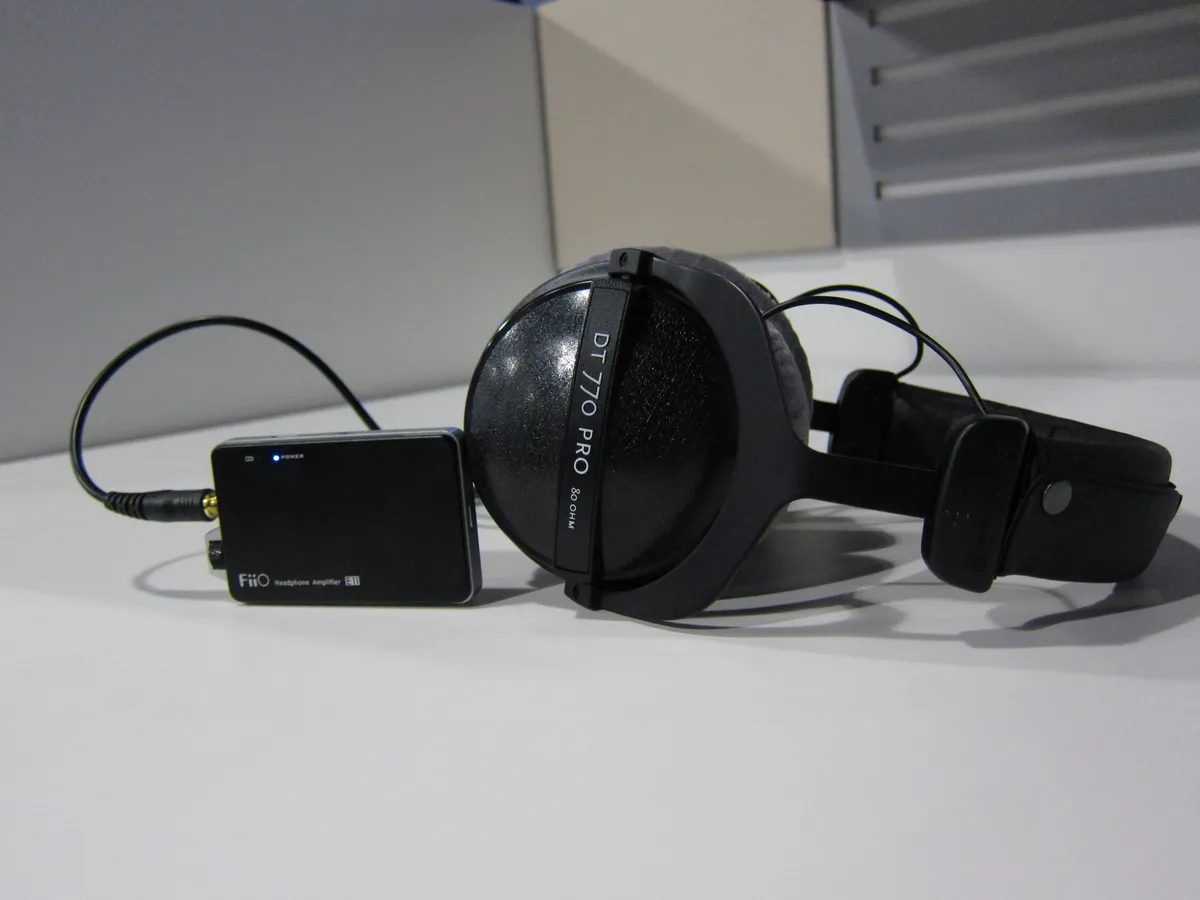
Desktop DAC/amp listening context — Wikimedia Commons
FiiO K11 Review Snapshot (2026)
| Field | Detail |
|---|---|
| Manufacturer | FiiO (Guangzhou, China — portable and desktop audio brand since 2007) |
| Product type | Desktop integrated DAC + headphone amplifier |
| Launch | October 2023 (international); still current in 2026 |
| MSRP | ~$129.99 USD on FiiO’s store (street often $130–$160 depending on color and retailer) |
| DAC | Cirrus Logic CS43198 (single-chip delta-sigma; Master HiFi tier in Cirrus marketing) |
| USB | Type-C — PCM up to 384 kHz / 32-bit, DSD256; driverless on Windows 10+ |
| Amplifier | Fully balanced headphone stage (not THX AAA — that is K7 territory) |
| Headphone outputs | 6.35 mm single-ended + 4.4 mm balanced (Pentaconn) |
| Line I/O | RCA line-out; coaxial digital out (USB mode only, shared jack with coax in) |
| Digital inputs | USB-C, optical TOSLINK, coaxial RCA |
| Power | External 12 V / 2 A adapter |
| Gain | Three hardware levels, each with its own volume curve |
| Output modes | PO (power/headphones) and LO (line-out) — independent remembered volumes |
| Dimensions | 147 × 133 × 32.3 mm; ~407 g |
| Colors | Obsidian black, Midnight silver, Titanium |
| NexReview score | 8.5/10 — excellent entry balanced value; not the wattage king |
Buy if you want balanced desktop power under $150, run multiple digital sources (PC, TV optical, coax transport), and prefer FiiO’s display-forward ergonomics over bare-metal minimalism. Skip if you only use single-ended 6.35 mm forever, need 600 Ω voltage headroom, or want Bluetooth at this price — see our broader amp reviews guide and best DAC amp under 200 comparisons.
What Is the FiiO K11? (Real Product Check)
FiiO is a long-running Chinese audio company known for portable DACs, digital audio players, IEMs, and the K desktop line (K5 Pro ESS, K7, K9 Pro). The K11 is not a guitar amp, car amplifier, or unrelated “K11” SKU from another industry. It is FiiO’s entry balanced desktop combo — positioned below the FiiO K7 in price and power, but above dongle-class USB sticks in connectivity and amplifier headroom.
FiiO released the K11 in September–October 2023 as a slim, feature-rich answer to “I outgrew my laptop jack but I am not ready for a $200 stack.” Official materials emphasize more than 16 low-noise LDO regulators, an external 12 V switching supply, and a fully balanced amplifier path capable of 1.4 W per channel into 32 Ω on the 4.4 mm port — numbers that were flagship-adjacent a decade ago and now sit at ~$130.
Do not confuse K11 with K11 R2R
Retailers and forums sometimes blur two distinct SKUs:
| FiiO K11 (this review) | FiiO K11 R2R | |
|---|---|---|
| DAC architecture | CS43198 delta-sigma | 24-bit R2R resistor ladder |
| Typical street price | ~$130–$160 | ~$170–$190 |
| Sound tilt | Clean, precise, detail-forward | Warmer, more textured, “analog” presentation |
| Extra modes | Standard PCM/DSD playback | NOS/OS switching on R2R path |
| Chassis / amp | Shared family look; similar I/O | Same footprint; verify the box label |
Both share the slim chassis and strong balanced output class, but they are different DAC implementations with different tuning goals. If you search FiiO K11 review and see comments about “R2R warmth,” that is the R2R variant — not the original CS43198 unit reviewed here. When buying, confirm CS43198 on the spec sheet or product page.
Compact headphone amplifier on desk — Wikimedia Commons
Key Specs That Actually Affect Pairing
Chip names sell brochures; power, noise, and impedance behavior sell headphones. FiiO’s published figures (verify on FiiO’s K11 product page before purchase):
| Spec | 6.35 mm single-ended | 4.4 mm balanced |
|---|---|---|
| Output power (THD+N < 1%, high gain) | ≥520 mW per channel @ 32 Ω | ≥1400 mW per channel @ 32 Ω |
| Output power @ 300 Ω | ≥60 mW per channel | ≥250 mW per channel |
| THD+N (lab condition) | < 0.00035% @ 1 kHz, 10 kΩ load | Same ultra-low class on line path |
| Output impedance | < 1.2 Ω @ 32 Ω load | < 2.4 Ω @ 32 Ω load |
| Noise floor (A-weighted) | < 2.8 µV (PO) | < 4.9 µV (BAL) |
| SNR | ≥123 dB (A-weighted) | Same |
How to read this table:
- 32 Ω power matters for planars, HD 58X-class dynamics, and many modern over-ears. 1400 mW balanced is genuinely strong for an entry box — the reason the K11 appears in our best DAC amp under 200 honorable-mention row.
- 300 Ω power matters for Sennheiser HD 600/650/660S and similar voltage-hungry dynamics. 250 mW balanced @ 300 Ω is usable for comfortable listening, but it is not the same headroom class as the K7’s 560 mW @ 300 Ω balanced. HD 600 owners who live at high listening levels should audition or cross-shop the K7.
- Three gain steps with separate volume curves help sensitive IEMs on low gain without starving hard-to-drive cans on high gain — a practical edge over two-step rivals like the base K7.
USB playback supports PCM 384 kHz / 32-bit and DSD256. Optical input typically caps at 96 kHz / 24-bit; coaxial input at 192 kHz / 24-bit per FiiO documentation — fine for TVs, disc players, and older transports. Coaxial digital output works in USB DAC mode but shares the physical coax jack with coax input, so you cannot run coax in and coax out simultaneously without replugging.
Build, Design, and Desk Ergonomics
The K11 chassis is slim aluminum — 147 mm wide, 32.3 mm tall including feet, and ~407 g — noticeably lower profile than the taller K7. Silicone anti-slip feet keep it stable under a monitor stand or beside a keyboard. FiiO offers Obsidian black, Midnight silver, and Titanium finishes; all share the same electronics.
The front panel centers on a custom high-contrast LCD showing sample rate, volume, gain, and output mode, plus a multi-function rotary knob that handles power, volume, menu navigation, and input switching. Double-press the knob to toggle PO (headphone power) vs LO (line-out) modes; each mode remembers its last volume independently — a small quality-of-life win when switching between headphones and powered speakers.
The top FiiO logo glows RGB, with brightness, color, and pattern adjustable through the menu. FiiO also uses the lighting as a sample-rate indicator (similar philosophy to the K7’s RGB ring). Minimalist desks may find it flashy; others appreciate glancing confirmation that a hi-res file is actually decoding.
Rear and side connectivity is generous for the price:
- USB-C for PC, Mac, and many Android phones (FiiO notes phone decoding without draining the phone battery on supported paths)
- Optical and coaxial for TVs, consoles, and transports
- RCA line-out for active speakers or a downstream amp
- 4.4 mm balanced and 6.35 mm single-ended headphone jacks
Tradeoffs are honest: no Bluetooth, no remote, external power brick, and no balanced XLR line-out. If wireless desk streaming matters, look at FiiO K7 BT or Topping DX3 Pro+ class units in our amp reviews cluster. If your primary headphones are wireless ANC models like the Sony WH-1000XM5 or Bose QuietComfort Ultra, you do not need a desktop DAC/amp at all — those products include their own electronics.
Sound Character — What Changes vs Your Laptop Jack
The K11 is tuned around CS43198 — a chip Cirrus Logic positions in its Master HiFi tier. Community impressions across Head-Fi, Reddit r/HeadphoneAdvice, and measurement threads generally describe low noise, stable imaging, and a clean, slightly precise presentation rather than tubey warmth. It is closer to “transparent desktop source” than “color box.”
What you should expect when upgrading from a phone, laptop, or cheap dongle:
Noise floor and IEM use
Published noise floors in the sub-3 µV single-ended / sub-5 µV balanced range translate to quiet backgrounds with sensitive IEMs on low gain — a real upgrade over noisy motherboard 3.5 mm jacks. If you hear hiss, check gain step, source volume, and cable quality before blaming the DAC.
Dynamics on mid-efficiency headphones
On HD 58X, DT 770/880 (appropriate impedance), HiFiMAN Edition XS, and many 32 Ω planars, the balanced 4.4 mm port delivers tighter bass control and more headroom than single-ended — not because balanced is magic, but because that is where FiiO routes the higher-power differential stage. Running the same headphones single-ended still works; you leave watts on the table.
Where the K11 stops being “enough”
Exotic low-sensitivity planars, 600 Ω vintage dynamics, or listeners who crank HD 600-class cans to concert levels may hear softer macro-dynamics versus the FiiO K7 or a dedicated stack. The K11 removes noise and moderate power bottlenecks; it does not rewrite headphone physics.
DAC coloration vs bottleneck removal
The K11 will not fix a bad recording or make budget headphones sound like electrostatics. If your problem is tonality (too dull, too sharp), try EQ in your player, different pads, or the K11 R2R variant before chasing another delta-sigma box. If your problem is volume, hiss, or thin bass from underpowering, the K11 is a rational fix.
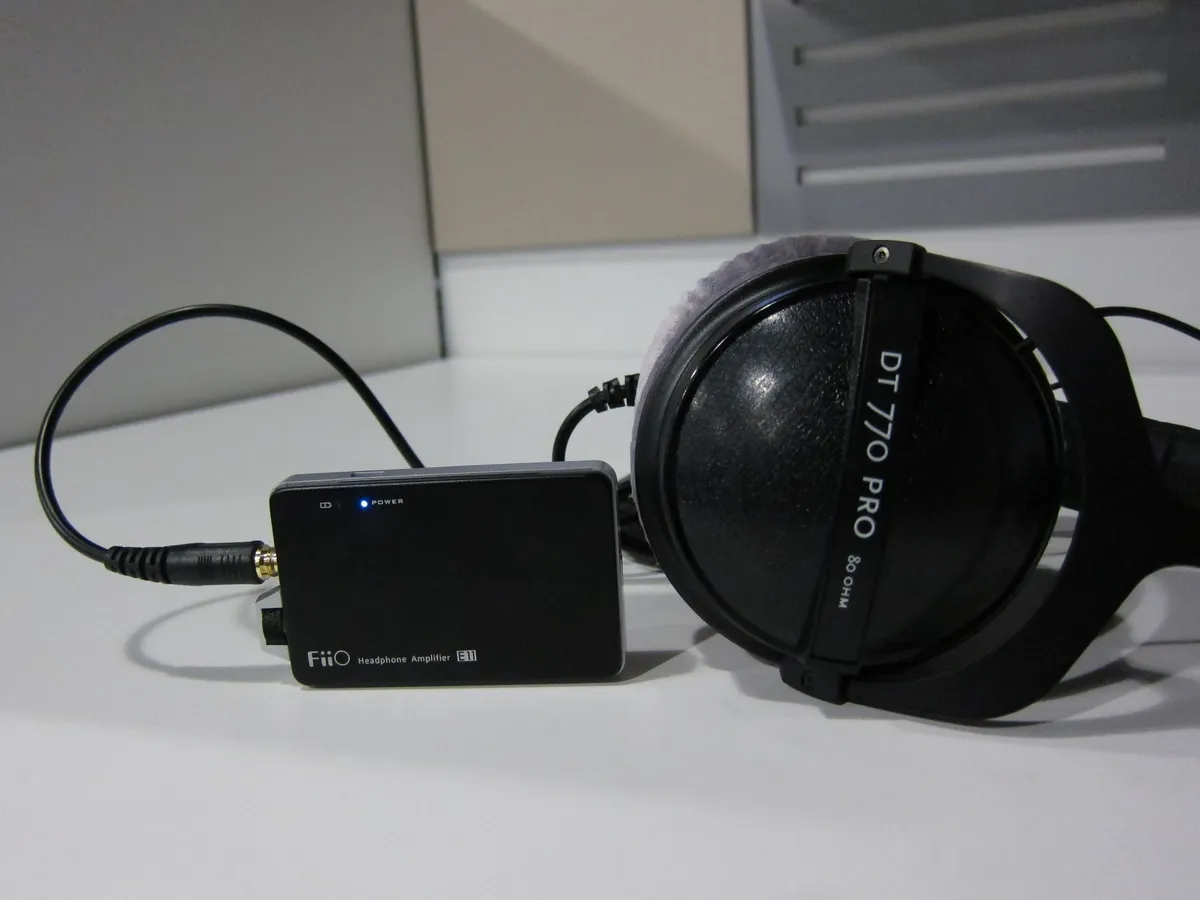
Wired headphones on desk — Wikimedia Commons
Who Should Buy the FiiO K11?
Strong fits
- First balanced desktop upgrade — You own or plan 4.4 mm cables and want one box under $150 with real watts.
- Multi-source desks — USB for a PC or MacBook Air M4, optical from a TV, coax from a transport — all into one knob.
- Gain-step discipline — You switch between sensitive IEMs and over-ears and want three curves instead of a binary low/high lottery.
- Console-adjacent gaming — FiiO documents PS5 and Nintendo Switch compatibility in USB DAC mode without drivers on modern Windows — handy for wired gaming headphones at a desk.
- Display-minded users — You like confirming sample rate on hardware, not digging through OS menus.
Who should skip (or buy something else)
| Profile | Better direction |
|---|---|
| Single-ended only, forever | Topping DX1 II or FiiO K5 Pro ESS if still stocked — save money without unused 4.4 mm |
| Maximum 300 Ω / planar headroom | FiiO K7 — materially higher balanced power @ 300 Ω |
| Warm, textured tuning preference | FiiO K11 R2R — same chassis family, different DAC character |
| Bluetooth + remote on the desk | Topping DX3 Pro+ or FiiO K7 BT |
| Travel / phone-only listening | USB-C dongle — not a desktop brick |
| Wireless ANC as primary cans | Skip desktop amps — see wireless reviews linked above |
This FiiO K11 review is blunt on the last rows: desktop DAC/amps serve wired analog headphones. They do not upgrade Bluetooth headphones you never plug in.
FiiO K11 vs K7 — The Decision Most K-Series Shoppers Face
Both are FiiO desktop combos with balanced 4.4 mm output. The fork is price, power, and chip philosophy.
| FiiO K11 | FiiO K7 | |
|---|---|---|
| Typical street price | ~$130–$160 | ~$199–$230 |
| DAC | CS43198 (single chip) | Dual AK4493SEQ |
| Amplifier | FiiO balanced stage | Dual THX AAA 788+ |
| Balanced power @ 32 Ω | ≥1400 mW | ≥2000 mW |
| Balanced power @ 300 Ω | ≥250 mW | ≥560 mW |
| Gain steps | Three (independent curves) | Two (L/H) |
| Display | Custom LCD + RGB logo | RGB ring around knob |
| Output routing | PO / LO (headphones vs line) | HP / LO / PRE (adds volume-controlled pre) |
Rule: If $70 more buys you meaningfully more 300 Ω and planar headroom you will actually use, the K7 is the rational step-up — our FiiO K7 review covers that path in depth. If your headphones are efficient or mid-impedance, and you value inputs + display + three gain steps at entry pricing, the K11 is the smarter save.
FiiO K11 vs Topping DX1 II vs iFi ZEN DAC 3
K11 vs Topping DX1 II (~$119): Topping often wins measurement chatter and minimalist aesthetics at a slightly lower price. The K11 wins balanced power specs, optical/coax alongside USB-C, LCD feedback, and console-friendly positioning. Pairing depends on whether you need the extra inputs and display — not a universal “Topping always wins” story.
K11 vs iFi ZEN DAC 3 (~$229 MSRP, often discounted): iFi brings XBass+, PowerMatch, and Burr-Brown tuning with a strong 4.4 mm story but USB-only digital input. If your desk is TV-plus-PC, the K11’s SPDIF may matter more than iFi’s analog flavor — see our iFi ZEN DAC 3 review for the counter-case.
Setup Tips (Windows, macOS, Gain, and Routing)
- Start on the lowest gain with IEMs; climb gain steps only when the volume knob runs out of travel on hard-to-drive cans.
- macOS — USB audio is typically plug-and-play; use Audio MIDI Setup if you chase specific sample rates.
- Windows 10/11 — Often driverless for standard playback; install FiiO’s USB driver if you need higher-rate or ASIO-specific behavior per FiiO’s download page.
- PO vs LO — Use PO for headphones; LO for a fixed-level line to an amp or active speakers with their own volume control.
- Coax jack planning — Remember coax in and coax out share one connector; label your cables if you swap TV vs digital-out duties.
- Balanced cables — Buy from reputable brands with correct pinout for your headphone model; a bad cable causes silence or channel imbalance, not “DAC failure.”
- PS5 / Switch — Treat as USB DAC sources; optical from a TV remains the cleaner path for some console setups where USB audio is restricted.
Pros and Cons (Owner-Realistic)
| Pros | Cons |
|---|---|
| 1.4 W-class balanced headroom @ 32 Ω under ~$150 | Less 300 Ω voltage than K7 |
| USB-C + optical + coax + RCA line-out | No Bluetooth or remote |
| Three gain steps with dedicated volume curves | CS43198 can feel clinical vs R2R sibling |
| LCD + RGB logo aid daily sanity checks | Shared coax jack limits simultaneous in/out |
| Driverless USB on modern Windows; console-friendly docs | External PSU and “gadget” aesthetics |
FAQ
Is the FiiO K11 the same as the FiiO K11 R2R?
No. The K11 R2R uses a resistor-ladder DAC with different tuning and a higher price. This FiiO K11 review covers the original CS43198 model.
What is the FiiO K11 street price in 2026?
MSRP remains ~$129.99 on FiiO’s site; real-world listings often land $130–$160 depending on color, region, and sales. Verify before checkout — prices shift.
Does the FiiO K11 need drivers on Windows?
Windows 10 and above typically work driverless in USB DAC mode. FiiO provides optional drivers if you need specific high-rate or ASIO behavior.
Is the FiiO K11 worth it for HD 600 / HD 650?
Yes on 4.4 mm balanced with high gain for normal listening levels. For maximum headroom and dynamics at high volume, the FiiO K7 is the safer buy.
Can the FiiO K11 power planar magnetic headphones?
Generally yes for mid-tier 32 Ω planars (Sundara, Edition XS, many similar). Exotic low-sensitivity flagships may want more current — check sensitivity and impedance first.
FiiO K11 vs K7 — which should I buy?
K11 for budget balanced desktop with strong features under $150. K7 if 300 Ω dynamics, heavy planars, or THX headroom justify ~$70 more.
Does balanced always sound better on the K11?
Not automatically — but on this SKU, balanced is the high-power path you paid for. Single-ended is fine for easy cans; balanced is the proper way to use most of the wattage.
Can I use the K11 with powered speakers?
Yes via RCA line-out in LO mode. Use PO when driving headphones; switch modes with a double-press of the knob.
Will the K11 work with PS5 or Nintendo Switch?
FiiO documents USB DAC compatibility with PS5 and Switch in driverless mode. Console USB audio policies vary by game and firmware — optical from a TV is often the fallback.
Is this medical or financial advice?
No — this is audio gear guidance. Prices, firmware, and stock change; confirm on FiiO’s site and authorized retailers before buying.
Verdict
The FiiO K11 remains one of the most rational entry balanced desktop upgrades in 2026 for wired listeners who want real connectivity and strong 32 Ω headroom without K7 money. CS43198 decoding, 1400 mW balanced output, three gain curves, and USB-C plus optical/coax cover the use cases that make people search FiiO K11 review in the first place — noisy laptop jacks, TV optical feeds, and first 4.4 mm cable purchases.
It is not the universal desktop DAC/amp: 300 Ω purists and hard planar owners should cross-shop the FiiO K7, warm-tone seekers should audition the K11 R2R, and wireless-only headphone owners should ignore desktop boxes altogether. Within its lane — sub-$150 balanced desktop with display-forward ergonomics — the K11 earns a strong recommendation in our amp reviews and best DAC amp under 200 clusters.
Score: 8.5/10 — Best Entry Balanced Desktop DAC/Amp Under $150